Why Is Real-Time Data Becoming Essential for Crypto Trading?

Crypto markets can change in minutes.
A token can move sharply after a major transaction, a sudden liquidity shift, a whale movement, a new piece of news, or a change in market sentiment. By the time a trader notices what happened, the market may already have moved.
This is why real-time crypto market data is becoming increasingly important.
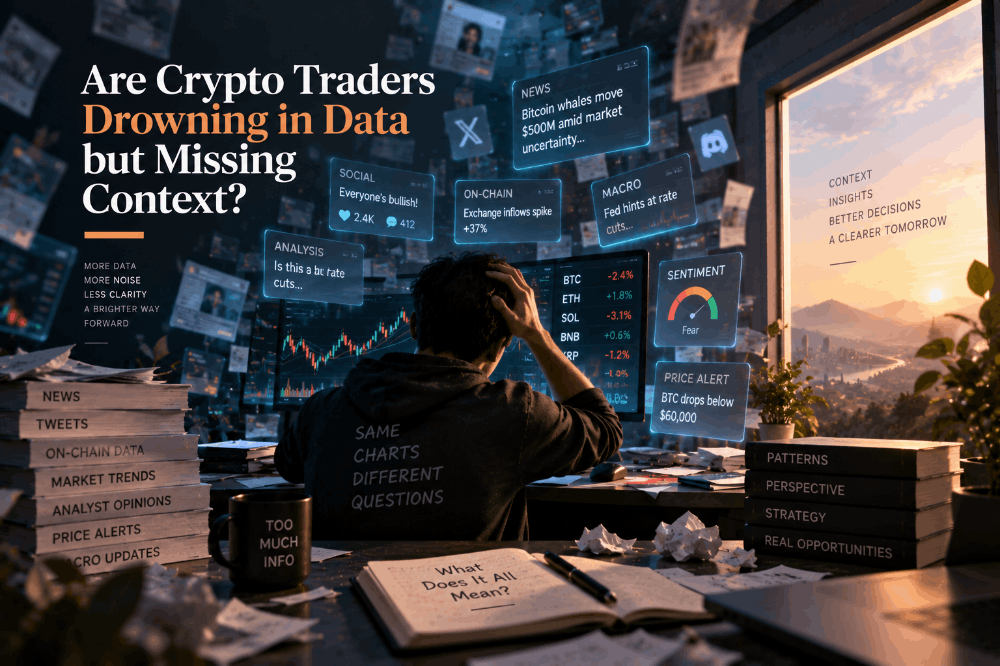
The challenge, however, is not simply getting information faster. Traders also need to understand what that information means and whether several market developments are connected.
Speed without context can still leave traders reacting too late.
Crypto Markets Move Faster Than Traditional Research Cycles
Crypto markets operate continuously, which creates a different information environment for traders.
There is no closing bell that pauses market activity overnight. Prices, liquidity, wallet activity, derivatives positioning, and sentiment can continue changing around the clock.
A trader researching the market using information from several hours ago may already be working with an outdated picture.
This makes live crypto data useful for monitoring what is happening as conditions change.
But real-time information creates another problem: there is simply more of it.
The goal is not to watch every market update. It is to identify which changes actually matter.
What Can Change in Real Time?
Real-time market information goes far beyond price.
Several parts of the crypto market can change at the same time:
- Trading volume can suddenly increase.
- Liquidity can move between exchanges or trading pairs.
- Large wallets can become active.
- Open interest can rise or fall.
- Funding rates can change.
- Stablecoin flows can shift.
- Market sentiment can change after breaking news.
- On-chain activity can accelerate.
- A particular sector or narrative can suddenly attract attention.
Individually, these events may not explain much.
Together, they can provide a clearer picture of what is happening in the market.
That is where real-time market analysis becomes more useful than simply watching a live price feed.
Faster Data Does Not Automatically Mean Better Decisions
There is an important distinction between speed and usefulness.
Imagine a trader receives dozens of alerts within an hour. Each alert arrives quickly, but the trader still has to determine:
What changed?
Why did it change?
Is it connected to another market development?
Does it matter beyond the next few minutes?
This is one reason why more information does not necessarily make market analysis easier.
A fast stream of disconnected updates can create the same problem as having outdated information: the trader still lacks context.
The value of real-time data comes from making changing information easier to interpret.
Market Activity Often Happens Before the Chart Tells the Full Story
Price charts are essential, but they primarily show the result of market activity.
Other data sources can provide additional clues about what is happening underneath that movement.
For example, a sharp price move might occur alongside increased trading volume and rising derivatives activity. Another move could happen while liquidity is becoming thinner and large wallets are transferring assets.
The price movement may look similar on a chart, but the surrounding market conditions can be very different.
This is why crypto market monitoring increasingly involves looking beyond price alone.
The objective is not to replace price data. It is to understand the environment surrounding it.
Real-Time Data Can Help Traders Follow Market Changes as They Develop
Another advantage of live information is that it allows traders to follow a developing situation instead of only analyzing it afterward.
Consider a sudden increase in activity around a particular asset.
A trader might first notice the price movement. Then volume begins increasing. Shortly afterward, derivatives activity changes and social sentiment starts shifting.
Looking at these developments separately can make them seem like unrelated events.
Viewed together, they may describe a broader change in market attention.
This kind of monitoring is particularly relevant in crypto because narratives can develop very quickly.
A sector that receives little attention in the morning can become one of the most discussed areas of the market later the same day.
Liquidity Makes Real-Time Information Even More Important
Liquidity is another reason timing matters.
Two assets can experience similar levels of buying or selling pressure but react differently depending on available liquidity.
When liquidity is thin, relatively smaller orders can sometimes have a larger effect on price.
Monitoring crypto market liquidity alongside price and volume can therefore provide additional context around market movements.
It can also help explain why a move appears unusually strong or why volatility increases suddenly.
Real-time liquidity information is not about predicting exactly what happens next. It is about understanding the conditions under which current market activity is taking place.
News Can Change the Market Before Traders Have Time to Process It
News is another major source of real-time market movement.
A regulatory announcement, partnership, product launch, security incident, exchange development, or macroeconomic event can quickly affect market expectations.
But the first headline is not always the complete story.
Traders may need to connect the news with:
- Current market positioning
- Trading volume
- Liquidity
- Sentiment
- On-chain activity
- Derivatives data
- Previous market reactions
This is where crypto market intelligence becomes different from simply receiving news alerts.
The important question is not only “What happened?”
It is also “What else is changing around it?”
AI Can Help Process Real-Time Market Information
The growing amount of market data has also created an opportunity for AI.
An AI-powered system can continuously monitor multiple information sources and help organize developments as they occur.
Instead of manually checking separate dashboards, news feeds, blockchain explorers, derivatives platforms, and social channels, traders can use AI to bring relevant information together.
This does not mean AI can eliminate uncertainty.
Markets remain unpredictable, and no system can guarantee the outcome of a trade.
The more practical role for AI is helping traders process large amounts of changing information and identify relationships that may otherwise take longer to notice.
That makes AI-powered market analysis an increasingly relevant part of modern crypto trading.
The Next Step Is Moving From Data to Context
Real-time data is valuable, but raw speed is only one part of the equation.
The bigger challenge is turning constantly changing information into something understandable.
A useful market intelligence system should help connect different developments rather than treating every event as an isolated alert.
For example:
A price movement becomes more meaningful when viewed alongside liquidity.
A whale transaction becomes more meaningful when considered alongside exchange flows.
A sudden change in sentiment becomes more meaningful when compared with price and derivatives activity.
This is the difference between receiving information and developing market context.
Where i5.xyz Fits
i5.xyz is built around the idea that traders need more than a stream of disconnected market updates.
Its approach combines different forms of market information to help create a more contextual view of what is happening across crypto markets.
Instead of focusing only on one metric, i5 brings together areas such as market activity, on-chain developments, liquidity, derivatives, sentiment, and news.
The goal is to make changing market conditions easier to understand without requiring traders to manually piece together every source.
For traders dealing with constant information flow, that shift from raw data toward contextual intelligence can make real-time market monitoring more useful.
Real-Time Data Is Becoming Part of the Trading Infrastructure
As crypto markets become more sophisticated, access to timely information is becoming less of a convenience and more of a fundamental part of market analysis.
But speed alone is unlikely to be enough.
The future of crypto trading will involve systems that can collect information quickly, filter what matters, connect related developments, and present the broader market context.
That is where real-time intelligence becomes more interesting than simply having another live dashboard.
The question is no longer only how quickly traders can receive information.
It is how quickly they can understand what is changing.
Conclusion
Crypto markets can move faster than traditional research processes can keep up with.
Real-time data helps traders stay closer to current market conditions, but its real value comes from context.
Price, liquidity, on-chain activity, derivatives, sentiment, and news can each tell part of the story. Bringing those pieces together can provide a more complete view of market activity as it develops.
As AI and market intelligence systems continue to evolve, real-time information may become less about receiving more alerts and more about understanding the market behind those alerts.
For crypto traders, that distinction could become increasingly important.
Get Early Access to i5
If you want to explore an AI-powered approach to crypto market intelligence, you can join the i5 Whitelist for early access to the i5 testnet.
You can also follow the i5 Telegram channel for testnet updates, announcements, and project developments.