How Are Rudraksha Beads Formed Naturally?
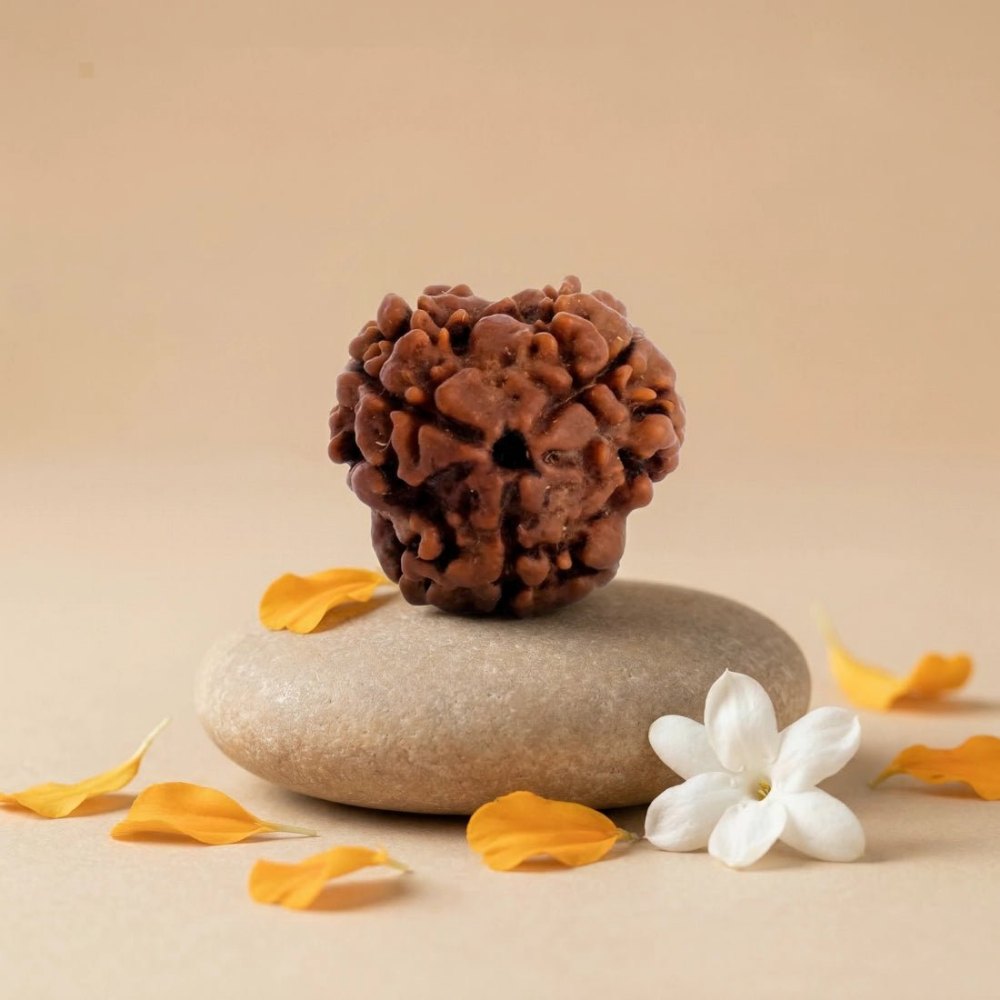
The textured surface of a Rudraksha bead can look almost carved, especially when its deep grooves run neatly from one end to the other. Yet these features develop naturally inside a fruit, long before the bead becomes part of a bracelet or prayer mala.
Rudraksha beads come from trees of the Elaeocarpus genus, commonly identified in botanical literature as Elaeocarpus ganitrus. Their formation follows a plant’s reproductive cycle, moving from flowers to fruits and finally to the hard, patterned structures we recognise as beads.
Understanding this journey reveals an important detail: although Rudraksha is often called a seed, the bead is more accurately the hard fruit stone surrounding the seeds.
The Journey Begins with Flowers
Before a Rudraksha bead can form, the tree must flower. Following successful pollination and fertilisation, the flower’s ovary develops into a fruit, while fertilised ovules develop into seeds.
This is a gradual biological process. The familiar brown bead does not appear directly on a branch as a bare, finished object. It develops beneath the fruit’s outer layers.
Flowering and fruit development depend on the tree’s growing conditions and seasonal cycle. Rather than following one fixed timetable everywhere, the process can vary between locations and trees.
A Fruit Grows Around the Developing Bead
As the fruit grows, different layers develop around its seeds. These include an outer skin, a fleshy middle layer, and a hard inner layer called the endocarp.
The endocarp becomes the Rudraksha bead. Its role in the fruit is protective, enclosing the internal spaces where seeds develop.
Botanical examination distinguishes this hard endocarp from the actual seeds inside it. Researchers have documented both the stony outer structure and the seeds with their own seed coats. This explains why calling the entire bead a “seed” is convenient in everyday language but less precise botanically.
A useful comparison is a fruit stone or pit: the protective structure and the seed it contains are closely connected, but they are not the same part.
How Does the Hard Surface Develop?
During maturation, the inner fruit layer becomes increasingly hard. Its tissues develop thick, strengthened cell walls, creating the durable structure that remains after the softer fruit material is removed.
Microscopic studies have identified lignified, thick-walled cells called sclereids in the Rudraksha endocarp. These cells contribute to its firm, woody character.
The surface texture also develops during growth. Its raised areas, depressions, and grooves are features of the fruit stone itself. Cleaning reveals this existing structure; it does not create the natural pattern.
This distinction matters because a genuine bead’s defining features originate in the developing fruit, rather than being added afterwards.
How Do the Mukhi Lines Form?
The prominent longitudinal divisions on a Rudraksha bead are commonly called mukhis or faces. They are associated with the bead’s naturally segmented structure.
Inside the endocarp are chambers known as locules. Botanical research examines these chambers, their seeds, and the surrounding structure to understand differences between beads. Studies have also documented unusual fruits containing endocarps with different chamber arrangements, including joined forms.
When examining a bead, distinguish its main longitudinal divisions from the many smaller wrinkles on its surface. Every shallow crease is not necessarily a separate mukhi.
The formation of these divisions is biological. Spiritual traditions assign meanings to different mukhi types, but those interpretations are separate from the process through which the fruit develops.
Why Do Rudraksha Beads Differ in Appearance?
Natural growth does not produce identical objects. Rudraksha beads can vary in size, outline, surface texture, and internal structure.
Some look relatively rounded, while others are more elongated or irregular. Their grooves may also differ in depth and prominence. Botanical studies of endocarps and embryos document variation rather than a single uniform bead structure.
These differences help explain why two natural beads may look unlike each other. However, an unusual appearance alone does not establish rarity, authenticity, or spiritual significance.
Likewise, a tidy or symmetrical bead is not automatically artificial. Identification requires more care than judging whether a bead looks “too perfect” or sufficiently rough.
What Happens After the Fruit Is Collected?
Once suitable fruits are collected, the outer skin and flesh are removed to expose the hard endocarp. Remaining fruit material is cleaned from the surface, including its deeper grooves.
The cleaned beads are then dried and prepared for their intended use. Depending on the product, preparation may include making a threading hole and assembling the beads into jewellery or a mala.
These steps should be distinguished from natural formation. The tree produces the fruit stone and its characteristic structure; people clean and prepare it for wearing or handling.
Artificially cutting additional grooves or joining separate pieces changes the structure rather than simply preparing a natural bead.
A Natural Structure with Cultural Meaning
A Rudraksha bead begins with a flower and develops inside a fruit. As that fruit matures, its inner layer hardens around the seeds, producing the textured, chambered stone later used as a bead.
Its natural formation is fascinating in its own right. Understanding that process allows you to appreciate Rudraksha as both a botanical structure and an object that carries spiritual meaning for many people.