When Numbers No Longer Sing
When Numbers No Longer Sing
(A Note from the Edge of the Market, 2026)
In a café called Stasiun — a real place on the slopes of Kampung Cibunut, a fictional village I invented so no one would feel offended — Sandi sat with his back to the window. That was his strangest habit: turning his back on the tea-plantation view, choosing instead to face the blue glow of his laptop screen, a feverish blue. The price charts moved up, down, up again. Like the heartbeat of a patient who drinks coffee while smoking.
The coffee in his hand had gone cold an hour ago. But Sandi didn’t drink. He just stared. He was waiting for the numbers to speak.
Three years. That was the length of his marriage to the crypto world. At first, curiosity — a coworker named Anton bought 0.1 Bitcoin and a month later could afford a folding bike. Then temptation. Then obligation: once his money was in, he couldn’t get out without taking a loss. He bought near the peak of late 2024, when Bitcoin touched $108,000, then fell to $62,000. He dollar-cost-averaged at $74,000. Now, February 2026, the price hovered between $88,000 and $92,000. Still in the red for him, though not as deep as before.
Beside him, his phone vibrated like a cricket. Notifications from a Telegram group filled with predictions: Bitcoin will hit $150,000 by year-end, just wait, the halving cycle isn’t dead. Five minutes later: 2026 is a transition year. The four-year cycle is dead. Sell before March. Two statements equally confident, equally empty.
Sandi sighed. Then he turned off the notifications.
---
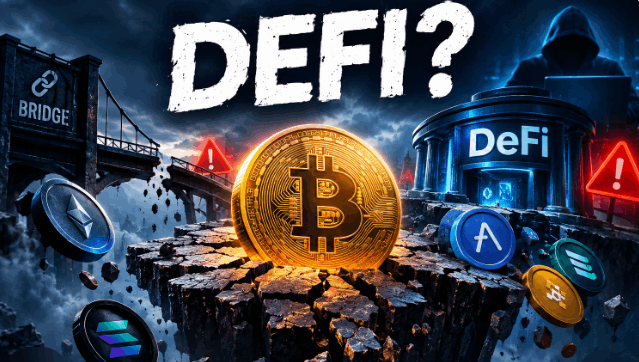
We may remember how, back around 2017–2021, crypto was celebrated as freedom. No banks, no governments, no middlemen skimming off every transaction. The slogan: be your own bank. But now, in 2026, we see something strange: crypto is starting to move like a macro asset. It rises when U.S. interest rates fall. It falls when war news breaks in Ukraine or Gaza. It trembles when Jerome Powell, the U.S. Federal Reserve chair, opens his mouth at Jackson Hole.
A friend — let’s call him Burhan, formerly a barber at Pasar Senen — once said to me, while snipping my uneven hair: "I used to think Bitcoin was digital gold. Now I realize it’s more like a drunk tech stock."
Burhan wasn’t wrong. Consider the data: Bitcoin’s correlation coefficient with the Nasdaq-100 index reached 0.73 in January 2026, up from 0.51 in January 2022 (source: CoinMetrics, Jan 2026 report). It no longer runs when traditional markets fall. It falls right along with them. An irony for those who once shouted about a hedge against inflation. The fact is, when U.S. inflation hit 9% in 2022, Bitcoin dropped 65%.
So we ask: will the four-year halving cycle (2012, 2016, 2020, 2024) — once so powerful, followed by a peak 12–18 months later — still hold in 2028? Or is it slowly dying, like an old song played so often that the lyrics lose their meaning?
---
A story from another country: in New York, the skyscrapers of Wall Street are bustling with pension fund managers adding Bitcoin to their portfolios. BlackRock, Fidelity, and Grayscale manage spot Bitcoin ETFs with total assets exceeding $120 billion as of February 2026. They don’t care about Satoshi Nakamoto’s vision of a peer-to-peer electronic cash system. They care only about annual returns. And as the big institutions enter, volatility slowly shrinks. But at the same time — crypto loses its fangs. It is no longer a tool of resistance. It becomes a commodity. Like corn. Like oil. Like silent gold in a vault.
I remember a poem from an old book with a torn cover, I’ve forgotten the title — probably by a fringe poet never included in anthologies:
Numbers never stand still.
They run.
But where?
No one knows.
Not even themselves.
---
Sandi, at the Stasiun café, finally closed his laptop. Dusk was falling. The streetlights in the village came on one by one, pale, like sleepy eyes. Outside the window, children played soccer. They laughed. They knew nothing about Bitcoin, ETFs, or halving. They knew one thing: the ball had to go into the goal. Maybe they were luckier.
But those of us already in the swirl must ask: what remains of a revolution if the revolution itself becomes what it once fought against? If decentralization is just another word for a new free market, with the same winners and losers — only different jargon?
Data speaks: in Indonesia, the OJK (Financial Services Authority) since January 2025 requires all crypto asset organizers to report every transaction above 5 million rupiah. As of 2026, registered wallets on official exchanges (CFX, Tokocrypto, etc.) number 22 million users. Each wallet is reported to PPATK, the financial intelligence unit. Sandi, who once could send money anywhere without anyone knowing, now has to fill out identity forms. "To prevent money laundering," the officer said on the phone. Sandi was silent. He knows that behind the phrase "consumer protection" sometimes hides good intentions that end in control.
I am not rejecting regulation. Nor am I an anarcho-capitalist. But I cannot close my eyes to the fact that power — in any form — tends to expand. It’s like water seeping into cracks of concrete. First it wasn’t there. Now it is. Tomorrow it will be larger. And the day after, perhaps, we will no longer remember that crypto was once dreamed of as a free space.
---
A woman named Riska — a fritter seller on the side of Pasar Minggu road — once asked me while flipping a tempeh fritter: "Sir, what’s the difference between Bitcoin and paper money?"
I fell silent. Not because I didn’t know the answer, but because the answer was too long to shout on a dusty roadside, amid the smoke of frying oil and the roar of motorbikes. Finally I just said: "Paper money you can hold. Bitcoin you can’t."
She nodded, though her eyes remained confused. Then she said: "So it’s just numbers on a screen?"
"Yes," I said. "Just numbers."
But numbers, as we know, can make you rich. They can also make you kill yourself. In 2026, price predictions range from soaring optimism to crouching pessimism. Bloomberg Intelligence panelists predict Bitcoin could reach $200,000 by the end of 2026. Meanwhile, Peter Schiff, the old-school gold bug, says it will fall back to $20,000. Both camps are equally confident. Both have charts, data, technical analysis with lines that squirm like snakes.
I recall a philosopher from Greece, Socrates, who was tried for corrupting the youth. He said: "All I know is that I know nothing." Maybe that’s what we should say about the crypto market this year. We can read charts, calculate MVRV ratios, watch dominance, compare with past cycles. But in the end, the market is a crowd of unpredictable humans — sometimes fearful, sometimes greedy, sometimes just following the herd because they’re afraid of missing the train.
---
Don’t ask where the wind will go,
For the wind never knows where it’s heading.
Let it pass,
Like we let time pass —
Which we can never catch.
That’s what I heard from an old man at the dock of Pelabuhan Ratu, while he was mending a torn net. He knew nothing about Bitcoin. But he knew something more important: that life cannot be predicted, and those most confident in their forecasts are often the first to fall.
---
Back to Sandi. At the Stasiun café, he finally stood up. He left behind the unfinished coffee, the cooling laptop, the chair still warm from his body. He walked out onto the dark village road. In the distance, the Maghrib call to prayer sounded. The children who had been playing soccer had gone home. What remained was only dust and the night wind, and a toothless cat scavenging leftover fritters under the table.
I don’t know whether Sandi will sell his crypto assets tomorrow morning. I don’t know whether a new halving cycle will begin or the old cycle will die like a dinosaur. But I do know one thing: amid all the predictions and regulations, amid all the charts and news, there are people like Sandi, Riska, Burhan — people who simply want their lives to be a little better, who simply want the money they save not to be eroded by inflation (in Indonesia, 2026 inflation is around 4.2% year-on-year), who simply want to believe that there is a way out of the system that has long made them feel small.
Perhaps that is what remains of crypto’s promise. Not the technology. Not decentralization. But hope — that in an increasingly centralized world, there is still room for those without a voice to try something new.
But hope, as we know, is the easiest thing to commodify. And in 2026, we must ask: can we still distinguish between hope and euphoria? Between conviction and folly? Between a genuine revolution and a revolution that merely changes clothes — from an anarcho‑flannel shirt to a sleek stockbroker’s suit?
I have no answer. Perhaps no one does. Only this: on a fictional hillside village, a man named Sandi walks home in the dark. In his pocket, his phone still vibrates — maybe with a price alert. Or maybe just a message from his wife: "We’re out of sugar. Buy some at Mak Yati’s stall."
Which is more important? That’s for us to choose.