What is the future of space exploration?

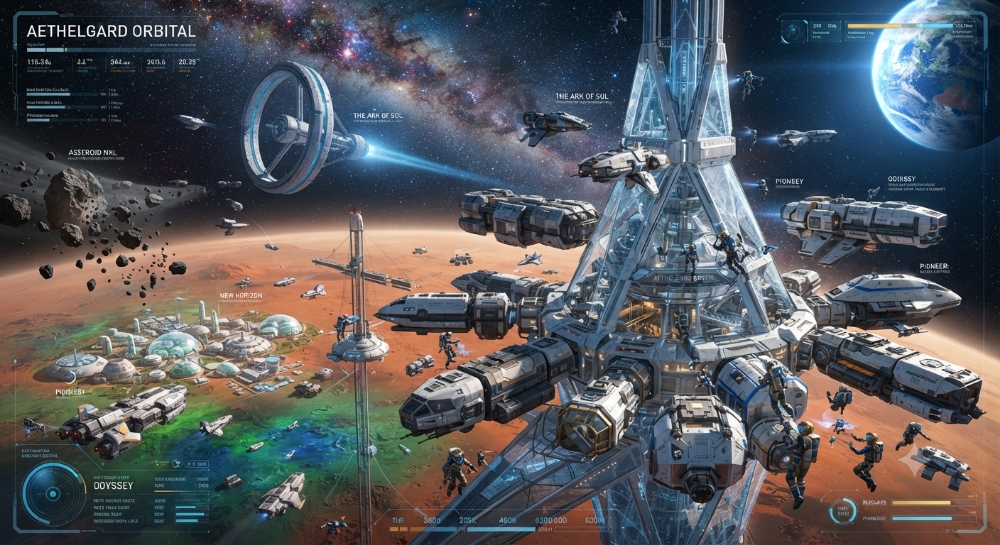 Future of space exploration
Space colonization and economy
Mars and lunar missions
The future of space exploration is rapidly transitioning from a period of government-led scientific discovery into a dynamic era of commercialization, permanent human settlement, and deep-space industrialization.
For decades, space agencies like NASA and global partners focused primarily on orbital missions and lunar flybys.
Today, humanity stands on the threshold of making space an accessible extension of our economic and residential sphere.
One of the most immediate milestones is the return to the Moon through sustainable programs like NASA's Artemis, alongside ambitions from international space agencies and private enterprises.
Unlike the Apollo era, the goal this time is not merely to visit and leave, but to establish permanent lunar outposts. The Moon will serve as a vital testing ground for advanced life-support systems, in-situ resource utilization (using lunar ice for water and rocket propellant), and a stepping stone for future crewed missions to Mars.
Simultaneously, the private space sector—driven by companies like SpaceX, Blue Origin, and numerous aerospace startups—is fundamentally reshaping the economics of space travel. Reusable rocket technology has drastically reduced the cost per kilogram of launching payloads into orbit. This affordability has opened the floodgates for commercial applications, including global satellite internet constellations, space tourism, and microgravity manufacturing. Facilities in low-Earth orbit are beginning to manufacture high-purity fiber optics, pharmaceuticals, and crystals that cannot be produced with the same quality under Earth’s gravity.
Looking further ahead, Mars remains the primary target for human interplanetary colonization. Establishing a self-sustaining settlement on the Red Planet will test the absolute limits of robotics, autonomous energy generation, and closed-loop recycling systems. Beyond Mars, robotic probes continue to explore the outer solar system, probing the subsurface oceans of icy moons like Europa and Enceladus for signs of extraterrestrial microbial life, while the James Webb Space Telescope and its successors analyze the atmospheres of distant exoplanets.
Ultimately, the future of space exploration is not just about planting flags or satisfying scientific curiosity. It is about transforming humanity into a multi-planetary species, securing new resources, and expanding our understanding of the universe while ensuring sustainable practices both on Earth and among the stars.