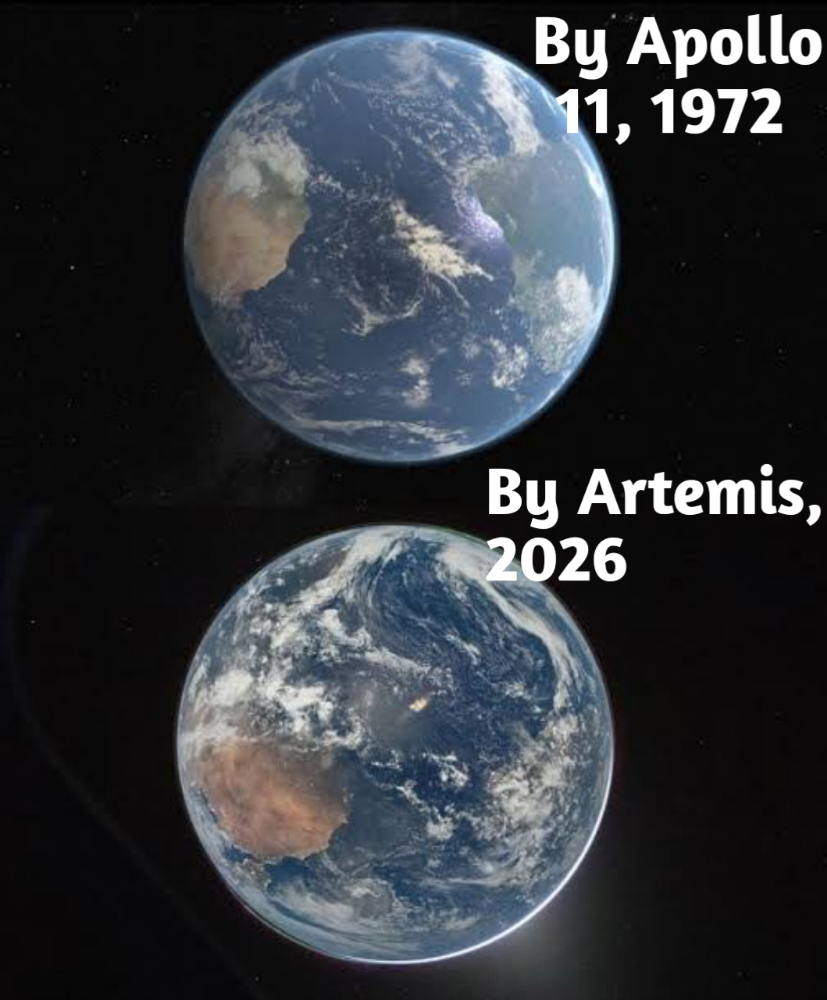
58 years of Earth, A space view.

In 1972, as astronauts aboard Apollo turned their cameras toward home, Earth appeared as a glowing blue marble , pure, vibrant, and seemingly eternal. Fast forward nearly six decades, and a new generation aboard Artemis gazes back at that same planet. The view is familiar yet the story it tells is profoundly different.
From space, Earth still looks breathtaking. Swirls of white clouds dance over deep oceans, continents glow in earthy tones, and the fragile atmosphere hugs the planet like a thin veil. At first glance, not much has changed. But this is the illusion of distance. What you cannot see from space speaks louder than what you can.
The Apollo missions marked humanity’s first daring leap beyond Earth. They were driven by competition, curiosity, and a desire to explore the unknown. When Apollo 17 astronauts captured their iconic image of Earth, it became a symbol of unity, a reminder that all of humanity shares one small, delicate world.
Now comes Artemis, not as a rival but as a successor. Its mission is not just to revisit the Moon, but to redefine our relationship with space and perhaps with Earth itself. The Artemis II mission carried astronauts farther than any humans had gone before, breaking records set during the Apollo era.
But the real comparison isn’t just about distance or technology. It’s about perspective.
In the 1970s, the world below Apollo was less crowded, less industrialized, and far less connected. Climate change was barely part of public conversation. Forests were denser, wildlife more abundant, and the atmosphere less burdened by human activity. The Earth that Apollo saw was already changing but slowly, almost invisibly.
By the time Artemis astronauts looked back, the pace of change had accelerated dramatically. Over these 58 years, human activity has reshaped the planet in ways that are difficult to grasp from orbit. Cities have expanded into vast networks of light. Forests have retreated. Ice caps have thinned. The atmosphere has warmed, carrying the unmistakable fingerprint of industrial growth.
And yet, from space, Earth still appears calm and almost unchanged. That’s the paradox. The difference between Apollo’s Earth and Artemis’s Earth is not easily captured in a single photograph. Lighting conditions, camera angles, and orbital positions can make the planet look different even when it hasn’t changed significantly in appears.
But beneath that visual continuity lies a deeper transformation. Artemis represents more than a technological comeback, it reflects a shift in human awareness. Unlike Apollo, which was shaped by geopolitical rivalry, Artemis carries a broader vision. Its crew is more diverse, symbolizing a global effort rather than a national one. Its goals extend beyond exploration to sustainability, science, and long-term presence beyond Earth.
In a way, Artemis is holding up a mirror not just to space, but to humanity itself. The question is no longer “Can we reach the Moon?” That was answered decades ago. The new question is, “What kind of civilization are we becoming while we do it?”
Looking back at Earth from the vast darkness of space has always been a humbling experience. Apollo astronauts described it as life-changing, a moment when borders disappeared, and humanity felt united. Artemis astronauts echo that sentiment, but with an added layer of urgency. They return not just with awe, but with awareness.
We know that Earth is not as unchanging as it looks from afar. We know that the thin blue atmosphere is fragile. And we know that the future of this planet depends not on how far we can travel into space , but on how wisely we choose to live here.
Fifty-eight years separate Apollo and Artemis. The view of Earth may still be beautiful, but the responsibility it carries has never been greater. We must be more responsible for this cause to leave better environment for next generation. Otherwise they will put us in the times of selfishness.
Thank you so much for your valuable time till here. Like, upvote and leave comment for feedback.
Note: The article also published on my read.cash Wall.
Cheers,
Amjad