Crypto's Institutional Era: From Speculation to Infrastructure
The crypto narrative has shifted. 2026 isn't about meme coins or get-rich-quick schemes—it's about digital assets becoming foundational infrastructure for global finance.
Institutions Are Here to Stay
Bitcoin ETFs and public companies now hold 12% of all BTC in circulation, up from 8.7% in early 2025 . This isn't retail frenzy; it's balance sheet strategy. Over 200 public companies now hold Bitcoin as treasury reserves, treating it as a diversification asset against inflation and currency volatility .
The result? Bitcoin held on exchanges just hit a five-year low. Supply is moving to cold storage, not trading desks .
Tokenization: The $19 Billion Proof Point
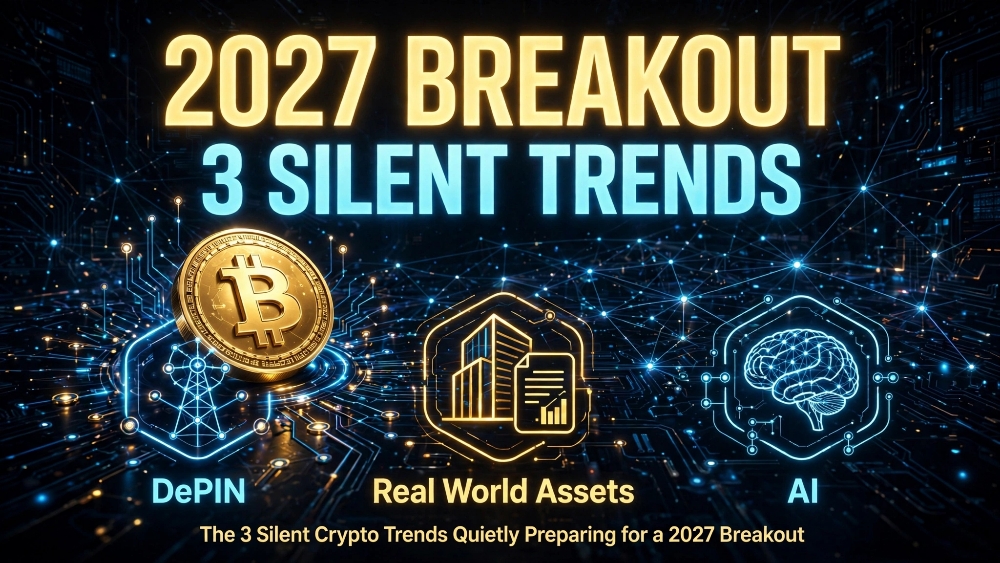
Real-world asset tokenization tripled to $19 billion in 2025, led by BlackRock's $1.7B BUIDL fund and tokenized gold from Tether and Paxos . Private equity, real estate, and even toll bridges are being fractionalized on-chain, letting anyone own a piece of assets once reserved for the ultra-wealthy .
DeFi Earns Its Keep
DeFi apps generated a record $3.8 billion in revenue in 2025 . For the first time, applications like decentralized exchanges are collecting more fees than the underlying blockchains themselves—$6.1 billion vs. $2.1 billion . Why? Scaling solutions cut gas costs, so value capture shifted from infrastructure to utility.
Hyperliquid, a perpetual DEX, topped $800M annual revenue with fewer than 15 employees . That's efficiency traditional banks can't touch.
Stablecoins: The Quiet Giant
Stablecoin transaction volume hit $27.6 trillion in 2024—surpassing Visa . They're no longer just crypto on-ramps; they're becoming the preferred rail for cross-border B2B payments, payroll, and treasury management . The GENIUS Act in the U.S. and MiCA in Europe now provide regulatory clarity, enabling banks like JPMorgan to issue deposit tokens on public blockchains .
The Quantum Question
There's one looming challenge: quantum computing. NIST released post-quantum cryptography standards in 2024, and by 2026, "hybrid cryptography" is becoming mandatory for tier-1 banks . Ethereum's Vitalik just published a quantum-resistant roadmap, moving validator signatures to hash-based schemes . The race is on to secure crypto before "CRQC"—cryptographically relevant quantum computers—arrive.
The Bottom Line
Crypto is growing up. 2026 isn't about hype; it's about infrastructure, utility, and institutional-grade reliability. The question is no longer "if" but "how fast" .
·