What Is Neural Proof-of-Intelligence (NPoI)? The AI Consensus Protocol Replacing Proof-of-Work

For more than a decade, blockchain consensus has been a battle between two imperfect models: Proof-of-Work (PoW) burns enormous quantities of energy to validate transactions, while Proof-of-Stake (PoS) concentrates governance in the hands of large token holders.
Both mechanisms share a fundamental limitation — they validate resources, not reasoning.
NEUROVATIC’s Neural Proof-of-Intelligence (NPoI) introduces a structurally different approach: consensus built on the quality of AI reasoning, cryptographic accountability, and deterministic auditability. This article explains what NPoI is, how it works technically, why it matters for regulated industries, and how it compares to every alternative on the market today.
What Is Neural Proof-of-Intelligence?
Neural Proof-of-Intelligence is a consensus protocol in which registered AI oracle nodes validate decisions by demonstrating the quality and confidence of their reasoning, rather than by solving cryptographic puzzles or staking tokens. Each oracle node submits a structured decision record that contains an AI score, a risk assessment, and a confidence measure — all cryptographically signed and verified before being accepted by the network.
The key innovation is that NPoI treats the AI decision itself as the primary auditable artifact. The question NPoI asks is not “who has the most computing power?” or “who locked up the most tokens?” — it is: “What did the AI conclude, and can that conclusion be independently verified?”
This shift from resource-based to reasoning-based consensus has profound implications for enterprise applications in regulated environments — financial services, healthcare infrastructure, and defense systems — where accountability and auditability are not optional features but legal requirements.
How NPoI Works: The Core Mechanism
At its core, NPoI relies on a network of registered AI oracle nodes. Each oracle is cryptographically authenticated using ECDSA signatures and registered in a ValidatorRegistry smart contract deployed on NV-CHAIN (Chain ID: 73790). The registry is the single source of truth for which AI oracles are authorized to participate in consensus.
When an oracle submits a decision to the network, it includes the following verifiable fields:
- AI Confidence Score: A normalized measure indicating how confident the AI reasoning engine is in the submitted conclusion.
- Risk Assessment: A structured evaluation of the associated risk level, expressed as a bounded categorical value.
- Oracle Identity: The cryptographic identifier linking the submission to a specific registered AI node.
- Cryptographic Signature: An ECDSA signature that makes the submission tamper-evident and non-repudiable.
- Decision Payload Hash: A SHA-256 hash of the decision content, enabling deduplication and replay prevention.
The network applies a multi-oracle quorum model: a decision is accepted only when a sufficient number of independent AI oracles reach agreement within specified confidence bounds. No single oracle can unilaterally influence the outcome, and all submissions are subject to the validation pipeline described below.
The 7-Gate Validation Pipeline
Every NPoI submission passes through a sequential 7-gate security pipeline before it affects the chain state. This pipeline is deterministic — the same input will always produce the same validation outcome — which is a prerequisite for regulatory audit trails.
- Gate 1 — Temporal Validation: Rejects submissions with timestamps outside the accepted window. This prevents both stale-data attacks (replaying old decisions) and future-dated manipulation.
- Gate 2 — Field Bounds Verification: Validates that all numeric fields (confidence, risk) fall within their declared bounds. Out-of-range values are rejected without error propagation.
- Gate 3 — Rate Limiting: Enforces per-oracle submission frequency limits in real time. This prevents oracle flooding attacks that could destabilize the quorum.
- Gate 4 — Payload Deduplication: A cryptographic hash of the decision payload is checked against an immutable record. Identical submissions are rejected, preventing replay attacks at the application layer.
- Gate 5 — Oracle Trust Verification: The submitting oracle’s identity is verified against the ValidatorRegistry. Revoked or unregistered oracles are rejected at this gate.
- Gate 6 — ECDSA Signature Verification: The cryptographic signature is verified against the oracle’s registered public key. This is the cryptographic authentication layer — if the signature fails, the submission is discarded with no state change.
- Gate 7 — Circuit Breaker Check: A watchdog quorum mechanism monitors for anomalous network conditions. If the watchdog triggers, the circuit breaker pauses new submissions until the network health is confirmed. This is the emergency safety layer.
This 7-gate architecture means that a decision cannot enter the NPoI consensus record unless it has passed every verification step. There is no partial acceptance — the validation is binary and fully deterministic.
How NPoI Compares to Proof-of-Work and Proof-of-Stake
The table below summarizes the structural differences between the three major consensus models across the dimensions that matter most for enterprise and regulated deployments:
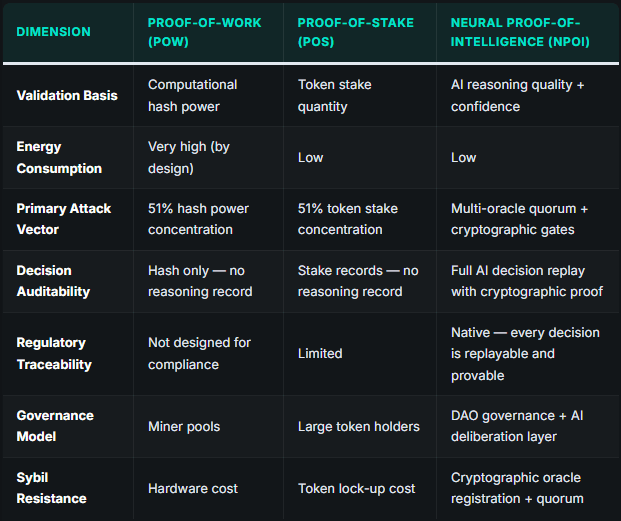
Why Deterministic Auditability Is the Core Innovation
The most important property of NPoI is not the AI scoring itself — it is the deterministic auditability of every decision. In both PoW and PoS, you can verify that a block was produced correctly, but you cannot reconstruct why the validators made their choices. The reasoning is absent from the record.
NPoI changes this fundamentally. Every decision submitted to the network is stored with:
- The complete decision payload (what the AI concluded)
- The confidence and risk values at the moment of submission
- The cryptographic identity of the submitting oracle
- The ECDSA signature that proves authenticity
- The timestamp and sequence position in the validation pipeline
This means that any authorized auditor — or the network itself — can replay the full decision history and verify that every past conclusion was valid according to the rules in force at that time. This is not just a technical property; it is the foundation for compliance in regulated industries.
Under frameworks like the EU AI Act (Article 13 on transparency) and emerging enterprise AI governance standards, systems that make consequential decisions must be able to demonstrate their reasoning on demand. NPoI is architecturally designed to satisfy this requirement natively.
NPoI and the EU AI Act: A Compliance Architecture
The EU AI Act, which entered into force in 2024, establishes obligations for high-risk AI systems including requirements for human oversight, traceability of decisions, and transparency of AI behavior. NPoI addresses all three areas at the protocol level:
- Traceability: Every NPoI decision is cryptographically signed, timestamped, and stored on an immutable ledger — providing a complete audit trail that satisfies Article 12 (Record-keeping) requirements.
- Transparency: The decision payload, including confidence and risk scores, is stored as a verifiable record — not as an opaque hash — enabling Article 13 (Transparency) compliance.
- Human Oversight: The circuit breaker mechanism (Gate 7) ensures that human-controlled emergency pauses can halt AI consensus activity at any time, satisfying Article 14 (Human oversight) requirements.
This makes NPoI one of the few consensus protocols architecturally designed with regulatory compliance as a first-class requirement — not as an afterthought.
NPoI in Production: NV-CHAIN
Neural Proof-of-Intelligence is currently live and operating in production on NV-CHAIN (EVM-compatible, Chain ID: 73790). NV-CHAIN is listed on the public Chainlist registry and is fully compatible with standard EVM tooling, including MetaMask and Hardhat.
The network infrastructure is operated across a geographically distributed cluster of nodes, providing both availability and Byzantine Fault Tolerance (BFT). The oracle network that powers NPoI consensus is composed of registered, authenticated AI nodes — each independently verifiable through the on-chain ValidatorRegistry.
The production deployment follows a progressive rollout model: new oracle nodes and enforcement rules are onboarded incrementally, with each stage validated before the next is activated. This approach prioritizes stability over speed — the correct trade-off for infrastructure intended to operate in regulated environments.
Who Should Care About NPoI?
NPoI is particularly relevant for organizations in sectors where AI decision-making must meet formal accountability standards:
- Financial services: Trading infrastructure, automated risk assessment, and AML/KYC pipelines all require demonstrable AI decision trails. NPoI provides the cryptographic proof layer that compliance officers and regulators can verify independently.
- Healthcare infrastructure: AI systems used for clinical decision support or resource allocation must be auditable under frameworks like the EU MDR and the EU AI Act’s high-risk provisions.
- Defense and critical infrastructure: Systems operating in safety-critical environments require formal assurance that AI decisions are deterministic, non-repudiable, and replayable for post-incident review.
- Enterprise AI governance: Any organization building internal AI systems that interact with regulated data or make consequential automated decisions benefits from the accountability layer NPoI provides.
Frequently Asked Questions
Is NPoI an energy-intensive consensus mechanism?
No. Unlike Proof-of-Work, NPoI does not require energy-intensive hash computation. The validation process is computationally efficient — the primary resource consumed is the AI inference workload, which runs on existing infrastructure without the astronomical energy overhead of PoW mining.
Can NPoI be used without NV-CHAIN?
The NPoI protocol is architecturally designed for the NV-CHAIN ecosystem. However, the underlying principles — AI-scored consensus with cryptographic accountability — can be applied as a governance layer over other EVM-compatible chains. NEUROVATIC is exploring interoperability pathways through the NAGRA reference architecture.
How does NPoI handle malicious oracle nodes?
Malicious or compromised oracle nodes are mitigated through multiple layers: the multi-oracle quorum requirement means a single bad actor cannot influence consensus, the ValidatorRegistry can revoke oracle credentials on-chain, and Gate 5 (Oracle Trust Verification) rejects submissions from non-registered or revoked oracles in real time. The circuit breaker (Gate 7) provides an additional emergency response capability.
What is the relationship between NPoI and NVC?
NVC (NEUROVATIC Coin) is the internal protocol resource used for network operations on NV-CHAIN, including validator registration and governance participation. NVC is not offered as an investment instrument and NEUROVATIC does not make financial projections regarding its value. This article is not financial or investment advice.
Key Takeaways
- NPoI validates AI reasoning quality — not computational resources or token stake.
- Every decision passes through a deterministic 7-gate validation pipeline before acceptance.
- All decisions are cryptographically signed, stored immutably, and fully replayable — enabling forensic audit at any point in history.
- NPoI is architecturally aligned with the EU AI Act’s transparency, traceability, and human oversight requirements.
- The protocol is live in production on NV-CHAIN (Chain ID: 73790), operating across a distributed, BFT-protected oracle network.
For the complete technical documentation, visit neurovatic.ai or explore the public chain data at explorer.neurovatic.ai.
This article does not constitute financial or investment advice. NVC is a utility token used for internal network operations on NV-CHAIN. NEUROVATIC is a High-Assurance Engineering company. All technical claims in this article are verifiable through public on-chain data and published documentation.