Embassy South Reserve: Why Waiting Risks Your Preferred Home

The Hidden Risk of Waiting: Why Embassy South Reserve Inventory Is Moving Faster Than Expected
In Bengaluru’s fast-evolving real estate market, timing often decides more than price. For buyers eyeing premium homes in North Bengaluru, one new launch is already testing that principle: Embassy South Reserve.
Launched in mid-September 2026 as part of the larger Embassy Origins township, this 14-acre community of 855 apartments has drawn strong early interest. While exact day-to-day booking figures are not publicly broken out, the broader sales environment, Embassy Developments’ recent performance, and typical patterns in well-located premium launches point to a clear reality — preferred configurations and higher floors do not stay available indefinitely.
The biggest risk is rarely the headline price. It is the quiet disappearance of the exact 3 BHK or 3.5 BHK you wanted, the better view, or the preferred floor, while you wait for “one more site visit” or a hoped-for price correction that may never come.
This page examines the factors driving inventory velocity at Embassy South Reserve, the practical advantages of acting early, and the real opportunity cost of delay. It is written for serious homebuyers and investors who want clarity rather than hype.

The Strong Residential Sales Backdrop in 2026
Bengaluru’s residential market, particularly the premium and luxury segments, has shown resilience and growth through 2025–26. Embassy Developments itself reported significant scale in the past year: approximately ₹22,000 crore of residential gross development value launched over the preceding 12 months, generating around ₹7,000 crore in sales. The company has set an ambitious target of ₹8,000 crore in residential sales for the current fiscal year and plans further launches worth roughly ₹10,000 crore by March 2027.
North Bengaluru accounts for a large share of Embassy’s current pipeline — close to 90% according to management comments. This concentration reflects infrastructure momentum around the airport corridor, improving connectivity, and sustained demand from professionals, entrepreneurs, and families seeking larger, greener homes outside traditional central locations.
Embassy South Reserve sits squarely in this growth zone. Spread across 14 acres within the 85-acre Embassy Origins master plan at Tharahunse (north of Yelahanka), it offers 2, 2.5, 3 and 3.5 BHK apartments ranging roughly from 1,300 to 2,200 sq ft, with starting prices around ₹1.76–2.1 crore depending on configuration and exact built-up area. The project is RERA-registered (PRM/KA/RERA/1251/309/PR/090926/008925) with targeted completion in the early 2030s.
In such an environment, new launches that combine brand credibility, green design, airport proximity (approximately 20 minutes), and accessible entry pricing often see faster movement in the more desirable unit types. This is not unique to one project — it is a recurring pattern across well-received premium developments in the city.
Why Preferred Units Tend to Move First
Not all of the 855 apartments are equal in buyer eyes. Experience across similar launches shows a consistent preference hierarchy:
- 3 BHK and 3.5 BHK configurations usually attract families and buyers looking for long-term livability. These sizes offer more flexibility for home offices, guest space, or growing children.
- Higher floors are frequently preferred for views, light, and perceived prestige, especially in low-density projects with landscaped surroundings.
- Specific orientations and corner units that maximise privacy or open views disappear faster once the sales office opens for bookings.
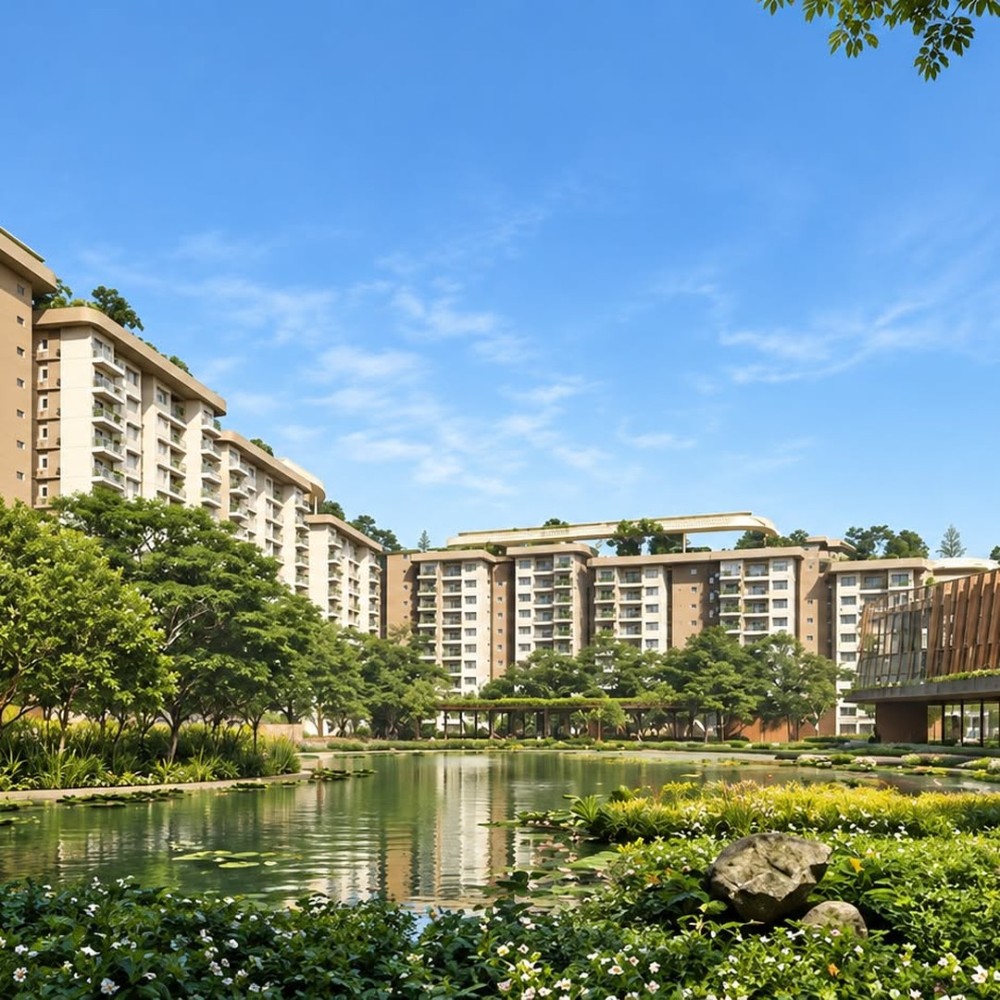
At Embassy South Reserve, the design philosophy of “Natural Intelligence” — led by Bengaluru-based Bhumiputra Architecture — emphasises a continuous green spine, thousands of trees across multiple species, water features, and a cooler microclimate. Buyers who prioritise these elements naturally gravitate toward units that best capture the landscape experience. Once those preferred stacks or floors are reserved, later buyers face compromises on floor level, view, or layout.
The project’s scale (nine towers reported in some listings) creates choice, yet it does not eliminate scarcity of the most sought-after options. Early movers typically secure better selection; those who wait often find the remaining inventory skewed toward less preferred configurations.
The Accessibility Factor: 10% Down Payment and Flexible Plans
This structure lowers the barrier for end-users who may still be finalising finances or selling an existing property. It also appeals to investors who want to lock in current pricing while spreading the remaining payments over the construction timeline (targeted completion around Q1 2032).
When a project combines reasonable entry pricing, a low initial outlay, strong location fundamentals, and a credible developer, conversion rates in the early weeks tend to be higher than in projects that demand 20–30% upfront or lack clear payment flexibility. The ease of starting the process itself contributes to inventory movement.
The Real Cost of Waiting: Opportunity, Not Just Price
Many prospective buyers focus narrowly on whether the base price will rise by a few percentage points. In reality, the larger costs of delay are often non-monetary or indirect:
- Loss of preferred inventory — The exact unit type, floor, and view you want may no longer be available. Switching to a different configuration or lower floor can feel like a permanent compromise.
- Missed price stability window — Early phases frequently offer the most competitive pricing and incentive structures. Subsequent price revisions, if any, usually move upward in a rising market corridor.
- Psychological and lifestyle delay — Waiting another six or twelve months means postponing the lifestyle and potential capital appreciation that come with ownership in a growing micro-market.
- Comparison fatigue — Prolonged research across multiple projects often leads to decision paralysis, during which the better options in a strong launch quietly get booked.
As the outline for this topic notes, the biggest cost is rarely the listed price. It is the opportunity you lose by delaying. In a market where North Bengaluru continues to attract both end-users and capital, the window for optimal selection is finite.
Practical Considerations for Buyers Evaluating Embassy South Reserve
Before deciding, consider these practical steps:
Review the full project context
Embassy South Reserve is the apartment component of the larger Embassy Origins township, which also includes the villa community Embassy Riverine and future commercial development (Embassy Innovation Park on adjoining land). Understanding the master plan helps assess long-term livability and potential value drivers.
Prioritise your non-negotiables
List the must-haves: size (3 BHK vs 2.5 BHK), floor preference, view orientation, budget ceiling, and timeline. Visit the experience centre to see model apartments and the master plan in person. This reduces the chance of later regret.
Understand the payment and legal framework
Confirm the exact down-payment requirement, construction-linked schedule, RERA details, and bank pre-approvals. Transparent documentation is a strength of organised developers and reduces future friction.
Compare realistically
Look at competing launches in North Bengaluru on location, density, green cover, developer track record, and payment flexibility. Embassy’s concentration of pipeline in the north and recent sales scale provide useful context for relative demand.
Factor in possession timeline
With completion targeted for the early 2030s, this is a medium-term commitment. Buyers who need ready-to-move homes in 12–18 months will need to look elsewhere; those comfortable with under-construction timelines can prioritise selection and pricing.
Balanced View: Strengths and Caveats
Strengths
- Credible developer with demonstrated residential sales momentum
- Low-density green design within a larger planned township
- Airport-corridor location with improving infrastructure
- Accessible starting prices and flexible payment plans for the segment
- Clear RERA registration
Caveats
- Under-construction status means buyers must be comfortable with a multi-year wait
- Exact inventory velocity and remaining preferred units change daily — only a current sales consultation provides real-time clarity
- As with any new launch, final specifications, amenities delivery, and construction quality will be proven over time
A measured approach is to treat early interest as a signal of genuine demand rather than manufactured scarcity, while still verifying current availability directly.
How This Fits the Broader North Bengaluru Opportunity
North Bengaluru’s transformation is structural: airport expansion, metro plans, aerospace and industrial activity, and the gradual shift of premium housing beyond the traditional core. Projects that combine scale, green design, and brand trust are well positioned to benefit. Embassy South Reserve’s placement inside a larger integrated development adds another layer of potential lifestyle and commercial synergy over the coming decade.
For buyers whose needs align with the product (mid-to-large apartments in a green, connected setting), the practical question is less “Will the project sell?” and more “Will the specific unit I want still be available when I am ready to decide?”
Actionable Next Steps
- Clarify your non-negotiable requirements (size, budget, floor preference).
- Schedule a visit to the sales experience centre at Embassy Origins for current inventory and pricing.
- Review RERA documentation and payment schedule in detail.
- Compare two or three competing options on the same criteria so the decision is relative rather than absolute.
- If the fit is strong, secure preferred inventory while selection remains open rather than waiting for perfect market timing that may not materialise.
The market does not pause while individual buyers deliberate. In a project showing early momentum within a strong sales environment, the cost of hesitation is often measured in lost choice rather than a higher number on a price list.
Ready to evaluate whether Embassy South Reserve still offers the configuration you want?
DM for brochure details, current availability insights, or to arrange a site visit discussion. What is the one factor that would make you move from research to decision on a North Bengaluru home?
FAQ Section
Is Embassy South Reserve inventory really moving fast?
As a new September 2026 launch, public day-by-day sales figures are limited. However, the overall residential sales environment, Embassy’s recent launch and sales scale, and typical patterns in preferred 3/3.5 BHK and higher-floor units in well-located projects indicate that desirable inventory does not remain static for long. Real-time status is best confirmed directly with the sales team.
What is the minimum down payment required?
Buyers can typically book with around 10% down payment, followed by a construction-linked payment plan. Exact terms should be verified at the time of enquiry as they can vary by unit and financing arrangement.
Which unit types are in highest demand?
Embassy South Reserve configurations (3 BHK and 3.5 BHK) and higher floors generally see stronger early interest from families and buyers prioritising space and views. Specific availability changes continuously.
What is the expected possession timeline?
The project is targeted for completion in the early 2030s (around Q1 2032 in some references). Buyers should treat this as an under-construction commitment and plan accordingly.
How does Embassy South Reserve fit into the larger Embassy Origins township?
It is the apartment component of the first phase of the approximately 85-acre Embassy Origins development, which also includes villa offerings and planned future commercial elements. The integrated plan is designed around green and natural systems.
Should I wait for a possible price drop?
In a corridor with strong demand drivers and a developer actively expanding its residential presence, waiting carries the risk of reduced unit selection and potential upward price movement. Individual financial circumstances and risk tolerance should guide the final decision.