Is the Universe Just an Engine?

Have you ever been playing a massive open-world video game, looked off into the horizon, and wondered how your GPU isn’t actively bursting into flames? The answer, of course, is that the graphics engine is cheating. It isn’t rendering the entire world at once. It only draws what you are looking at, drops the resolution of distant objects, and caps the framerate so the hardware doesn’t melt down. Developers call these tricks optimization. They are the clever computational shortcuts that make complex virtual worlds possible on finite hardware.
Here is the trippy part though. When you look closely at the fundamental laws of modern physics, our actual universe appears to be using the exact same playbook. From the speed limit of light to the bizarre mechanics of quantum probability, reality is packed with features that look less like continuous physical phenomena and remarkably like processing constraints, memory management, and rendering tricks. While philosopher Nick Bostrom famously popularized the simulation argument in the early 2000s through formal probability, looking at the universe through the practical lens of software architecture turns a fun sci-fi thought experiment into a surprisingly tight logical framework.
The Speed of Light as Maximum Clock Speed
In standard physics, the speed of light (about 186,000 miles per second) is taught as the universe’s ultimate speed limit. Albert Einstein showed that nothing with mass can travel faster than this, and even light itself is locked at this speed. But if you ask why this speed limit exists, traditional physics basically shrugs and says, “That’s just how the universe works.”
If you look at the universe like a giant computer, though, this speed limit makes total sense. It acts just like a processor’s clock speed. In a computer, the clock speed limits how fast information can travel through the wires and update the system. If information traveled instantly, the computer would overload and crash. By capping how fast light and information can move, reality ensures that events happen in order without crashing the universe’s system.
This idea also explains why time slows down when you move really fast (what physicists call time dilation). Imagine a video game where your computer only has a fixed amount of power. If your character moves across the map at extreme speed, the computer has to spend most of its power rendering your movement. To keep up, it has to lower the game’s internal frame rate. In the real world, as you move faster through space, reality shifts its processing power to your movement, causing your internal clock to slow down so the universe never exceeds its processing capacity.
Quantum Superposition and Occlusion Culling
If the speed of light is the universe’s way of managing processing speed, quantum mechanics is its trick for saving graphics power. Normally, we assume that an object stays in a specific spot whether we are looking at it or not. But quantum physics completely flips that idea. On a subatomic level, particles don’t actually exist in fixed locations until they are measured. Instead, they exist in a fuzzy cloud of possibilities.
This works almost identically to a trick video game developers use called occlusion culling. To save memory and stop graphics cards from melting, games don’t waste power drawing things you can’t see. Like the contents of a closed treasure chest or a room behind a locked door. The game leaves those objects hidden as simple code, only fully rendering them the exact moment you open the chest or turn the camera toward them.
The universe appears to do the exact same thing. In famous physics experiments, a particle behaves like a wave of possibilities right up until a sensor detects it. The moment an observation happens, the particle snaps into a single, concrete spot. In game terms, reality avoids the heavy processing cost of tracking exact locations for every single atom in existence, keeping them as lightweight mathematical code until someone actually looks.
Quantum Entanglement as Shared Memory Pointers
Perhaps the most famous headache in twentieth-century physics was quantum entanglement. When two particles become entangled, measuring the quantum state of one instantly determines the state of the other, no matter how many light-years separate them. Einstein famously rejected this idea in a 1935 paper co-authored with Boris Podolsky and Nathan Rosen, mocking it as “spooky action at a distance” because it seemed to violate the local speed-of-light limit. Decades later, experiments testing Bell’s Theorem proved that non-local quantum entanglement is a real feature of our universe.
From a physical standpoint, instantaneous communication across light-years breaks our understanding of space. But from a software engineering perspective, it is routine. Imagine two distinct visual objects placed on opposite sides of a game map. If both objects are programmed to reference the exact same memory address or pointer in the backend code, updating that variable changes both objects simultaneously.
The spatial distance between the two objects on screen is merely a visual representation generated for the player’s user interface. The backend engine does not care about the pixels displayed on screen. It simply updates a value stored at a single location in memory. If our physical universe is a rendered projection formed from a deeper computational state, space itself is just UI. Entangled particles do not need to send faster-than-light signals across millions of miles of space because, in the underlying memory architecture, they were never separated in the first place.
Pixels, Planck Units, and the Boundaries of Reality
If you zoom in far enough on any digital display, the smooth, continuous image breaks down into discrete pixels. You cannot have a fraction of a pixel, nor can an object move half a pixel on a low-resolution grid. Modern physics uncovers a strikingly similar threshold when probing the ultra-small scales of reality.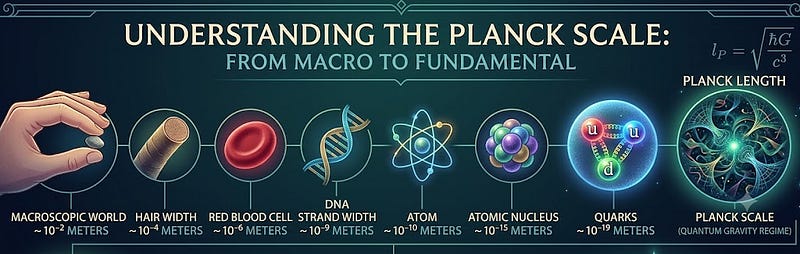
According to quantum field theory, physical reality ceases to be continuous at the Planck scale. The Planck length represents the smallest possible unit of distance, below which the traditional concepts of space and geometry completely break down. Similarly, the Planck time is the smallest possible measurement of time. It is the duration it takes for light to travel one Planck length.
In a perfectly analog world, space and time should be infinitely divisible. You should be able to divide any distance in half forever. Yet, quantum physics demonstrates that energy, charge, and space come in discrete packets, or quanta. The existence of the Planck length and Planck time strongly mirrors the spatial resolution and temporal tick-rate of a simulated grid system. Reality, it turns out, appears to be digitized at its most fundamental level.
A Rendered Reality or Just a Useful Lens?
Does all of this mean we are definitely living inside a giant alien supercomputer? Not necessarily. It is always important to maintain a healthy degree of scientific skepticism. Throughout human history, scientists have routinely explained the cosmos using the most advanced technology of their era. During the Industrial Revolution, physicists viewed the universe as a grand, mechanical clockwork engine running on thermodynamic principles. Today, in the information age, it is natural that we look at quantum field equations and see source code.
It is entirely possible that computation is simply the best metaphor we currently have to describe deep mathematical structures that we do not yet fully understand. Yet, whether the simulation hypothesis turns out to be literally true or merely a way for us to understand the best we can, framing physics in terms of operational logic forces us to ask better questions. It bridges the gap between abstract quantum mechanics and physical reality, showing that the quirks of our cosmos might not be strange glitches after all, but rather the necessary architecture required to keep a universe running.
Thanks for reading everyone! Visit my site to learn more about me and explore what I’m building at Learn With Hatty. I hope everyone has a great day and as I always say, stay curious and keep learning.
Original article on PublishOX