Who are you, Mrs. Watanabe?

The concept of global investing usually evokes images of hedge funds and Wall Street brokers. Yet, one of the most iconic figures in the international foreign exchange market became "Mrs. Watanabe" - a stereotypical Japanese housewife who manages her household's life savings from her kitchen table, trading on the Forex market.
This moniker, derived from a popular surname in Japan, entered the financial lexicon at the turn of the century. It described the phenomenon of middle-class Japanese women who took control of household budgets and actively managed international investments. Due to the massive scale of their operations, with capital running into billions of dollars, this army of retail investors gained real power capable of moving global currency rates.
The pillar of Mrs. Watanabe's success was one of the oldest and most respected market techniques: the carry trade strategy.
Author's Note: I am not a financial advisor (in fact, I’d probably be the worst advisor you’ve ever met). My only goal is to present the news and findings I've gathered regarding the world of investing.
The Anatomy of the Classic Carry Trade
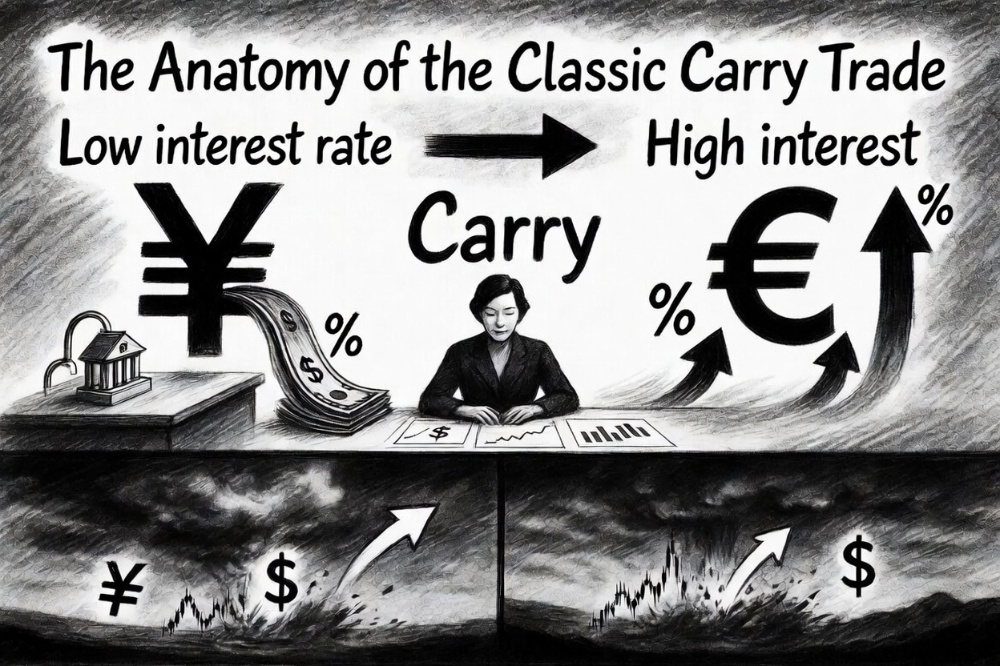
The essence of this mechanism lies in exploiting the interest rate differential between two different currencies. This process takes place in two key steps:
- Funding: The investor borrows or sells a low-interest-rate currency (the so-called funding currency). For decades, the Japanese yen served as the ideal example.
- Investment: The acquired funds are then invested in a currency with a high interest rate (the so-called target currency).
The investor's profit (the titular carry) is the direct difference between the cost of acquiring the capital and the return on its investment.
Key Risks and Portfolio Management
While this model may seem mathematically foolproof, it is not without risk. The carry trade requires a high risk tolerance and a long-term investment horizon, which allows investors to weather periodic fluctuations. The main threats to investors are:
- Exchange Rate Risk: A sharp depreciation of the target currency against the funding currency can wipe out interest gains in an instant and result in heavy losses.
- Market Volatility: Sudden geopolitical or economic turmoil often leads to the so-called unwinding of carry trades - a mass exodus of investors to safe-haven assets, which drastically amplifies currency fluctuations.
A New Era: The Carry Trade in the Crypto World
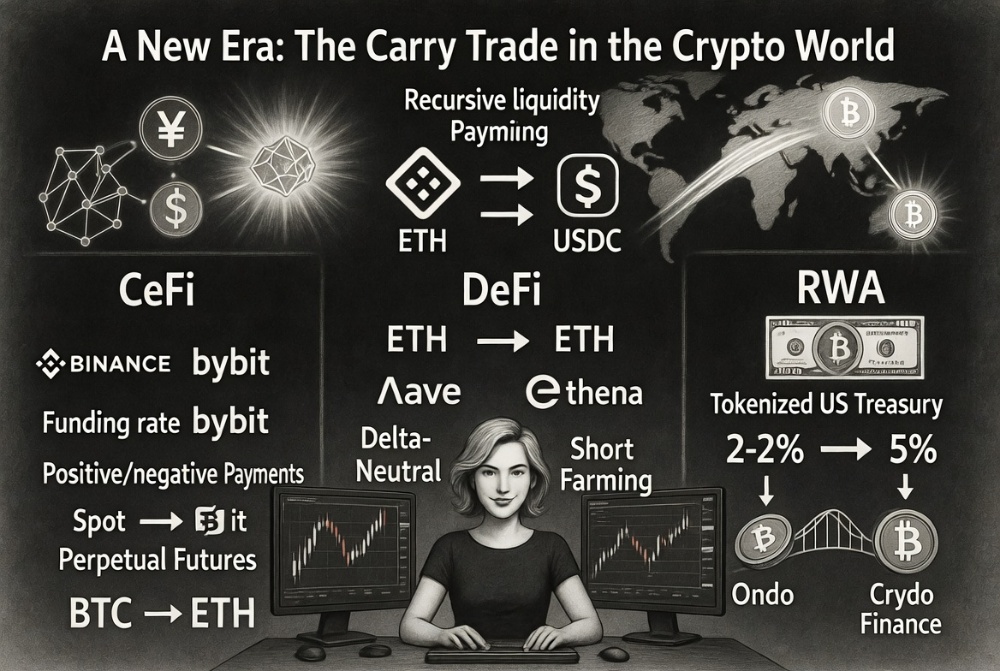
These strategies are primarily deployed across three areas:
CeFi (Centralized Finance)
Platforms such as Binance, OKX, and Bybit offer automated trading bots that allow users to mechanically replicate carry trade strategies with a very low barrier to entry.
- Funding Rate Arbitrage (Market Neutrality): This is the most popular form of crypto carry trade. An investor buys a cryptocurrency on the Spot market and simultaneously opens a short position on Perpetual Futures contracts. If the market is bullish, the funding rate is positive - meaning short position holders receive payments from long position holders (typically every 8 hours). The profit comes from these payments, while maintaining zero exposure to the price fluctuations of the underlying asset.
- Collateralized Loans (Lending): This involves borrowing capital in a currency with a low APY (e.g., stable assets like BTC or ETH) and converting it into stablecoins, which are then deployed into high-yield "Earn" products.
DeFi (Decentralized Finance)
DeFi allows for the creation of advanced, automated financial structures managed entirely by smart contracts.
- Liquidity Loops (Recursive Lending): An investor deposits an asset with a low borrowing cost (e.g., ETH) into a protocol like Aave, borrows stablecoins (e.g., USDC) against it, swaps those stablecoins for more ETH, and deposits them again. The profit is generated from the difference between the appreciation of ETH plus governance token rewards (e.g., AAVE tokens) and the low cost of the loan.
- Delta-Neutral Yield Farming: This utilizes next-generation protocols like Ethena (USDe). The system automatically deposits collateral in the form of staked ETH (LST) and opens a short position on centralized exchanges (CEX). The yield comes from two combined sources: ETH staking rewards and the positive funding rate from the short position.
- Cross-Chain Carry Trade: Exploiting differences in yield across various blockchain networks. An investor borrows capital on a cheap, stable network (e.g., Solana) where rates are low, and moves it via a bridge to a newly launched network (e.g., a fresh Layer 2 solution), where protocols offer massive token incentives to attract liquidity.
The RWA Sector (Real World Assets)
This is the most dynamically growing bridge connecting crypto with the traditional debt market. Platforms like Ondo Finance and Mountain Protocol offer tokenized US Treasury bills (T-Bills). Investors can borrow "cheap" stablecoins in DeFi (yield playing at 2-3%) and invest them into tokenized bonds (generating around 5%), earning on the pure US interest rate differential.
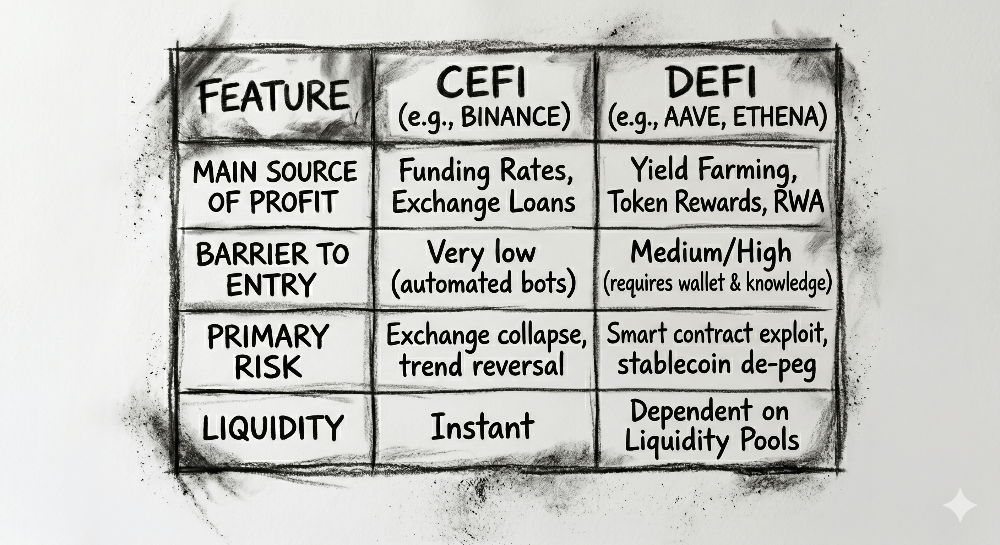
Environment Comparison: CeFi vs. DeFi
The table below highlights the key differences in executing a carry trade strategy within the crypto market:
What Must the Modern "Mrs. Watanabe" Watch Out For?
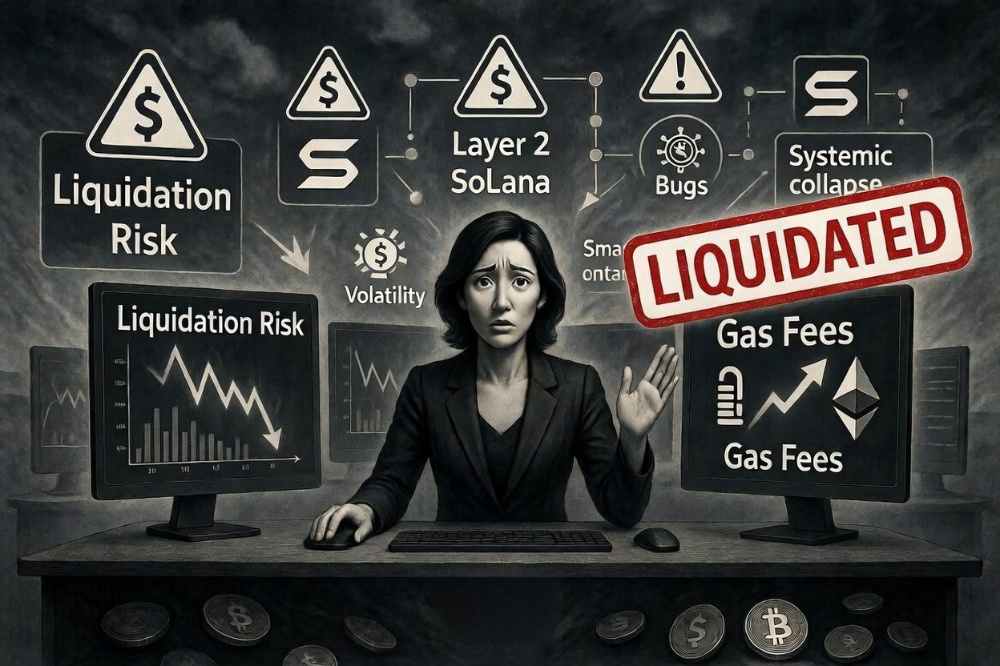
First and foremost, a critical danger in DeFi is liquidation risk. If the value of the digital collateral drops sharply, the algorithm will close the investor's position in a fraction of a second. Secondly, transaction costs (gas fees) can become a major bottleneck. On networks like Ethereum, high fees can completely consume the profit generated from the interest differential. For this reason, modern carry trades have largely migrated to cheaper alternatives, such as Layer 2 (L2) networks and Solana.
Whether in its traditional form with the Japanese yen or its modern Web3 counterpart, the carry trade remains a powerful tool for investors. However, it demands a deep understanding of market mechanics, a high risk tolerance, and continuous monitoring of systemic risks.
As crypto enthusiasts and active participants in the Web3 space, you have likely encountered various forms of carry trade strategies more than once—whether by hunting for high funding rates or optimizing liquidity loops in DeFi.
What about you? Do you have your own favorite, battle-tested carry trade strategies, or do you find the risks involved to be too high? Share your experiences with us!
Resources:
https://pl.tradingview.com/news/invezz:374875ee6f437:0/
https://boringowl.io/blog/carry-trade-twoja-strategia-inwestycyjna-przeglad-zalet-i-potencjalnych-ryzyk
https://www.reuters.com/business/finance/big-japan-banks-forecast-record-profits-signal-optimism-domestic-rates-normalise-2024-05-15/