Genuinely Cool Things Blockchain Is Doing Right Now
It's easy to get cynical about blockchain after a decade of hype cycles, failed pilots, and things that never needed a blockchain in the first place. But underneath the noise, there are real, currently-running projects doing something a normal database genuinely couldn't do as well. Here are five of them, all real, all live, all sourced.
Tracing a durian back to the exact tree it grew on (Singapore)
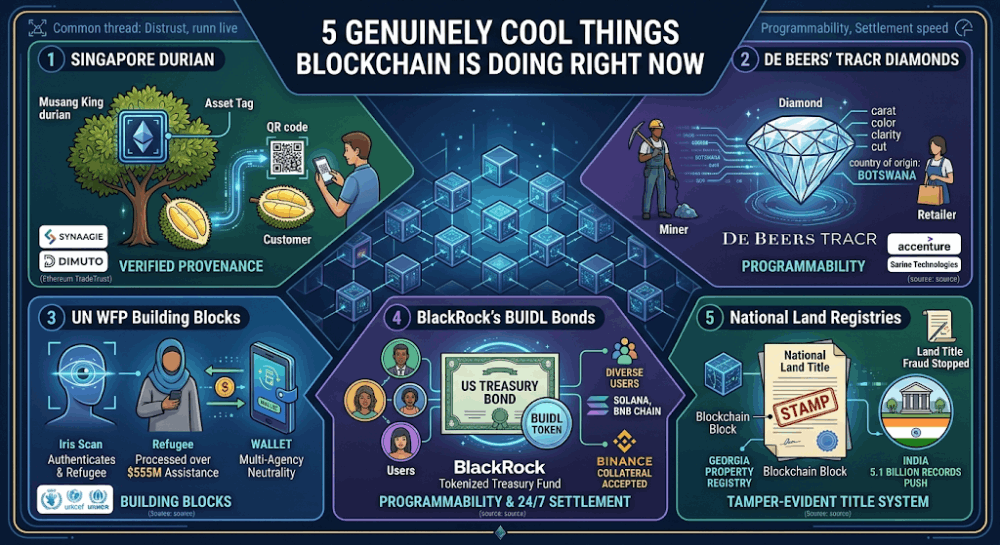
Durian is a serious business in Southeast Asia, premium varieties like Musang King and Black Thorn can command steep prices, which naturally invites fraud. In July 2026, Singapore-based e-commerce firm Synagie launched AGONG Durian, a brand built entirely around blockchain-verified provenance. Every durian tree is assigned a unique digital identity, recording its variety and orchard of origin; buyers scan a QR code on the packaging to see exactly which farm their fruit came from, verified against tamper-resistant blockchain records (The Star, 2026).
This builds on groundwork laid by DiMuto, a Singaporean agri-tech startup that's been digitizing fruit into traceable assets since 2019, recording transaction data on Ethereum through Singapore's TradeTrust trade portal. DiMuto has tracked roughly four million durians for Thailand's largest durian exporter alone, and separately partnered with Havenport to extend trade financing to growers based on that traceability data (Startup Fortune, 2026) (AgFunderNews).
Why it's a good fit: food fraud is a real, expensive problem, and no single party in the supply chain (grower, exporter, distributor, retailer) is fully trusted by all the others. A shared, tamper-evident record genuinely helps here, rather than just sounding impressive on a press release.
Giving 3+ million diamonds a birth certificate (De Beers' Tracr)
Diamonds have long been authenticated with paper certificates that describe a stone's characteristics but rarely its full journey. De Beers, in partnership with Accenture, built Tracr — a blockchain platform that assigns each diamond a unique digital identity at the point it's mined, recording carat, colour, clarity, and cut, then tracking it as it moves from rough stone to polished, retail-ready gem.
As of 2025, the platform hosts over 3 million registered diamonds, with all diamonds over one carat now traceable to a single country of origin (De Beers Group). In 2025, Tracr also struck a partnership with diamond-scanning company Sarine Technologies to algorithmically match diamonds against their registered records at scale (GJEPC, 2025), and Botswana's state-owned Okavango Diamond Company joined the platform in 2025 to strengthen the ethical provenance of its national diamond exports (Mining Indaba, 2025).
Why it's a good fit: conflict diamonds and mislabeled origins are a genuine, long-standing industry problem, and the parties involved (miners, cutters, retailers, regulators, consumers) span multiple countries and interests, none of which trust each other's paperwork by default.
Delivering aid to over a million refugees (UN World Food Programme)
Since 2017, the UN World Food Programme has used a blockchain platform called Building Blocks to deliver food and cash assistance directly to refugees in Jordan and Bangladesh. Refugees authenticate with an iris scan linked to a blockchain-based account, then pay for groceries without cash, cards, or a bank account. To date, the platform has processed over US$555 million in assistance across 25 million transactions, saving an estimated US$3.5 million in bank fees (WFP).
The system runs on a private, permissioned blockchain, and its "neutrality" is actually the point: all participating humanitarian agencies are equal owners of the platform, with no single organization controlling it (UN Innovation Network, 2026). It's since expanded to emergency responses in Ukraine, Lebanon, and Syria, and other UN agencies, including UNHCR and UNICEF, have adopted similar blockchain-based wallet systems for their own aid delivery (LSE International Development, 2025).
Why it's a good fit: in a conflict zone, local banks may be unreliable, non-existent, or actively distrusted, and multiple aid agencies need to coordinate without duplicating support to the same person. A shared ledger neatly solves both problems at once.
Turning US Treasury bonds into something you can trade at 2am (BlackRock's BUIDL)
In March 2024, BlackRock, the world's largest asset manager, launched BUIDL, a tokenized money market fund holding short-term US Treasuries, issued on-chain via Securitize. Unlike a normal fund share, a BUIDL token settles almost instantly instead of the standard one-to-two-day wait, can be traded 24/7, and can be used directly as collateral in decentralized finance protocols, something physically impossible with a traditional brokerage-held fund share (CryptoBriefing, 2026).
The fund has grown to roughly $2.5 billion in assets, expanded beyond its original blockchain to also run on BNB Chain and Solana, and in November 2025 was listed as accepted collateral for institutional trading on Binance, the world's largest crypto exchange (CoinDesk, 2025). More broadly, the tokenized real-world asset market has grown past $30 billion, with Boston Consulting Group and Ripple projecting it could reach $18.9 trillion by 2033 (CoinDesk, 2026).
Why it's a good fit: this one's a little different from the others, it's less about eliminating a distrusted middleman and more about programmability and settlement speed. Once an asset lives on a blockchain, it can be moved, split, and used as collateral instantly, around the clock, across platforms that were never designed to talk to each other, something traditional finance's batch-settled, business-hours infrastructure simply can't do.
Making it harder to steal someone's house (national land registries)
Land title fraud (forged documents, duplicate sales, lost paper records) is a serious problem in many countries, and it disproportionately harms people without the resources to fight a legal battle over a house they thought they owned. Several governments have turned to blockchain to fix this at the source.
Georgia partnered with the Bitfury Group to build a blockchain-based property titling system, which has processed over 1.3 million property registrations and is often cited as one of the earliest genuine government blockchain success stories (DataIntelo, 2026). Dubai's Land Department, working with Propy, issued its first property token ownership certificate in 2025, laying groundwork for fractional property ownership recorded on-chain (FIBREE, 2025). India's blockchain land registry push, targeting an eventual 5.1 billion property records, is described as the largest government blockchain implementation in the world by scale (DataIntelo, 2026).
Why it's a good fit: land title records are exactly the kind of thing that benefits from being tamper-evident and independently verifiable, the entire value of a title system comes from everyone trusting it hasn't been secretly altered, which is precisely the property blockchain was built to guarantee.
The common thread
None of these examples are blockchain for the sake of blockchain. Each one involves either genuine mutual distrust between multiple real-world parties (fraud-prone supply chains, conflict zones, land disputes), or a genuine technical need for programmability and round-the-clock settlement that older financial infrastructure can't offer. That's usually the tell for whether a blockchain application is solving a real problem or just riding the hype.
Sources
- The Star — "Mao Shan Wang or not? Blockchain-tagging lets Singapore customers check durian origins" (2026)
- Startup Fortune — "Singapore's AGONG Durian Uses Blockchain to Prove Every Fruit Is Genuine" (2026)
- AgFunderNews — "Singapore offers $9m boost to blockchain projects, starting with farmer finance"
- De Beers Group — "Tracr: Diamond Traceability Platform"
- GJEPC — "De Beers' Tracr & Sarine Technologies Join Hands for Diamond Traceability Solution" (2025)
- Mining Indaba — "Okavango Diamond Company boosts traceability with Tracr blockchain integration" (2025)
- World Food Programme — "Building Blocks"
- UN Innovation Network — "How the Building Blocks blockchain network is transforming humanitarian aid" (2026)
- LSE International Development — "How Blockchain is Contributing to the Humanitarian Sector as of 2025"
- CryptoBriefing — "BlackRock deepens tokenization push with new onchain fund offerings" (2026)
- CoinDesk — "BlackRock's Tokenized Fund Gets Listed as Collateral on Binance, Launches on BNB Chain" (2025)
- DataIntelo — "Blockchain for Land Registry and Asset Tracking Market Research Report 2033" (2026)
- FIBREE — "Blockchain and the Future of Land Title Registries: Global Innovations in Property Ownership" (2025)