Why Community Is the Real Moat in Web3
Why Community Is the Real Moat in Web3
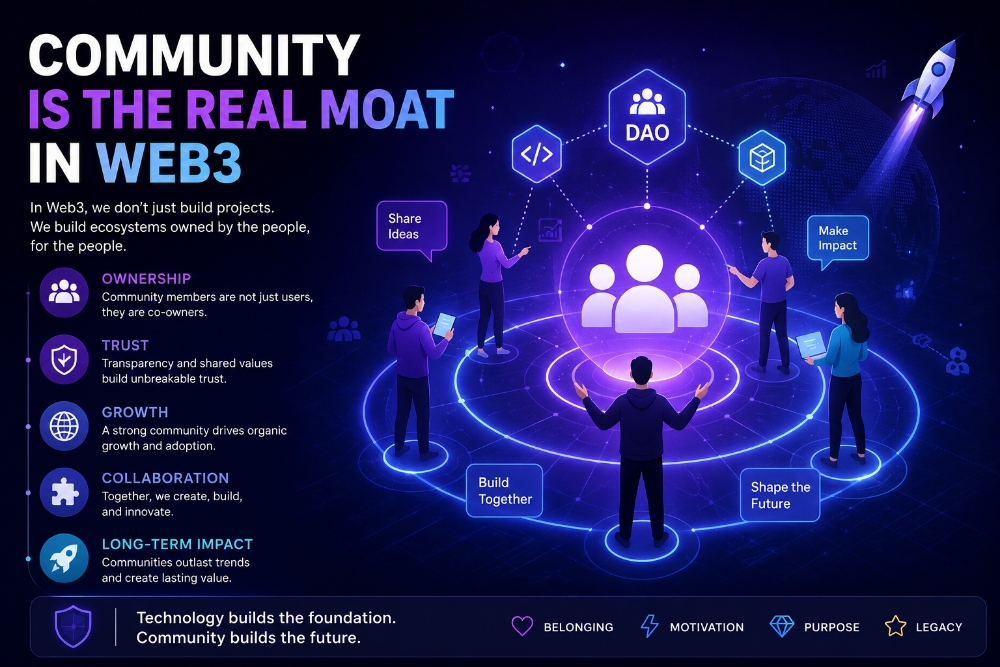
When people talk about successful Web3 projects, the conversation often revolves around technology, tokenomics, funding, or partnerships. While these factors are important, they are not what ultimately determines whether a project survives and thrives.
The strongest advantage in Web3 is not the code. It is not the treasury. It is not even the product.
It is the community.
The Shift From Users to Owners
In traditional Web2 platforms, users consume products while companies capture most of the value. Social media platforms, gaming companies, and marketplaces build massive ecosystems, but the people contributing their time and attention rarely have a stake in the success of the platform.
Web3 changes this dynamic.
Through tokens, governance systems, rewards programs, and decentralized participation, community members can become stakeholders. They are no longer just users; they are contributors, promoters, builders, and owners.
This alignment creates a powerful network effect. When people have a genuine stake in a project's success, they become far more invested in helping it grow.
Why Technology Alone Is Not Enough
History has shown that superior technology does not always win.
Many projects launch with impressive whitepapers, innovative features, and highly skilled development teams. Yet countless promising protocols disappear within months because they fail to build an engaged community.
A project without a community is like a city without residents. The infrastructure may be impressive, but there is nobody there to bring it to life.
Meanwhile, projects with passionate communities often survive market downturns, bear markets, and periods of uncertainty because their supporters continue building, creating content, onboarding newcomers, and spreading awareness.
What Makes a Strong Web3 Community?
A strong community is more than a large follower count on social media.
True communities are built on participation.
Members actively contribute ideas, create educational content, provide feedback, organize events, welcome newcomers, and help solve problems. They feel connected to a shared mission rather than simply chasing rewards.
The best Web3 communities share several characteristics:
Clear vision and purpose
Active communication
Opportunities for contribution
Transparency from leadership
Recognition for community efforts
A culture of collaboration
When these elements come together, a community becomes an ecosystem rather than an audience.
The Rise of Community-Led Growth
One of the most fascinating aspects of Web3 is how communities often become a project's most effective marketing team.
Community members create memes, write articles, host spaces, design graphics, produce videos, and educate others about the project. Unlike traditional advertising, this content is driven by genuine enthusiasm and belief.
This form of organic growth can be incredibly powerful because people trust recommendations from peers more than they trust advertisements.
A motivated community can achieve what millions of dollars in marketing spend cannot.
Building During Bear Markets
Bull markets attract attention. Bear markets reveal conviction.
During periods of market decline, speculative participants often leave. What remains are the builders, believers, and long-term supporters.
Projects that continue engaging their communities during difficult times often emerge stronger when market conditions improve. The relationships formed during challenging periods create loyalty that cannot be purchased.
This is why many successful Web3 founders focus less on short-term price action and more on creating lasting value for their communities.
The Future of Web3 Communities
As the industry matures, communities will likely play an even greater role in governance, innovation, and growth.
The next generation of Web3 projects may not be defined by the size of their funding rounds but by the strength of their communities. The projects that empower people to participate meaningfully will have a significant advantage over those that treat community members as passive users.
In a decentralized world, value is created collectively.
Conclusion
Technology can be copied. Features can be replicated. Capital can be raised.
But a passionate, engaged, and mission-driven community is far harder to recreate.
That is why community remains the real moat in Web3.
The projects that understand this are not simply building product