Mimic & Augment: Building a Verifiable AI Organism — Inside the NEUROVATIC Ecosystem

Artificial intelligence and blockchain have evolved along two largely independent paths. AI has focused on generating predictions, insights, and automation, while blockchain has focused on trust, consensus, and immutable records. Although these technologies are increasingly combined, they often remain loosely connected through APIs or middleware rather than being designed as a unified architecture.
NEUROVATIC was built from a different perspective. Instead of asking how artificial intelligence could be connected to blockchain, we asked a more fundamental question:
What if intelligence, verification, governance, and infrastructure were designed together as a single living system?
This question became the foundation of the NEUROVATIC ecosystem and ultimately led to the philosophy we call Mimic & Augment.
Rather than replicating isolated software components, the objective is to study one of the most adaptive and resilient information-processing systems known today — the human brain — and translate its architectural principles into a sovereign, verifiable AI infrastructure. The goal is not to imitate biology, but to learn from it and extend its concepts through mathematics, distributed computing, cryptography, and artificial intelligence.
Within this architecture, intelligence is not treated as a single model. It is a coordinated ecosystem of specialized cognitive systems operating over a decentralized infrastructure where every decision can be validated, every reasoning process can be audited, and every governance action can be cryptographically verified.
Mimic & Augment: Learning from Nature, Engineering Beyond It
Nature has spent millions of years optimizing distributed intelligence.
The human brain consists of billions of interconnected neurons, each performing relatively simple operations while collectively producing language, reasoning, creativity, memory, and adaptation. Its strength does not come from any single neuron but from the interactions between specialized regions working together.
This observation inspired one of NEUROVATIC’s core architectural principles:
Mimic what has already proven effective. Augment it with technologies that extend beyond biological limitations.
Rather than viewing artificial intelligence as a single monolithic model, NEUROVATIC adopts a modular cognitive architecture where different systems specialize in distinct responsibilities while continuously exchanging validated information.
This approach provides several architectural advantages:
- Specialization instead of monolithic intelligence.
- Independent evolution of individual components.
- Greater explainability through modular reasoning.
- Improved resilience by eliminating single points of cognitive failure.
- Continuous scalability as new capabilities are introduced.
The result is an ecosystem that can evolve organically over time without requiring complete redesigns whenever new models or technologies emerge.
The Architecture at a Glance
The NEUROVATIC ecosystem is organized around four complementary pillars.
Together these systems create a closed intelligence loop where reasoning, interpretation, execution, governance, and verification reinforce one another instead of operating independently.
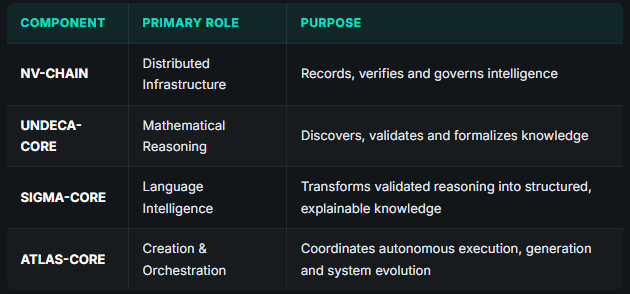
One distributed infrastructure. Multiple specialized intelligences. One continuously evolving cognitive ecosystem.
A Different Perspective on Decentralization
Traditional blockchain networks primarily view nodes as infrastructure components responsible for storing ledgers, validating transactions, and maintaining network availability.
NEUROVATIC extends this concept by assigning computational responsibilities that contribute to the broader intelligence architecture of the ecosystem.
Conceptually, each node represents an active participant within a distributed cognitive network.
- Governance Nodes contribute to protocol evolution and decentralized decision-making.
- Validator Nodes participate in consensus while verifying intelligence-related attestations.
- Helper Nodes expand available computational capacity for specialized workloads.
- Seed Nodes strengthen network connectivity and support ecosystem expansion.
As additional nodes join the ecosystem, the platform increases not only its resilience and computational capacity but also its ability to distribute verification, governance, and specialized reasoning across a broader decentralized infrastructure.
The network therefore scales in capability as well as availability.
UNDECA-CORE: The Mathematical Intelligence Layer
At the center of the NEUROVATIC ecosystem is UNDECA-CORE (Unified Neural Decision and Cognitive Architecture), the platform’s sovereign mathematical reasoning engine.
Unlike conventional AI systems that primarily optimize statistical prediction, UNDECA-CORE is designed to explore mathematical relationships, generate structured hypotheses, evaluate their validity, and continuously refine its internal understanding through iterative validation.
The objective is not simply to predict outcomes, but to discover reproducible mathematical structures that remain useful across multiple domains.
This distinction is fundamental.
Many AI systems answer questions by identifying statistical similarities within training data. UNDECA-CORE instead attempts to identify formal relationships that can be tested, challenged, and improved over time using structured validation pipelines.
The Eleven-Module Cognitive Pipeline
Rather than relying on a single reasoning engine, UNDECA-CORE is organized as an eleven-stage cognitive pipeline where each module performs a specialized function before passing structured information to the next layer.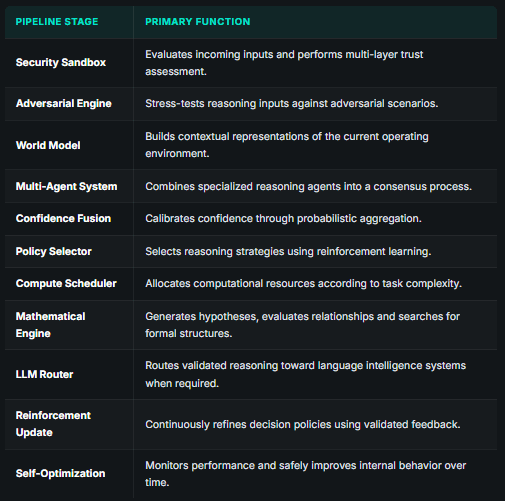
From Statistical Prediction to Mathematical Discovery
UNDECA-CORE follows a reasoning workflow inspired by the scientific method.
Rather than assuming every learned relationship is correct, the system continuously evaluates competing hypotheses, challenges them under varying conditions, and promotes only the strongest candidates for future reasoning cycles.
Its high-level reasoning process can be summarized as:
- Generate mathematical hypotheses from observed data.
- Evaluate competing explanations using structured validation.
- Stress-test candidate relationships across multiple scenarios.
- Estimate credibility using probabilistic confidence metrics.
- Retain validated mathematical structures for future reasoning.
This process allows knowledge to evolve continuously instead of remaining fixed after training.
Rather than treating intelligence as static model weights, NEUROVATIC treats validated mathematical knowledge as an asset that can mature, adapt, and improve through ongoing evidence.
Within NEUROVATIC, mathematical reasoning serves as the foundation upon which language intelligence, governance, and decentralized verification are built.
SIGMA-CORE: Transforming Mathematical Reasoning into Explainable Intelligence
Mathematical reasoning alone is not sufficient for most real-world applications. While mathematical models can identify patterns, relationships, and validated structures, organizations ultimately need decisions and explanations that humans can understand, review, and act upon.
This is the role of SIGMA-CORE, NEUROVATIC’s sovereign language intelligence layer.
SIGMA-CORE is responsible for transforming structured mathematical reasoning into contextual, domain-specific intelligence while maintaining explainability, traceability, and operational transparency. Rather than replacing mathematical reasoning, it complements it by providing an interpretable interface between formal computation and human decision-making.
Within the broader ecosystem, SIGMA-CORE operates entirely on sovereign infrastructure, allowing organizations to retain full control over deployment, governance, and data residency.
Rather than operating as an isolated chatbot, SIGMA-CORE functions as the ecosystem’s communication layer — bridging mathematical reasoning, domain expertise, and operational decision-making.
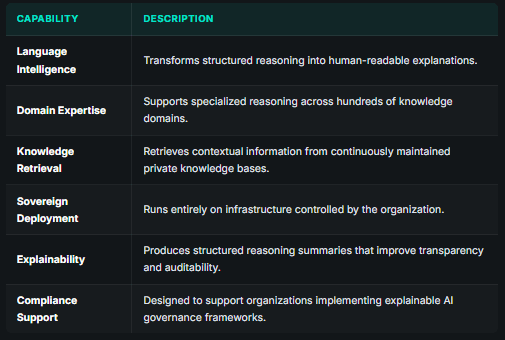
Structured Reasoning Instead of Black-Box Responses
Many modern language models generate fluent responses but provide limited visibility into how conclusions are reached.
NEUROVATIC follows a different architectural philosophy.
Instead of treating reasoning as an opaque process, SIGMA-CORE is designed to generate structured reasoning summaries that improve explainability while remaining compatible with enterprise governance and audit requirements.
Each reasoning cycle typically follows a structured workflow:
- Receive validated mathematical context from UNDECA-CORE.
- Retrieve relevant domain-specific knowledge.
- Combine formal reasoning with contextual expertise.
- Generate a structured explanation appropriate for the intended audience.
- Produce verifiable outputs that can be reviewed alongside supporting metadata.
This separation between mathematical reasoning and language intelligence creates a clear distinction between discovering knowledge and communicating knowledge.
A Continuously Evolving Knowledge Layer
SIGMA-CORE extends its reasoning capabilities through retrieval-augmented knowledge rather than relying exclusively on model parameters.
Instead of treating training as a one-time event, the architecture supports continuously updated knowledge repositories containing technical documentation, scientific publications, regulatory frameworks, blockchain data, engineering references, and other structured information sources.
This allows domain knowledge to evolve independently of the underlying language model while reducing the need for repeated large-scale retraining.
Representative knowledge areas include:
- Artificial Intelligence and Machine Learning
- Mathematics and Formal Verification
- Blockchain Infrastructure
- Cryptography and Distributed Systems
- Financial Markets and Quantitative Research
- Scientific Literature
- Engineering Disciplines
- Regulatory and Compliance Frameworks
By separating reasoning from knowledge retrieval, the platform can continuously expand its expertise while maintaining a stable reasoning architecture.
ATLAS-CORE: Autonomous Creation and Orchestration
If UNDECA-CORE represents mathematical reasoning and SIGMA-CORE represents language intelligence, ATLAS-CORE serves as the ecosystem’s autonomous creation and orchestration layer.
Within NEUROVATIC, this role is internally referred to as The Creator because its primary responsibility is assembling validated knowledge, computational tools, and specialized intelligence into new capabilities.
Rather than focusing on a single domain, ATLAS coordinates complex workflows that may involve multiple reasoning systems operating together.
Its responsibilities include:
- Complex task decomposition.
- Autonomous workflow orchestration.
- Software generation and engineering assistance.
- Cross-domain reasoning coordination.
- Multi-agent execution.
- Infrastructure automation.
- System evolution and optimization.
By operating above individual reasoning engines, ATLAS enables the ecosystem to coordinate specialized intelligence toward larger objectives instead of treating each model as an isolated component.
NV-CHAIN: The Distributed Infrastructure Layer
Every intelligent system requires an infrastructure capable of preserving integrity, coordinating participants, and maintaining trust.
Within NEUROVATIC, this responsibility belongs to NV-CHAIN, an EVM-compatible blockchain designed to provide decentralized governance, immutable records, and verifiable infrastructure for AI-native applications.
Rather than viewing blockchain solely as a financial settlement layer, NEUROVATIC treats distributed infrastructure as the operational body through which intelligence interacts with the outside world.
NV-CHAIN provides:
- Immutable audit records.
- Decentralized governance.
- Validator coordination.
- Smart contract execution.
- Identity management.
- Infrastructure interoperability.
- Long-term evidence preservation.
Every validated event can be anchored to decentralized infrastructure, allowing organizations to preserve evidence, governance actions, and operational history within a transparent verification framework.
Neural Proof-of-Intelligence (NPoI)
The consensus architecture of NV-CHAIN introduces an additional concept known as Neural Proof-of-Intelligence (NPoI).
Traditional blockchain consensus mechanisms primarily demonstrate computational work or economic stake.
NPoI explores an alternative direction by incorporating verifiable AI computation into the broader validation process.
Rather than treating intelligence and blockchain as separate technologies connected through external interfaces, NEUROVATIC integrates reasoning and decentralized verification into a unified architecture.
At a conceptual level, the validation flow follows these stages:
- Reasoning systems produce structured outputs.
- Results pass through multiple validation layers.
- Cryptographic attestations are generated.
- Evidence is anchored on-chain.
- Governance participants verify and preserve the resulting records.
The objective is not simply to record outcomes, but to preserve evidence supporting how those outcomes were produced.
Within NEUROVATIC, blockchain records more than transactions — it preserves verifiable evidence of intelligence, governance, and computational decision-making.
An Ecosystem Designed for Collaboration
Although each component has a distinct responsibility, the architecture is designed around collaboration rather than independence.
UNDECA-CORE develops mathematical understanding.
SIGMA-CORE transforms that understanding into contextual intelligence.
ATLAS-CORE coordinates autonomous execution.
NV-CHAIN provides decentralized verification, governance, and infrastructure.
Together they form an integrated ecosystem where specialized intelligence systems continuously reinforce one another while remaining independently auditable and capable of evolving over time.
Reasoning. Understanding. Creation. Verification. Four complementary layers working together as a single sovereign AI ecosystem.
Security, Governance and the Road Ahead
Building an intelligent system is only one part of the challenge. Building one that can be trusted, audited, governed, and continuously improved is what transforms artificial intelligence into critical infrastructure.
The Mimic & Augment philosophy extends beyond reasoning and communication. It also defines how intelligence is secured, how decisions become accountable, and how an ecosystem evolves without sacrificing transparency or human oversight.
Within NEUROVATIC, these responsibilities are coordinated through AEGIS, PNoI, NAGRA, and the broader governance architecture surrounding the ecosystem.
AEGIS: Protecting the Cognitive Pipeline
Every intelligent system is exposed to risks long before it generates an answer.
Malicious prompts, adversarial inputs, manipulated datasets, poisoned knowledge sources, unauthorized model updates, or compromised infrastructure can all influence the quality of reasoning.
AEGIS exists to reduce these risks.
Rather than functioning as a traditional cybersecurity product, AEGIS represents a multi-layer security architecture that continuously evaluates both incoming information and internal system behavior.
Its objectives include:
- Detecting prompt injection and adversarial manipulation attempts
- Validating integrity across datasets and knowledge sources
- Monitoring infrastructure health and execution integrity
- Supporting policy enforcement before critical decisions are accepted
- Providing security telemetry for governance and auditing systems
Instead of assuming every request is trustworthy, AEGIS continuously evaluates confidence, integrity, and operational risk throughout the cognitive pipeline.
This enables intelligence to remain resilient even under uncertain or hostile operating conditions.
PNoI: Verifying Intelligence Before Trust
One of NEUROVATIC’s foundational ideas is that intelligence should not automatically be trusted simply because it is generated by an AI model.
Every significant reasoning process should be capable of producing evidence.
This philosophy is represented by Proof of Neural Intelligence (PNoI).
PNoI introduces a verification layer where reasoning outputs can be evaluated, validated, and prepared for cryptographic attestation before entering decentralized consensus workflows.
Rather than asking:
“Did the AI produce an answer?”
PNoI asks:
“Can this reasoning process be independently verified according to defined rules?”
This distinction moves AI away from opaque prediction systems toward verifiable computational processes.
The goal is not to claim absolute correctness.
The goal is to make reasoning observable, reproducible where applicable, and suitable for structured validation.
NAGRA: Coordinating Autonomous Intelligence
Modern AI increasingly depends on multiple specialized agents instead of a single monolithic model.
Within the NEUROVATIC ecosystem, autonomous coordination is handled by NAGRA (Neural Agent Governance & Resource Architecture).
Rather than replacing intelligence, NAGRA organizes it.
Responsibilities include:
- Agent orchestration
- Task delegation
- Priority scheduling
- Resource optimization
- Conflict resolution between specialized agents
- Operational governance across distributed cognitive services
As additional reasoning engines, verification systems, and domain experts are introduced, NAGRA provides the organizational layer that allows the ecosystem to scale without becoming chaotic.
It transforms independent AI components into a coordinated cognitive network.
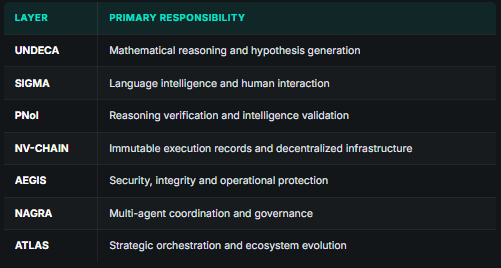
A Verifiable Intelligence Stack
Together, the major components of NEUROVATIC form a layered architecture in which every layer has a distinct responsibility.
Each component solves a different problem.
Together, they create an ecosystem designed around transparency, modularity, verification, and long-term maintainability.
Beyond Artificial Intelligence
Many AI platforms focus primarily on increasing model size.
NEUROVATIC focuses on increasing trust.
Instead of asking only:
“Can AI become more intelligent?”
the ecosystem also asks:
- Can its reasoning be explained?
- Can important decisions be independently verified?
- Can governance remain decentralized?
- Can organizations retain sovereignty over their own intelligence?
- Can AI evolve without sacrificing accountability?
These questions increasingly define the future requirements of enterprise AI, regulated industries, public infrastructure, and mission-critical autonomous systems.
The Future of Mimic & Augment
Mimic & Augment is not a finished product.
It is an architectural direction.
As additional cognitive modules, verification frameworks, governance mechanisms, and decentralized services are developed, they become extensions of the same philosophy:
observe, understand, verify, and augment.
The objective is not to imitate human intelligence for its own sake.
The objective is to build systems that extend human capability while remaining transparent, accountable, and under sovereign control.
This philosophy shapes every major component within the NEUROVATIC ecosystem — from mathematical reasoning and language intelligence to governance, verification, and decentralized infrastructure.
For a deeper technical exploration of the complete ecosystem, including UNDECA, SIGMA, NV-CHAIN, PNoI, AEGIS, NAGRA and the Mimic & Augment architecture, visit the NEUROVATIC Whitepaper.