Swing Trading vs Scalping: Which Crypto Strategy Fits You?

Not every crypto trader approaches the market in the same way.
Some traders prefer to hold a position for several days or even weeks, waiting for a larger market move. Others open and close positions within minutes, attempting to capture small price fluctuations throughout the day.
These approaches are commonly known as swing trading and scalping.
Neither strategy is automatically better than the other. They simply require different levels of time commitment, risk tolerance, discipline, and market awareness.
Understanding the difference can help you choose a crypto trading strategy that actually fits the way you think and operate.
What Is Crypto Swing Trading?
Crypto swing trading focuses on capturing larger price movements over a period ranging from several days to several weeks.
Instead of reacting to every small fluctuation, swing traders try to identify broader trends and meaningful market setups.
A swing trader might look for:
- Breakouts from established ranges
- Trend reversals
- Support and resistance levels
- Changes in trading volume
- Market structure shifts
- Strong market narratives
The objective is to enter a position when a favorable setup develops and hold it long enough to capture a significant portion of the move.
Why Traders Choose Swing Trading
Swing trading can be attractive for people who don't want to monitor charts constantly.
You may spend time researching and analyzing a setup, enter the position, and then monitor it periodically rather than watching every candle.
However, holding positions overnight introduces additional exposure to news, market gaps, and sudden volatility.
What Is Crypto Scalping?
Crypto scalping takes the opposite approach.
Scalpers attempt to capture very small price movements by entering and exiting positions quickly.
A single trade might last only a few minutes.
Instead of looking for one large move, scalpers may execute multiple trades during a trading session.
They typically pay close attention to:
- Short-term price action
- Order books
- Trading volume
- Liquidity
- Spread
- Momentum
- Exchange activity
Because individual profits can be relatively small, execution and consistency become extremely important.
Swing Trading vs Scalping at a Glance
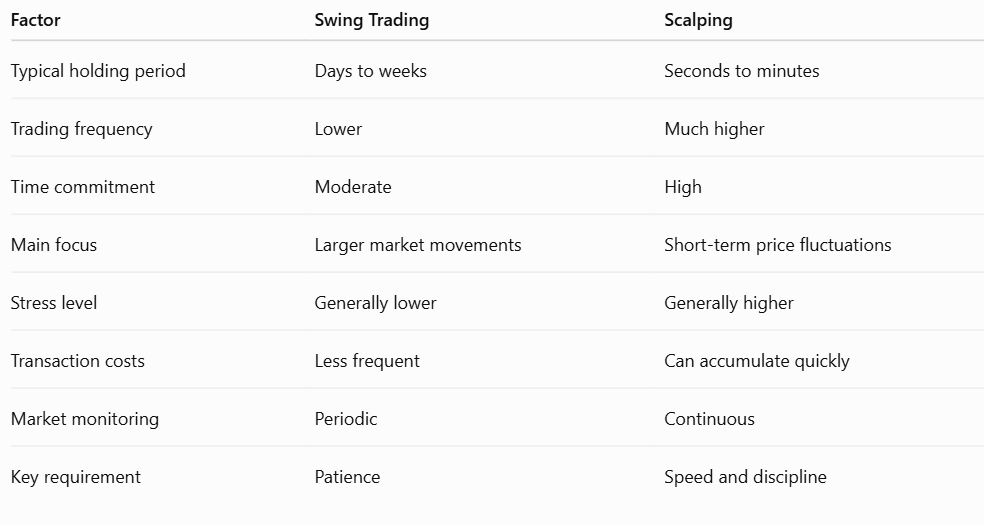
The difference isn't simply about how long you hold a position.
It changes almost every part of the trading process.
Which Strategy Requires More Time?
This is one of the biggest questions to ask before choosing between the two.
Swing trading usually requires less screen time. Research can be done before entering a trade, followed by periodic monitoring.
Scalping is much more demanding.
A scalper needs to monitor market movements continuously because opportunities can appear and disappear within minutes.
If you have a full-time job or limited availability, scalping may be difficult to maintain consistently.
Swing trading may provide more flexibility.
Risk Looks Different in Each Strategy
Both approaches carry risk, but the risks appear in different ways.
A swing trader may face:
- Overnight volatility
- Unexpected news
- Market reversals
- Larger price fluctuations
A scalper may face:
- Frequent small losses
- Trading fees
- Slippage
- Execution delays
- Emotional fatigue
- Overtrading
Neither strategy eliminates risk.
The important question is whether you have a risk management system that matches your chosen approach.
Why Liquidity Matters More for Scalpers
Liquidity is important for every trader, but it becomes particularly important when you're scalping.
If an asset has low liquidity, entering and exiting quickly can become expensive because of:
- Wider spreads
- Slippage
- Limited order-book depth
This is why experienced scalpers often focus heavily on crypto exchange trading data.
They want to know whether enough buyers and sellers are available to execute positions efficiently.
For swing traders, liquidity still matters, but the impact of a small spread may be less significant because they aren't executing as frequently.
Market Intelligence Can Help Both Strategies
Swing traders and scalpers may use different timeframes, but both benefit from understanding market context.
Crypto trading intelligence can help traders monitor information such as:
- Market sentiment
- Exchange activity
- Liquidity changes
- On-chain movements
- Whale activity
- Trading volume
- Derivatives data
- Breaking market events
For a swing trader, these insights can help determine whether a developing trend has enough momentum to last.
For a scalper, real-time information can help identify short-term changes in market conditions.
The timeframe changes, but the need for good information doesn't.
Where AI-Powered Crypto Trading Fits In
The amount of data available to traders has increased dramatically.
Monitoring multiple exchanges, market trends, news sources, blockchain activity, and sentiment manually can be difficult.
This is where AI-powered crypto trading tools can become useful.
AI can help process large amounts of information and highlight:
- Unusual market activity
- Emerging trends
- Changes in sentiment
- Volume anomalies
- Liquidity shifts
- Potential market opportunities
For swing traders, this can simplify research.
For scalpers, faster access to relevant information can support real-time decision-making.
However, AI should be treated as a decision-support tool rather than a guarantee of profitable trades.
Which Strategy Is Better for Beginners?
For many beginners, swing trading may be easier to understand.
The slower timeframe gives traders more time to:
- Research an asset
- Analyze the market
- Define risk
- Plan entries
- Evaluate exits
Scalping requires much faster decision-making and greater familiarity with market mechanics.
A beginner who is still learning how exchanges, order books, fees, and liquidity work may find rapid-fire trading unnecessarily difficult.
That doesn't mean beginners cannot learn scalping. It simply means the learning curve can be steeper.
Your Personality Matters Too
Trading strategy isn't only about charts.
It's also about personality.
Swing trading may suit you if you:
- Prefer patience
- Don't want to watch charts all day
- Like analyzing broader trends
- Are comfortable holding positions
Scalping may suit you if you:
- Enjoy fast decision-making
- Can concentrate for long periods
- Prefer short-term positions
- Are comfortable executing multiple trades
Knowing how you naturally respond to pressure is just as important as understanding technical analysis.
Don't Choose a Strategy Based on Profit Claims
One of the biggest mistakes new traders make is choosing a strategy because someone online claims it produces faster or larger profits.
There is no strategy that guarantees consistent returns.
Scalping doesn't automatically produce more money because it involves more trades.
Swing trading doesn't automatically produce better results because positions are larger.
Your results depend on factors such as:
- Strategy quality
- Risk management
- Market conditions
- Execution
- Discipline
- Trading costs
Choose a strategy based on whether you can execute it consistently, not on how profitable someone says it can be.
A Practical Way to Choose
If you're unsure which approach fits you, start by asking four questions.
How much time can you dedicate?
If you can only check the market occasionally, swing trading may be more practical.
If you can dedicate several hours to focused market monitoring, scalping becomes more realistic.
How do you handle pressure?
If rapid decisions make you uncomfortable, slower trading may be a better fit.
How much trading experience do you have?
Beginners may benefit from learning market fundamentals before attempting very short-term strategies.
What markets are you trading?
Liquidity, volatility, and trading volume can influence which strategy is practical for a particular cryptocurrency.
You Don't Have to Choose One Forever
Your trading style can evolve.
A trader might start with swing trading to understand market structure and gradually explore shorter timeframes as their experience develops.
Others may discover that they prefer slower strategies permanently.
The important thing is to test a strategy, measure your results, and adjust based on evidence rather than constantly switching because of short-term outcomes.
Final Thoughts
Swing trading vs scalping isn't really a question of which strategy is universally better.
It's about which approach fits your time, personality, experience, risk tolerance, and ability to remain disciplined.
Swing trading gives traders more time to analyze broader market movements, while scalping focuses on rapid execution and smaller price fluctuations. Both can benefit from crypto market analysis, crypto trading intelligence, AI-powered crypto trading tools, and reliable exchange data.
Whatever strategy you choose, the foundation remains the same: understand the market, manage risk, follow a defined process, and avoid making decisions based solely on emotion.
The best crypto trading strategy isn't necessarily the fastest or most sophisticated one.
It's the one you can execute consistently.