A Crypto Casino Deposit Can Outlive Its Payment Quote

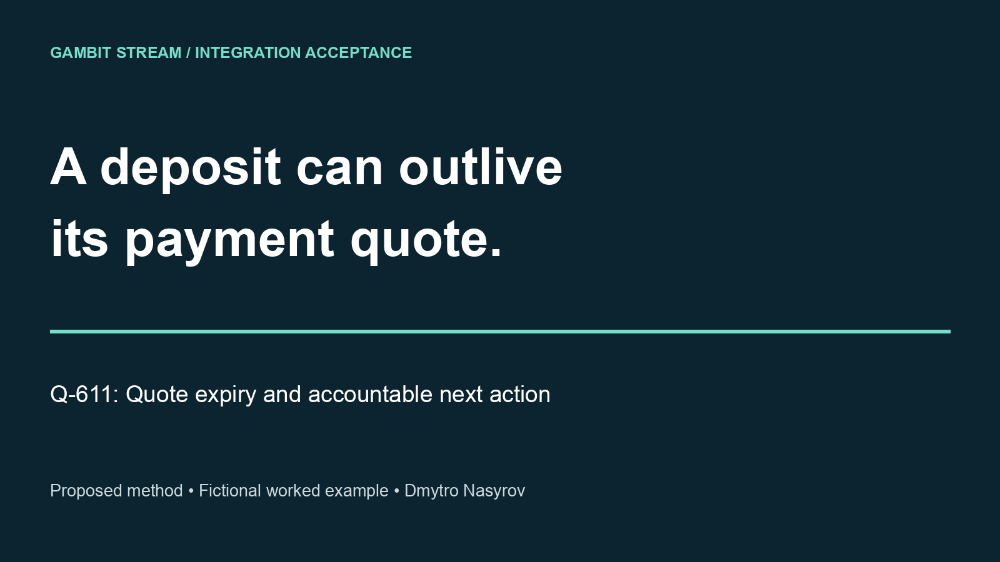
For a casino integration owner, quote expiry belongs in the acceptance scope before the cashier launches. The payment provider may identify an invoice as expired while still retaining a route for investigating funds associated with it. The operator needs a documented response to that situation. Silently applying the original exchange rate or silently discarding the deposit would each conceal a decision that someone must own.
This guide proposes Q-611, a quote-expiry review register, and walks through an invented operator example. It defines evidence and decision responsibilities. It does not execute a payment, set an exchange rate, authorize gambling credit or prescribe a legal refund policy. Every amount, timestamp and identifier in the example is fictional.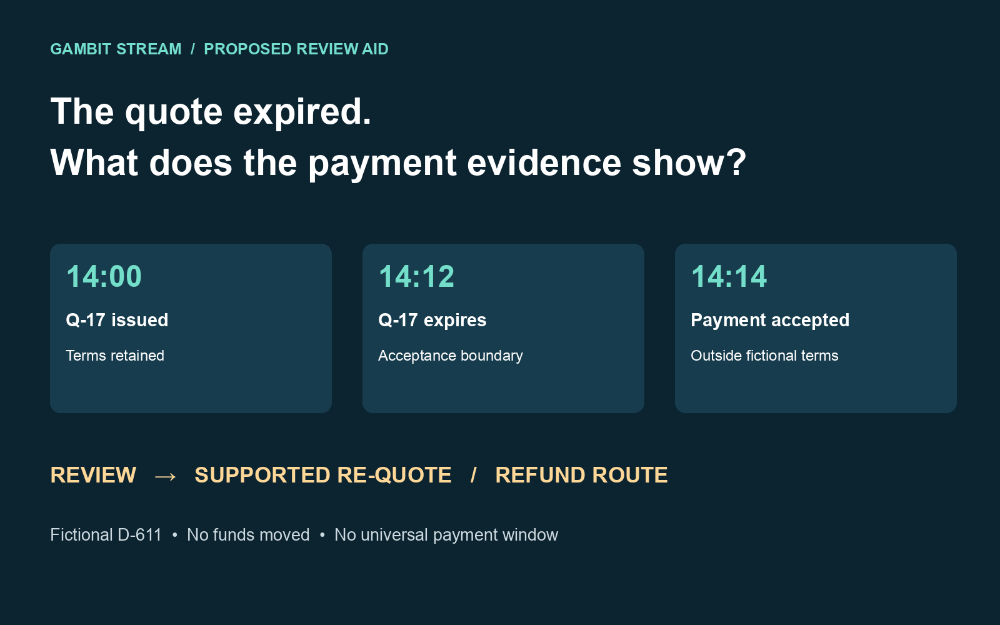
Keep quote expiry separate from confirmation time
A quote describes conversion terms for a defined interval and acceptance condition. A payment observation describes an event in a provider or network system. A wallet entry records an operator-side effect. These objects may refer to the same deposit, but their timestamps and authority differ. Keep their identifiers separate even when the user interface presents one progress bar.
First ask what the quote's deadline actually measures. It could concern a payment being broadcast, received by a provider or accepted against an invoice. Confirmation can be a later event. The integration contract must name the applicable event and its source. Without that definition, two teams can interpret the same late notification in incompatible ways while both believe they are following the timer.
An on-time payment whose confirmation arrives later should therefore be reviewed against its actual acceptance condition. A payment first received after that condition expires is a different case. Do not classify both as late merely because a webhook reached the operator after the displayed deadline. Delivery time is useful evidence about the integration, but it may not determine quote validity.
Use provider documentation within its actual scope
BitPay's support article on invoice expiry states: "Once expired, payments can no longer be accepted." The original explanation describes BitPay invoices, including its payment window and handling of payments submitted after expiry. That is a provider-specific rule, not a rule for every casino cashier or every cryptocurrency network.
The useful integration lesson is to retain the provider's documented expiry behavior with the exact product being purchased. A sales description saying that crypto payments are supported does not establish what happens to a late deposit. Ask which documentation, account configuration and contractual arrangement govern the proposed implementation. Record unresolved differences before approving the cashier's conversion policy.
For example, a provider may operate the invoice and refund workflow while the casino maintains its own player ledger. In another arrangement, responsibilities may be divided differently. Do not infer custody, refund authority or settlement guarantees from a callback field. Those responsibilities require their own evidence and agreements. The review register should identify the responsible party rather than assume that the integration developer controls the funds.
Retain the quote before it disappears from the screen
The player-facing timer is a presentation of terms. Keep a durable reference to the terms that the player actually received. At minimum, the proposed record identifies the quote version, requested asset and network, account currency, requested quantity, expiry instant and the event used to evaluate that expiry. Reference the relevant policy version alongside them.
Record rounding and fee treatment when those terms affect the displayed account amount. A quote for an asset quantity and a quote for a net credited amount are not interchangeable. If the provider deducts a fee or the account uses a different precision, the acceptance owner needs to know which value the cashier promised and which value the ledger is permitted to record. Use an explicit time convention. A date without a timezone cannot reliably describe a deadline shared by a browser, provider and operator. Retain original timestamps and their provenance rather than rewriting all evidence to one convenient-looking field. A normalized comparison value can help the reviewer, provided the original event time and the transformation rule remain available.
Identify the payment independently of the quote
Q-611 starts with a deposit reference that survives changes to the quote. It also retains the provider invoice or order reference and the relevant network transaction reference when available. The exact identity model depends on the integration. A transaction hash alone may not specify the intended transfer or account association in every payment system.
For token transfers, ask whether network, asset identity and transfer position are necessary to identify the observed payment. For another network, an output reference may be relevant. These are questions for the provider's actual evidence model. The register does not prescribe one universal blockchain key or assume that similarly named assets on different networks are interchangeable. Keep quote replacement as a new relationship, rather than editing the original payment record to make it appear timely. If an operator considers a new quote, the original deposit should still point to its original terms. A reviewer should be able to reconstruct why the replacement was considered and whether anyone had authority to use it for that already observed payment.
Introduce the proposed Q-611 register
Use one review row for one deposit and the specific quote decision under investigation. A separate event log can contain several observations for that row. This prevents repeated notifications from appearing to be several deposits and prevents one latest status from erasing the earlier sequence. The register is a review aid, not an automated payment processor.
The proposed fields are deposit reference; provider invoice reference; asset and network identity; original quote reference and version; original expiry and acceptance condition; observed payment events with evidence references; existing credit reference or explicit absence; proposed disposition; and decision owner with approval evidence. Extend the fields only where the purchased integration needs additional distinctions.
Keep an empty owner visibly unassigned. Keep an unknown credit state visibly unknown. A blank cell should not be read as no payment, no balance effect or no refund. The reviewer must distinguish an absent effect verified in the relevant system from a system that nobody checked. That distinction determines whether the next action is investigation or a permitted operational change.
Work through a fictional late observation
Imagine the invented operator Alderwick Play creates deposit D-611 with quote Q-17 at 14:00 UTC. Its fictional terms expire at 14:12 UTC and define the relevant event as provider acceptance against the invoice. The example requests 40 demonstration units of an invented asset, DEMO-C, for an account denominated in EUR. No real token or exchange rate is involved.
At 14:16 UTC, an observation associated with the deposit reaches the operator. Its evidence refers to provider acceptance at 14:14 UTC. On those invented facts, the acceptance event occurred outside Q-17's interval. The reviewer cannot restore Q-17 merely by subtracting callback delivery latency. The exception needs the provider's actual status and the operator's approved policy.
The fictional completed row reads: D-611; invoice I-72; DEMO-C on DEMO-NET; Q-17 version 1; expiry 14:12 UTC by provider acceptance; acceptance 14:14 UTC under evidence EV-611; operator credit not yet checked; disposition HOLD FOR REVIEW; owner Payments Operations pending named acceptance. This is an illustrative completed record, not the result of an executed lookup.
Compare the three possible review routes
A review route retains the payment identity and gathers enough evidence to determine what actions are available. It should specify who checks the provider, who checks the operator ledger and who communicates with the player. Holding the case for review does not establish that the funds are safely held in any particular account. State only the custody facts actually established.
A replacement-quote route requires explicit support from the provider arrangement and the operator's authorized policy. Document the new quote, the basis for the proposed amount, relevant fees and any required player acceptance. Do not implement replacement as an invisible update to the expired quote. The old terms and the new proposal should remain distinguishable during a dispute or later review.
A refund route needs an identified party with the authority and operational ability to carry it out. Record prerequisites, destination verification responsibilities and evidence of completion under the actual arrangement. A support note saying refund requested is not evidence that a transfer occurred. This article neither selects a route for a real customer nor authorizes a movement of funds.
| Route under review | Required evidence | Decision boundary | | --- | --- | --- | | Investigate | Original quote, provider observation and existing credit lookup | Owner establishes which permitted routes remain available | | Supported replacement quote | New terms, applicability approval and required acceptance | Original terms remain retained; no silent conversion change | | Refund route | Responsible party, prerequisites and completion evidence | Request and completed effect remain separate |
Resolve the amount before creating a credit
The proposed account credit should refer to the approved disposition and its evidence. Retain original asset quantity, approved conversion basis, account currency, rounding and applicable fees as separate concepts. If a field is unavailable, keep that limitation explicit. Reconstructing a plausible amount from today's displayed rate is not evidence of the terms applicable to the earlier deposit.
The operator also needs a way to determine whether a credit already exists. Search scope should follow the integration's actual deposit and wallet identity model. A reviewer who checks only the latest callback may overlook an earlier successful credit whose acknowledgement was lost. Conversely, seeing a payment in the provider dashboard does not establish that an operator ledger entry exists.
Separate the decision to credit from confirmation that the authorized effect occurred. Retain the accepted decision reference and the resulting ledger reference when the workflow supports them. If the result cannot be retrieved, record an unknown outcome and escalate under the operating procedure. Do not turn a second click into the default method for resolving uncertainty.
Preserve the event sequence when notifications repeat
A repeated notification should add evidence about the same deposit rather than create a fresh entitlement to credit. The integration needs a documented relationship between provider events, the deposit decision and any wallet effect. Exact identifiers and deduplication behavior require implementation-specific review. A generic instruction to make webhooks idempotent does not explain which operation must remain unique.
Capture event time, receipt time and source where those values are available. Two notifications arriving in reverse order can otherwise make a case appear to move backwards or become eligible again. Keep the provider's original status alongside the operator's interpreted state. A simplified internal state may help the cashier, but it should not destroy the evidence needed to investigate the interpretation.
If the provider corrects an earlier observation, link the correction to the superseded evidence and the resulting review decision. Do not rewrite the history to show that the revised understanding was always known. The financial and support owners need to distinguish a changed fact from a changed policy and from a delivery retry that contained no new information.
Write a player message that matches the evidence
The cashier message should explain what the operator actually knows about the deposit and what happens next. When the quote has expired and the payment is under review, a message promising the original account amount would pre-empt the unresolved decision. A message saying the transfer failed would also overstate the evidence if a provider observation shows funds associated with the invoice.
Prepare messages for the separate cases: no accepted payment observed within the interval; payment accepted within the interval but confirmation pending; payment observed outside the interval; and operator credit outcome unknown. The wording can differ by provider and operating policy. The important acceptance question is whether each message corresponds to a defined state and accountable next action.
Give support the same evidence reference used by payments operations. A player should not have to retell the event sequence because two teams use unrelated case identifiers. Avoid putting raw financial payloads, wallet secrets or unnecessary personal information into public templates or ordinary chat. The proposed register should contain controlled references to approved evidence locations.
Agree the acceptance cases before signing off
Start with a payment accepted just before the quote boundary and a notification delivered after it. The expected review should follow the defined acceptance event rather than callback arrival. Then consider a payment accepted just after the boundary. A supplier demonstration should show how the implementation distinguishes those cases and which policy controls each result.
Add missing and contradictory evidence cases. The provider may report a payment while the operator cannot determine whether a credit exists. Another case may contain an expired invoice together with a later correction. For each case, name the evidence that the supplier must present and the decision that remains with the operator. A screen recording alone may omit the necessary identity links.
Include partial quantities, repeated notifications and an unavailable provider lookup where those situations are relevant to the purchased service. Do not claim that every provider supports a particular recovery mechanism. These are proposed acceptance scenarios for a controlled environment. They have not been run here, and no universal confirmation threshold or production-readiness result is asserted.
Divide responsibility across the supplier boundary
The payment provider should explain the states and evidence it supplies. The integration supplier should explain how those states map to operator records and cashier messages. The operator should identify who approves conversion exceptions, player communication and permitted balance effects. A contractual phrase such as full crypto integration leaves these different responsibilities unresolved unless the accompanying deliverables define them.
Gambit Stream's published crypto payment integration service is a starting point for discussing the engineering scope. I am Gambit Stream's CEO. Q-611 is my proposed editorial review aid; its field names do not describe a verified production schema, provider certification or a completed customer integration.
Ask for deliverables that let the receiving team reconstruct a disputed deposit: state mapping, quote evidence, identity rules, exception ownership and controlled demonstration records. The supplier should state exclusions with the same precision as included behavior. If refund execution belongs to a separate provider, the handover must identify that dependency rather than imply that an integration developer can complete it alone.
Distinguish a changed policy from a changed observation
Suppose Alderwick Play revises its exception policy while D-611 remains open. Version 2 permits a replacement quote in circumstances where version 1 required referral to the provider. The new policy does not change the original acceptance timestamp or make Q-17 valid again. Record which authorized version applies to the pending case and why. Retrospective applicability needs an explicit decision.
Keep observation corrections separate. If the provider later supplies evidence that acceptance occurred at 14:10 UTC, the case changes because a relevant fact changed. If the same 14:14 event arrives again, the case has acquired another delivery, not a new acceptance time. If an operator adopts a new policy, the facts may remain unchanged while the available disposition changes. These three transitions should be distinguishable in the review history.
A proposed revision record can identify the previous interpretation, new evidence or policy reference, approving owner and affected decision. It should also say whether any already authorized effect needs separate review. Do not automatically reverse or recreate a wallet entry because the supporting interpretation changed. The permitted correction route depends on the ledger, provider arrangement and operator's controls.
During acceptance, ask the supplier to explain how an unresolved case keeps its original policy context. Otherwise a configuration update can make a historical case appear to have been processed under terms that did not exist when it was opened. The purpose is a reconstructable decision history, not a guarantee that every earlier decision was correct.
Keep commercial exposure visible in the exception record
A quote-expiry dispute can concern several different quantities. The player sent an asset quantity; the provider may assess that payment under its invoice terms; the operator may consider a proposed account amount. Record the units with each value. Comparing two bare numbers without their asset, account currency and conversion basis can produce a false appearance of agreement.
Ask who bears any difference under each permitted route. The answer may depend on the commercial agreement and cannot be inferred from which team wrote the integration. Record the agreed responsibility without inventing a favorable rate or a guarantee of recovery. If fees remain unknown, mark them pending instead of forcing a complete-looking calculation from incomplete evidence.
For D-611, the useful next step is therefore not to calculate a fictional current EUR credit. The example intentionally leaves the conversion decision unresolved. The owner would first retrieve the provider's disposition options, confirm the applicable policy and determine whether any prior operator credit exists. That sequence prevents a neat arithmetic example from concealing missing authority. The acceptance record should allow a reviewer to say that identity and timing are established while conversion or fee treatment remains open. One all-or-nothing payment status is too coarse for that handover. Keeping the unresolved commercial field visible lets the right party answer it without reopening factual questions that already have adequate evidence.
Define what a closed exception actually means
Before marking the case closed, name the closure condition. Evidence retrieved, operator decision approved, account effect observed and player communication completed are different milestones. A team may complete its investigation while another team still owns the authorized effect. Retain that handoff rather than let a support ticket's closed status imply that every financial obligation has been discharged.
A proposed closure note for the fictional case would reference D-611, the retained Q-17 terms, the accepted provider evidence and the disposition authority. It would identify any resulting effect by its own reference. If no effect was permitted, it would retain the reason and responsible decision instead of manufacturing an empty transaction identifier. The note should remain understandable after the people involved change roles.
Review the closure condition with the receiving operations team during a controlled demonstration. Ask it to find the original quote and explain the unresolved fields using its own permitted access. Failure to retrieve evidence is a handover gap even when the supplier can display it from an administrator account. No such demonstration is claimed for this article; it is a proposed way to make the purchased responsibility reviewable.
Close the review without erasing the original terms
A completed review should retain the original quote, the payment evidence, the authorized disposition and the observed result. If the operator chooses a supported replacement quote, both versions remain visible. If a refund route is used, completion evidence remains distinct from its request. If the outcome stays unresolved, the owner and next review point remain explicit.
Use the same record during a supplier handover. Confirm that the receiving team can retrieve the relevant evidence through its actual permissions and identify unresolved deposits without relying on the departing team's memory. A copied spreadsheet is insufficient if its references lead to an inaccessible provider account. Retrieval responsibilities belong in the handover scope.
For a prospective crypto cashier integration, bring the proposed quote-expiry cases to the scope discussion. Require the responsible parties to agree what the deadline measures, who decides an exception and which evidence closes it. The resulting acceptance decision should describe the cases actually demonstrated, with remaining gaps retained, rather than declare every possible late payment solved.
More insights to read
- How to Specify Casino Provider Onboarding Acceptance
- Wallet Reconciliation After a Rejected Sportsbook Bet
- Game Launch Acceptance: Player, Currency and Session Boundaries
- Sportsbook iFrame Integration: Test Reconnects Against the Original Wallet Operation
- How to Reconstruct a Sportsbook Bet After a Wallet Timeout

Written by Dmytro Nasyrov PhD, software architect with 24 years of production experience. Dmytro is the founder and CTO of Pharos Production. He works on production software architecture for FinTech, AI, Web3 and blockchain systems.