Scalability in Web Development: Building Systems That Grow With You

In today’s digital world, building a website or application is only the beginning. What really determines long term success is whether your system can handle growth.
Scalability is the ability of a web application to manage increasing traffic, data, and user demand without compromising performance or reliability.
Understanding Scalability
At its core, scalability means your system can expand efficiently. When more users visit your site or more data flows through your application, a scalable system continues to perform smoothly.
Without scalability, even a well designed app can slow down, crash, or become unusable under pressure.
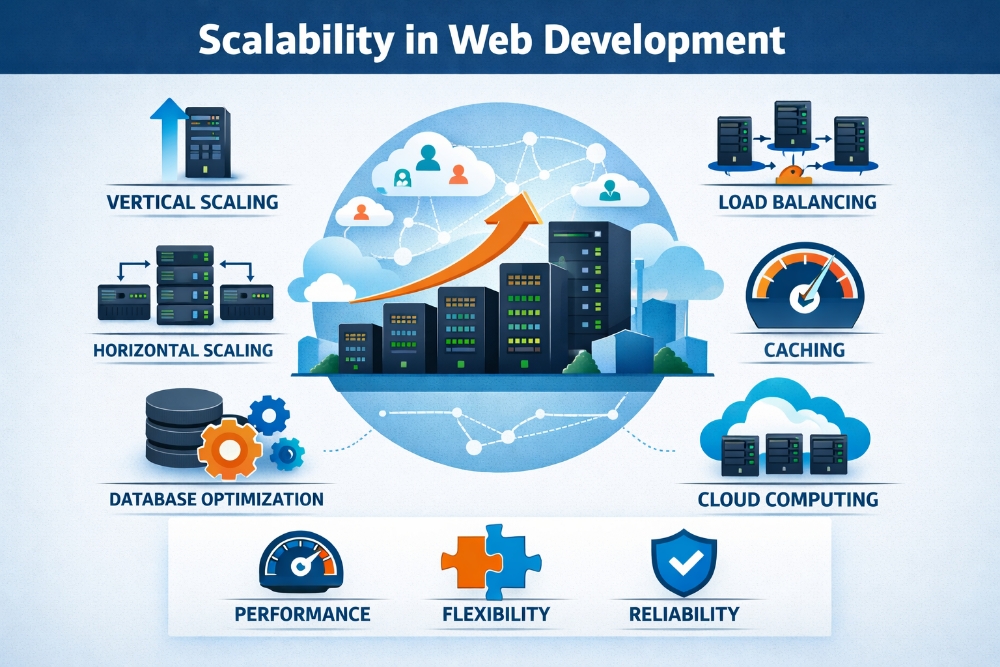
There are two main types of scalability. Vertical scaling involves upgrading your existing server by adding more power such as CPU or RAM. Horizontal scaling involves adding more servers to distribute the load. While vertical scaling is simpler, horizontal scaling is often more flexible and cost effective in the long run.
Why Scalability Matters
Scalability is not just a technical concern. It directly impacts user experience, business growth, and revenue.
A slow or unreliable website can drive users away. On the other hand, a scalable system ensures that your platform remains fast and responsive even during peak traffic.
For startups, scalability is especially critical. A sudden spike in users can be a good problem to have, but only if your system can handle it. For established businesses, scalability supports expansion into new markets and services without constant system overhauls.
Key Strategies for Building Scalable Web Systems
One of the most important strategies is designing with scalability in mind from the start.
This includes using modular architecture where components can be developed, deployed, and scaled independently.
Load balancing is another essential technique. By distributing incoming traffic across multiple servers, you prevent any single server from becoming a bottleneck. This improves both performance and reliability.
Caching plays a huge role in scalability. By storing frequently accessed data in memory, you reduce the need to repeatedly query databases. This significantly speeds up response times and reduces server load.
Database optimization is also crucial. As your data grows, inefficient queries can slow everything down.
Techniques like indexing, database sharding, and replication help maintain performance at scale.
Cloud computing has made scalability more accessible than ever.
Platforms allow you to automatically scale resources up or down based on demand. This flexibility ensures you only pay for what you use while maintaining performance.
Challenges in Scalability
Despite its importance, scalability comes with challenges. Distributed systems can become complex and harder to manage. Debugging issues across multiple servers or services requires careful monitoring and logging.
Cost is another factor. While scaling horizontally can be efficient, it still requires investment in infrastructure and maintenance. Poorly planned scaling can lead to unnecessary expenses.
Security also becomes more critical as systems grow. More users and more data mean more potential vulnerabilities.
Ensuring consistent security across all components is essential.
In all, Scalability is not something you add later. It is a mindset that should guide your design and development process from the beginning. By focusing on scalable architecture, efficient resource management, and continuous optimization, you can build web applications that not only handle growth but thrive on it.