The Hidden Truth About Proprietary Trading Firms and Being Funded

Introduction
Proprietary trading firms—commonly known as prop firms—have gained massive attention in recent years, especially among aspiring traders looking for access to larger trading capital. The promise is enticing: instead of risking your own limited funds, you can trade with the firm’s money, keep a portion of the profits, and minimize your personal exposure. On the surface, this seems like a golden opportunity. However, behind the glossy marketing lies a reality that is often less glamorous.
This article exposes the hidden truth behind being funded by prop firms, highlighting both opportunities and challenges that traders must understand before diving in.
The Prop Firm Model
Prop firms typically offer traders a chance to access company capital under strict rules and profit-sharing structures. Most modern online prop firms operate under a challenge model:
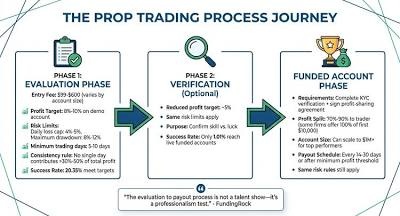
- Evaluation Phase: Traders must pass a trading challenge by hitting profit targets (e.g., 8–10%) within specific risk parameters.
- Verification Phase: Often, a second phase with similar rules but a smaller profit target.
- Funded Account: Once both stages are cleared, traders get access to the firm’s capital. Profits are shared, commonly 70–90% to the trader.
At first glance, this looks fair. But the real story lies in how these programs are structured.
The Business Behind Funding
Unlike traditional prop firms, many online retail prop firms don’t necessarily make their main income from trading profits. Instead, they profit primarily from fees traders pay to attempt the challenge. Thousands of hopeful traders sign up each month, and most fail to pass the evaluation. This failure rate—often 80–95%—is where the bulk of revenue comes from.
In essence:
- For many firms, you are the customer, not the partner.
- The “funded account” is often just a simulated account, not real capital placed in the markets.
- Your performance may never impact the firm’s actual trading balance sheet.
This doesn’t mean all firms are scams, but it does highlight how the business model is stacked against the average trader.
The Psychological Trap
Prop firms market themselves as the solution for small traders struggling with limited capital. Yet, their rules often create a psychological trap:
- Strict drawdown limits force traders to prioritize survival over long-term strategy.
- Profit targets under time pressure encourage risky, aggressive trades.
- Reset fees entice traders to keep trying after failure, often leading to a cycle of losses.
Instead of building discipline, many traders end up gambling, hoping to pass challenges quickly. Ironically, this goes against the very principles of professional risk management that real trading requires.
The Illusion of “Being Funded”
For those who succeed, the idea of being “funded” is often more illusion than reality. In many firms:
- Funded accounts are demo accounts, and payouts are made from firm revenues (fees), not actual trading profits.
- Withdrawal rules are strict: traders must reach minimum profit levels or wait for specific payout windows.
- Breaches of even minor rules—such as trading during restricted news events—can void accounts instantly.
Thus, while the marketing highlights freedom and big profits, the fine print reveals that being “funded” is not as liberating as it sounds.
Opportunities Still Exist
Despite the drawbacks, prop firms aren’t entirely negative. For disciplined, skilled traders, they can:
- Provide access to large trading capital without risking personal funds.
- Offer structured environments that enforce discipline.
- Serve as a stepping stone to professional trading if used wisely.
Some reputable firms also reinvest in their top traders, providing them with real capital allocations and opportunities to grow.
What Traders Should Know Before Joining
Before signing up for a prop firm, traders should:
- Read the fine print carefully—understand profit splits, payout rules, and breach conditions.
- Research the firm’s reputation—look for transparency, community feedback, and proof of real payouts.
- Evaluate your readiness—if you can’t consistently trade profitably on your own account, paying challenge fees may be a costly distraction.
- Focus on discipline over speed—success in trading is about sustainability, not quick wins.
Conclusion
The hidden truth about prop firms is that they are businesses first and trading partners second. Their primary profit often comes not from traders winning, but from traders failing. While this doesn’t make them fraudulent, it does mean that the dream of easy funding is often exaggerated.
For those who approach prop firms with realistic expectations, strong discipline, and a well-tested strategy, they can serve as a stepping stone to professional trading. For others, however, they risk becoming a costly cycle of fees and failed challenges.
In the end, being funded is not a shortcut to success—it’s another test of skill, patience, and discipline.
References
- Brown, A. (2022). The Rise of Retail Prop Trading Firms: A Double-Edged Sword. Financial Times.
- Investopedia. (2023). What Is a Proprietary Trading Firm? Retrieved from: https://www.investopedia.com
- MyForexFunds Case Study (2023). FTC Complaint Against Prop Firms. U.S. Federal Trade Commission.
- Smith, J. (2021). Psychological Pressures in Prop Trading Challenges. Journal of Behavioral Finance, 18(3), 45–56.
- Forex Peace Army (2023). Trader Reviews of Popular Prop Firms. Retrieved from: https://www.forexpeacearmy.com
- Babypips. (2023). The Truth About Forex Prop Firms and Funded Accounts. Retrieved from: https://www.babypips.com