The Complete Guide to Buying Wall Art, Sculptures, and Decorative Objects for Your Home

Everything you need to know before you buy — from wall art scale to indoor sculpture placement, metal art finishes to coastal boho styling — with expert curation from KUNSTPLAZA.
Decorating a home well is harder than it looks.
Not because good taste is rare — most people have a fairly clear sense of what they find beautiful. It's harder because the gap between seeing something beautiful and knowing how to bring it into your specific space, at the right scale, in the right combination, is not obvious until you've made a few expensive mistakes.
This guide exists to close that gap. It covers the major categories of home art and décor — wall art, metal art, tapestries, indoor sculptures, decorative objects, and design furniture — with practical buying guidance, styling frameworks, and material considerations drawn from real interior design practice.
The curation reference throughout this guide comes from KUNSTPLAZA, a German décor and design shop based in Passau that specializes in handpicked artisanal pieces bridging fine art and functional home design.
Let's start with the most fundamental category.
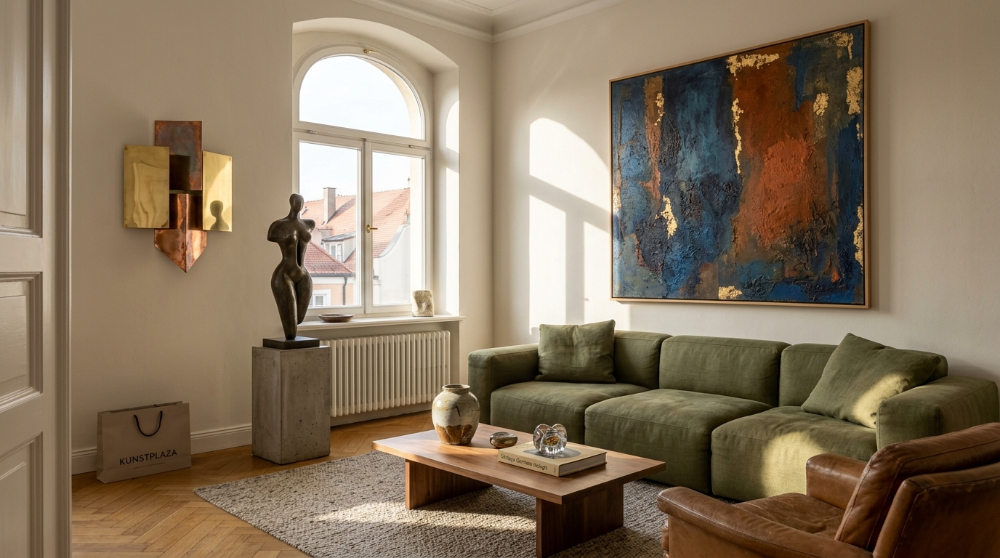
Part 1: Wall Art — The Complete Buying Guide
Why Wall Art Matters More Than Any Other Single Decorating Decision
Before anyone consciously registers furniture arrangement or lighting quality, they process what's on the walls. Wall art is the room's first communication — it tells you what kind of space this is, what mood it holds, what sensibility it reflects.
Despite this, most people spend more time researching a sofa than selecting wall art. The result is rooms that are adequately furnished but visually incomplete — walls that fill space without contributing meaning.
The Scale Problem (and How to Solve It)
Undersized wall art is the single most common residential decorating error. The cause is almost always the same: people buy a piece that looks substantial in a shop or on screen, hang it on a wall, and discover it looks lost.
The rule: Art should occupy at least 55–65% of the width of the wall or furniture piece below it. For a sofa 200cm wide, the art or art arrangement above it should span 110–130cm minimum. For a statement piece on an empty wall 3 meters wide, 100–150cm becomes the appropriate starting range.
When in doubt, go larger. The visual error of art slightly too large for a wall is far less noticeable than art clearly too small. The eye forgives generosity and registers timidity.
Types of Wall Art and What They Do
Metal Art Hand-finished metal wall art brings three-dimensional presence to a flat surface. Hammered textures, welded forms, and patinated finishes respond to light throughout the day — the piece literally looks different at 9am, at noon, and under evening lighting. This dynamic quality is unique to metal as a decorative material.
Metal art integrates into virtually any interior style. In Scandi spaces, a single large-format metal piece carries significant visual weight against minimal surroundings. In coastal boho interiors, metal's hardness contrasts productively with the soft textiles and organic forms of the style. In contemporary or industrial interiors, metal art feels native.
Fine Art Prints and Originals Printed reproductions of original artworks offer accessible entry points. For maximum impact, choose quality framing (the frame is often 40% of the visual equation), limit the number of pieces on a given wall, and prioritize coherence over variety.
Original artworks — from KUNSTPLAZA's curated selection or other artisanal sources — carry something reproductions cannot: maker-presence. An original piece was held, worked on, finished, and released by a specific human. This is not mysticism; it's visible in the surface variation, the mark quality, and the overall material specificity that reproduction cannot capture.
Tapestries and Textile Art Woven wall art performs functions no other wall art category can: it adds warmth, absorbs sound, introduces softness into hard-surface rooms, and creates movement (tapestries shift gently with air movement in ways that framed art cannot).
The coastal boho interior movement has driven significant tapestry revival. Natural-fiber tapestries in sand, terracotta, and muted botanical tones integrate directly into the style's core palette. But tapestries work equally well in Scandi interiors (introducing the single warm texture against otherwise cool minimal surfaces) and in transitional spaces where textile warmth is needed without the commitment of fabric-heavy furniture.
Part 2: Indoor Sculptures — What They Are and How to Use Them
The Case for Three-Dimensional Art in Interior Spaces
Indoor sculptures are the most neglected category in residential interior design. This is understandable — they require more consideration than wall art (scale, placement, viewing angles, relationship to furniture) and represent a different kind of investment. But the design payoff is disproportionate.
A well-placed indoor sculpture does something no wall art can: it anchors the room in three-dimensional space. It creates a focal point that works from multiple positions and viewing angles. It invites approach and close inspection. It makes the room feel occupied in a specific way — as though someone with genuine aesthetic conviction made a deliberate choice to put this exact thing here.
Where to Place Indoor Sculptures
Console tables and entry halls The entry hall is the first room impression. A sculpture on a console table — at eye height, with adequate clearance from surrounding objects — functions as the home's opening statement. Keep the surrounding surface relatively clear so the sculpture reads as intentional rather than cluttered.
Shelving and bookcases Individual sculptures on bookshelves create visual rhythm by interrupting the regularity of book spines. The key is scale variation — a larger piece alongside groups of smaller objects rather than multiple similar-scale pieces competing.
Plinths and floor placement Significant floor sculptures require clear space around them. A plinth elevates and isolates a piece, signaling its status as art-object rather than object-among-objects. Floor-placed sculptures work best when they don't compete with nearby furniture for visual dominance.
Window sills and light-adjacent placement Sculptures in natural light show their material and form most clearly. Translucent ceramics, polished metals, and textured stone all benefit from directional natural light that reveals their surface qualities.
What to Look for When Buying Sculptures
Material specificity: What exactly is it made of? "Resin" and "cold-cast bronze" and "solid bronze" look similar in photographs and differ enormously in weight, surface quality, and value. Ask. Read descriptions carefully. If the listing doesn't specify the material precisely, that's a signal.
Handmade vs. reproduced: A handcrafted ceramic piece will show surface variation — slight irregularities in form, texture variation across the surface, glaze pooling in recesses. These are not flaws; they're evidence of human making. Factory-produced pieces are consistent in ways handmade pieces are not. Decide which you want and buy accordingly.
Scale for your space: Measure the surface where the sculpture will sit. Measure your clearances. A piece 40cm tall on a shelf with 45cm of vertical clearance works; the same piece on a console with 35cm of clearance creates visual compression. Scale matters more than almost any other variable.
Part 3: Decorative Objects — Building a Room Through Details
Why Decorative Objects Define Interior Quality More Than Furniture
Furniture defines a room's function and proportion. Decorative objects define its quality, personality, and sense of being genuinely inhabited.
A well-furnished room without considered decorative objects feels like a showroom — functional but not lived in, presentable but not personal. The objects on surfaces, the vessels on shelves, the small sculptural pieces on side tables — these are what make a room feel like it belongs to someone with a point of view.
The best decorative objects share a few qualities that consistently distinguish them from inferior alternatives:
They reward close inspection. Pick up a hand-thrown ceramic bowl and you feel the weight distribution, the slight irregularity of form, the texture variation in the glaze. These qualities cannot be seen in a photograph; they're experienced only in person or inferred from material description. Always ask about weight and surface finish when buying decorative ceramics online.
They age into character. Brass develops patina. Unglazed ceramic absorbs the character of its environment over time. Stone develops worn surfaces with handling. Natural materials change in ways that improve rather than degrade them — which is what "artisanal quality" means in practical terms.
They create compositional rhythm. A shelf composed entirely of similar-height, similar-material objects is visually static. The same shelf with height variation (tall vessel, medium sculpture, small accent objects), material variation (ceramic alongside brass alongside wood), and some negative space between groupings has visual rhythm — the eye moves across it rather than registering it as a static block.
The "Quiet Luxury" Framework for Decorative Objects
The design concept currently described as "quiet luxury" translates directly into decorative object selection: fewer, better things; natural materials that telegraph quality without ostentation; objects that mean something rather than objects that fill space.
Practically, this means:
- Reduce the number of objects on any given surface by 30–40% from what feels "full"
- Replace trend-specific pieces with material-honest alternatives in natural finishes
- Invest in one or two genuinely excellent pieces rather than many adequate ones
- Leave intentional negative space — the space around objects is part of the composition
KUNSTPLAZA's curated decorative objects collection is built on this framework. Every piece is selected because it holds up to this standard — artisanal quality, natural material, compositional flexibility.
Part 4: Interior Style Frameworks — Coastal Boho and Scandi
Coastal Boho Interior: How to Build the Layered Aesthetic
Coastal boho is arguably the most influential residential interior aesthetic of the past five years — and also the most frequently misunderstood. It's not "beach house meets hippie van." It's a specific visual language with identifiable principles.
Core elements:
- A warm, sun-bleached palette: warm white, natural linen, sand, terracotta, muted sage, sun-washed blue
- Natural fiber textures: jute rugs, linen curtains, rattan furniture, woven tapestries, macramé
- Organic forms rather than geometric precision: irregular shapes, found objects, vessels with natural asymmetry
- Layering: multiple textures and materials at different scales, creating depth through accumulation rather than minimalism
- Plant life: indoor plants are essentially structural to the aesthetic — they introduce the living organic element the style requires
- Global craft references: handmade objects with artisanal provenance from different traditions, accumulated over time rather than purchased as a matched set
Art and décor specifics: Wall art in coastal boho interiors tends toward texture — tapestries, woven wall hangings, macramé, textile art, and organic natural forms (botanical prints, landscape references, abstract organic shapes). Metal art works in coastal boho contexts when it's rough-finished and organic rather than geometric and precision-cut.
Indoor sculptures in this aesthetic favor natural materials: unglazed ceramics, raw wood, woven forms, found organic objects. The quality signal is natural material authenticity rather than precision finish.
Decorative objects: ceramic vessels in earthy tones, natural fiber baskets functioning as storage-as-décor, driftwood forms, stone accent pieces, hand-woven textiles folded on surfaces.
Scandi Style: The Functional Beauty Framework
Scandinavian design rests on a philosophical conviction: that beauty and function are not competing values but mutually reinforcing ones. The most beautiful object is the one that does its job perfectly and looks exactly like something that does its job perfectly.
Core elements:
- A restrained palette derived from Nordic nature: white (snow, birch), grey (stone, sea), warm wood (pine, oak), black (charcoal, iron), occasional deep green (forest), muted red (barn)
- Clean architectural form: geometric clarity, absence of unnecessary ornamentation, visual honesty about structure
- Natural material quality: the material should be identifiable and excellent — wool that looks and feels like wool, wood that shows grain, ceramic with appropriate weight
- Negative space as active element: the space around objects is not empty — it gives objects room to exist, to breathe, to be fully seen
- Statement lighting: Scandi design historically elevates lighting to primary design element, using sculptural pendants and floor lamps as room-defining objects
- Functional objects elevated: everyday objects — chairs, storage vessels, serving pieces — designed to be beautiful because they work perfectly
Art and décor specifics: Wall art in Scandi interiors follows the negative space principle — one strong piece with significant empty wall around it, rather than gallery cluster. Metal art in large format works exceptionally well. Fine art prints in simple matte-black or natural wood frames. Monochrome or limited-palette photography.
Indoor sculptures should be singular and placed with intention — a single ceramic object on a surface, alone, rather than grouped.
Decorative objects should be essential: objects present because they're used (a wool throw, a ceramic coffee cup, a wooden serving board) or because they're genuinely beautiful and earn their space by being fully seen.
Part 5: Design Furniture — When Function Becomes Art Object
Design furniture occupies the intersection of furniture and sculpture — objects that function perfectly and exist as aesthetic statements simultaneously. The Eames Lounge Chair functions as a chair. It also exists as an argument about what a chair should be.
This category is important to understand because it changes how you think about furniture selection. Design furniture is not more expensive furniture — it's furniture with a considered point of view about form and material. A well-designed chair at moderate price is design furniture. An expensive but aesthetically incoherent piece is not.
KUNSTPLAZA's approach to design furniture follows the same curatorial logic as their art and décor categories: pieces selected for artisanal quality, aesthetic coherence, and the capacity to integrate into real living spaces without dominating them.
When selecting design furniture, the questions to ask are: Does this piece have a clear formal logic? Does its form follow its function in an honest way? Does it improve the space it's in, or does it compete with it?
Practical FAQ: Buying Art and Décor Online
How do I avoid buying wall art that looks wrong in my space?
Measure the wall before browsing. Establish your size minimum (use the 55–65% rule above). Then browse only within that size range. Never fall in love with a piece before confirming it fits your scale requirement.
Is it safe to buy original art or handmade sculptures online?
Yes, if you buy from curated sources with material-specific descriptions and clear provenance. KUNSTPLAZA's shop provides this curatorial context. Generic mass-market platforms require more buyer diligence.
What materials are most versatile for decorative objects?
Matte black ceramic, raw natural clay, patinated brass, unpolished stone, and natural-finish wood integrate across virtually all interior styles. Avoid high-gloss finishes and very trend-specific colors unless you're confident in the style direction you're committing to.
How do I know if a metal wall art piece is quality?
Look for descriptions of the finishing process (powder coating, patination, hand-finishing), weight specifications (heavier pieces indicate denser, higher-quality metal), and surface texture descriptions. A quality metal art piece should have visible evidence of human finishing — not the machine-perfect regularity of laser-cut production pieces.
Can tapestries work in modern or minimal interiors?
Yes. A large, simply woven tapestry in a neutral or muted tone integrates into Scandi minimal spaces by introducing the single warm texture element the style needs. The key is scale (large enough to read as intentional), material (natural fiber rather than synthetic), and restraint (one tapestry as a statement rather than multiple pieces competing).
Closing: Art Is Not a Finishing Touch
The standard interior design process puts furniture first and art last — as a finishing layer applied to an already-furnished space. This is backwards.
Art and decorative objects are not finishes. They're the reason the space feels inhabited. They're what determine whether a room feels like it belongs to someone or like it could belong to anyone.
The most successful interiors treat art, sculpture, decorative objects, and design furniture as primary decisions — not as afterthoughts purchased when the furniture budget is spent.
KUNSTPLAZA exists to support this approach. A curated shop where fine art quality meets everyday functionality, where every piece is hand-selected with genuine aesthetic intention, and where art lovers can find objects that belong in their homes — not in their wish lists.
KUNSTPLAZA — Décor and Design Shop Bridging fine art and everyday living since the beginning. Carossastr. 8d, 94036 Passau, Germany
📞 +49(0)851-96684600
🌐 kunstplaza.de/shop
📱 Instagram · Facebook · Twitter · Pinterest · LinkedIn · YouTube