Inside Iran’s $7B+ Crypto Economy: Survival, Sanctions, and Shadow Finance
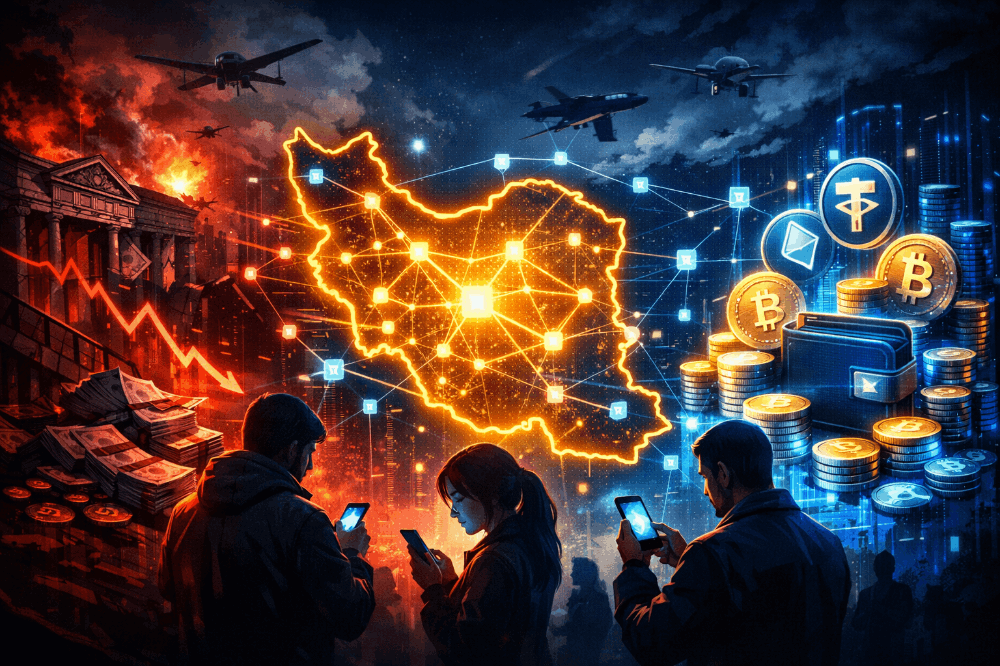
Iran’s cryptocurrency ecosystem is no longer a fringe experiment—it has evolved into a parallel financial system powering both survival and strategy. With estimates placing the country’s crypto activity at over $7.8 billion annually, digital assets have become deeply embedded in how Iran navigates sanctions, inflation, and geopolitical pressure.
This transformation is not driven by innovation alone. It is a calculated response to isolation from global financial networks, where crypto acts as both a workaround and a lifeline. From state-backed operations to everyday citizens preserving wealth, Iran’s crypto economy reflects a dual reality: shadow finance at the top and economic resilience at the grassroots level.
A Sanctions-Driven Financial Shift
Iran’s exclusion from global banking systems, particularly SWIFT, has forced the country to rethink how it conducts international trade and financial transactions. Traditional channels are heavily restricted, making cryptocurrency an attractive alternative.
Digital assets enable cross-border payments without relying on intermediaries that enforce sanctions. This capability has allowed Iran to maintain a level of economic activity despite increasing global pressure. In fact, analysts suggest that crypto has become a structural pillar of Iran’s financial system rather than a temporary workaround.
What makes this shift significant is its scale. A multi-billion-dollar crypto ecosystem in a sanctioned economy signals not just adoption—but systemic dependence.
The Rise of a Shadow Economy
Iran’s crypto market operates largely as a closed-loop ecosystem, where funds circulate between domestic exchanges and private wallets. This internal circulation reduces reliance on foreign platforms while still enabling limited external transactions when needed.
Data indicates that a large portion of crypto inflows originates domestically, highlighting how deeply embedded digital assets are in everyday financial activity.
However, the term “shadow economy” is not just rhetorical. The opacity of blockchain transactions, combined with regulatory loopholes, makes it difficult for international authorities to fully trace or control these flows. This creates a financial layer that exists parallel to the traditional global economy—largely outside its enforcement mechanisms.
State Influence and Strategic Deployment
A defining feature of Iran’s crypto landscape is the significant role played by state-linked entities. Reports indicate that organizations such as the Islamic Revolutionary Guard Corps (IRGC) account for a substantial share of the country’s crypto activity, with billions of dollars flowing through associated wallets.
This involvement transforms cryptocurrency from a mere financial tool into a geopolitical instrument. It is reportedly used for:
- Facilitating cross-border trade outside sanctioned channels
- Supporting allied groups and strategic operations
- Enabling transactions that would otherwise be blocked by global regulators
The scale and coordination of these activities suggest a long-term strategy rather than opportunistic usage.
Civilian Adoption: Crypto as a Survival Tool
While state actors leverage crypto for strategic purposes, ordinary Iranians are turning to digital assets for a much simpler reason—survival.
With inflation hovering around extreme levels and the national currency losing value rapidly, citizens are increasingly using crypto to protect their savings. Bitcoin withdrawals, for instance, have surged during periods of political unrest and economic instability.
For many, crypto offers:
- A hedge against currency devaluation
- A means to store value outside the banking system
- Greater financial autonomy in a constrained economy
This grassroots adoption highlights a critical insight: crypto in Iran is not just speculative—it is functional.
Stablecoins and the Search for Stability
Volatility remains a major concern in cryptocurrency markets, but Iran has adapted by leaning toward stablecoins. These digital assets, pegged to fiat currencies like the U.S. dollar, provide relative stability compared to traditional cryptocurrencies.
Both institutional players and retail users are increasingly favoring stablecoins for transactions and savings. This shift reflects a pragmatic approach—prioritizing value preservation over high-risk gains.
In an economy marked by uncertainty, stablecoins serve as a bridge between decentralized finance and real-world stability.
Crypto in Conflict and Trade
Beyond economic survival, cryptocurrency is playing a growing role in Iran’s wartime and trade strategies. Reports suggest that digital assets are being used to:
- Facilitate oil transactions outside traditional banking systems
- Enable discreet financial flows during geopolitical conflicts
- Support logistics and procurement in restricted environments
The speed, cost-efficiency, and relative anonymity of crypto transactions make them particularly suited for these use cases. This evolution underscores how digital assets are reshaping not just finance—but also geopolitics.
For a deeper breakdown of how these dynamics operate at a strategic level, explore this detailed analysis on Iran’s Strategic Use of Cryptocurrency in Conflict and Economic Crisis.
Challenges and Global Implications
Despite its advantages, Iran’s crypto ecosystem is not without risks. Cyberattacks, regulatory crackdowns, and increasing scrutiny from global authorities pose ongoing challenges.
Moreover, the rise of such a large crypto economy within a sanctioned nation raises critical questions:
- How can regulators effectively monitor decentralized systems?
- Where is the line between civilian use and state exploitation?
- Can crypto remain neutral in geopolitical conflicts?
These questions are not unique to Iran—they represent broader challenges for the global financial system.
Conclusion
Iran’s $7B+ crypto economy is a case study in how digital assets can reshape financial survival under extreme conditions. What began as an alternative has evolved into an essential component of both state strategy and civilian life.
At the macro level, crypto enables Iran to navigate sanctions and sustain economic activity. At the micro level, it empowers individuals to protect their wealth in an unstable environment.
The result is a dual-layered ecosystem—part shadow finance, part survival mechanism—that is likely to expand as geopolitical and economic pressures persist.