Six Years Building in Web3: What Changed for Ordinary Users
In November 2026 the Solana Foundation dropped the "mainnet beta" label. The network is now just "mainnet", with a shared protocol version called Solana 1.0. Balances, accounts and apps stay the same. Users did not have to do anything.
Solana launched as Mainnet Beta on 16 March 2020. Later that year I wrote my first line of Solidity. The word "beta" lasted six years and eight months, longer than most of the projects I watched launch.
I have been in crypto since 2014, from India. I started building in late 2020 on EVM chains, and these days I build mostly on Solana. Here is what changed for ordinary users in those six years, based only on what I saw myself.
2020: building when gas decided everything
My first contracts were simple token contracts in Solidity. On Ethereum, gas was the real product manager. You wrote the code, then waited for a quiet hour to deploy it.
I remember one weekend with a small token contract I wanted live on mainnet. I checked the gas tracker every hour, waiting for it to drop. It never dropped enough. The gas would have cost more than the whole project was worth to me, so in the end I deployed it on BSC instead.
Binance Smart Chain had launched its mainnet on 1 September 2020. By 2021 that is where the meme coins and the ad budgets went. I was running campaigns for tokens on chart sites and token trackers that year, and nearly all of them were BSC tokens.
Meanwhile Ethereum kept changing. EIP-1559 changed how fees work on 5 August 2021, and the Merge moved it to proof of stake on 15 September 2022. Dencun followed on 13 March 2024 and added blobs, which made rollup data much cheaper. In my experience, as of 2026, deploying on a rollup is no longer a weekend decision.
The outage years
A halt is hard to explain to someone who never lived through one. You cannot sell or move anything. You refresh Discord and wait for validators to agree on a restart.
The one I remember best came on 14 September 2021. A token sale (IDO) opened, bots flooded the network, and the Foundation's own report called it in effect a denial of service. The network was down for about 17 hours. The restart needed validators holding 80% of stake to coordinate. No funds were lost.
I was trading meme coins heavily that year and had a small Solana position open when it stopped. I could not touch it for most of a day. I kept the status page in one tab and Discord in another, and there was nothing to do except wait. When the network came back, everything was where I had left it, and since that day I have not assumed any chain is always on.
Five more full halts followed between April 2022 and February 2024, each with its own post-mortem. January 2022 was not a full halt, but performance was degraded for days.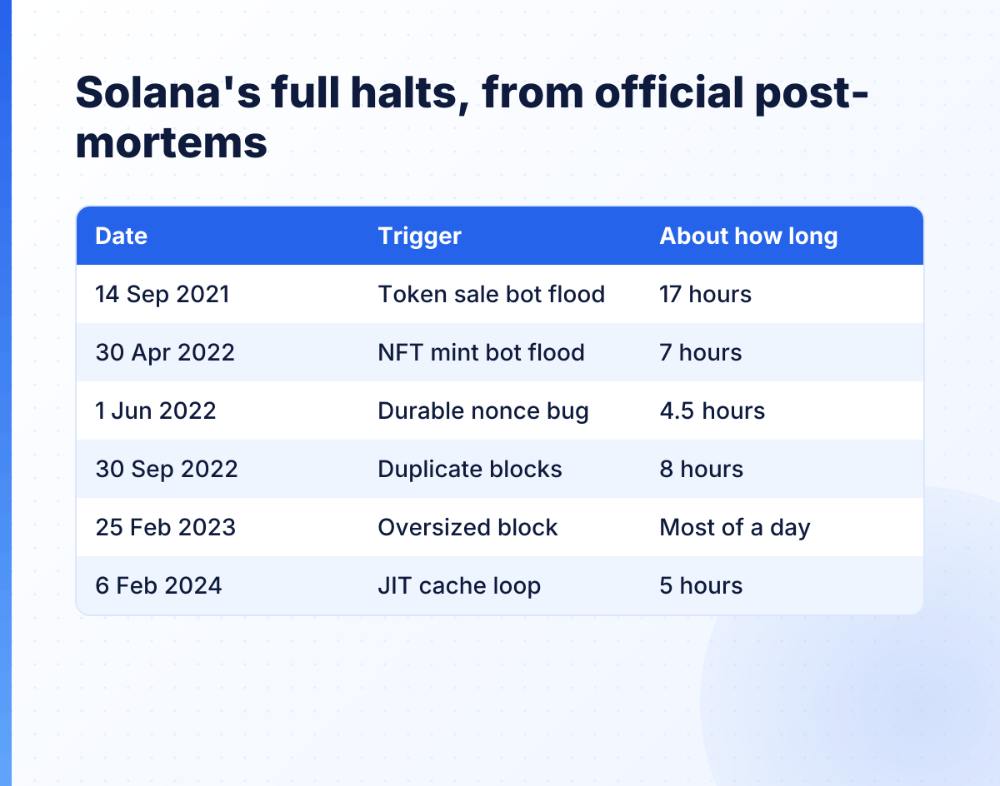
Fees and the transactions that just vanished
The base fee barely moved in all this time: 5,000 lamports per signature, half burned and half to the validator. The priority fee is what changed. After the April 2022 halt, the Foundation listed fee-based execution priority among the fixes. Today you can pay a price per compute unit to get ahead, and since SIMD-0096 that priority fee goes fully to the validator.
For me, the worst stretch after the halts was April 2024, during the memecoin rush. Many transactions were dropped before they ever reached a leader. Anza shipped Agave v1.17.31 on 12 April 2024, the first of a series of fixes.
That month my wallet showed one of my transactions as sent. It never appeared on the explorer. I pressed retry on the same transaction several times before I understood: its blockhash had expired.
That is how I learned to tell a failed transaction from a dropped one. A failed transaction reached a leader, ran, hit an error and paid its fee. A dropped transaction never landed at all. A blockhash is valid for about 150 blocks, and after that the transaction expires and has to be signed again.
The memecoin era changed who creates tokens
In 2021 on BSC, launching a token meant a developer, a contract and a marketing budget. I was on the marketing side. One project paid for chart site placements weeks before launch, while the contract was still being written.
Then bonding-curve launchpads turned token creation into a form anyone can fill in, and the number of creators exploded.
I think that is mostly good, because more people get to try. The old rule did not change, though. Most tokens still go to zero, and in my experience the real work starts after launch.
Token-2022: what a creator can do now
On 24 January 2024 the Foundation launched Token Extensions, the Token-2022 program. Things that used to need a custom program are now settings on the mint.
Transfer fees are the clearest example. A tax on every transfer used to mean writing your own program. Now it is a mint setting, and no-code tools such as Tokenry's Solana tax token creator set it up in a form. (I build Tokenry, so that one is my own tool.) Metadata can live on the mint itself, and non-transferable tokens are a setting too.
If you are choosing between the two token programs, here is the difference between SPL and Token-2022.
What I would tell a new Solana user today
When a transaction does not confirm, open the explorer before you press retry. A failed transaction and one that never landed are different problems. For the first you read the error. For the second you wait, then sign again with a fresh blockhash.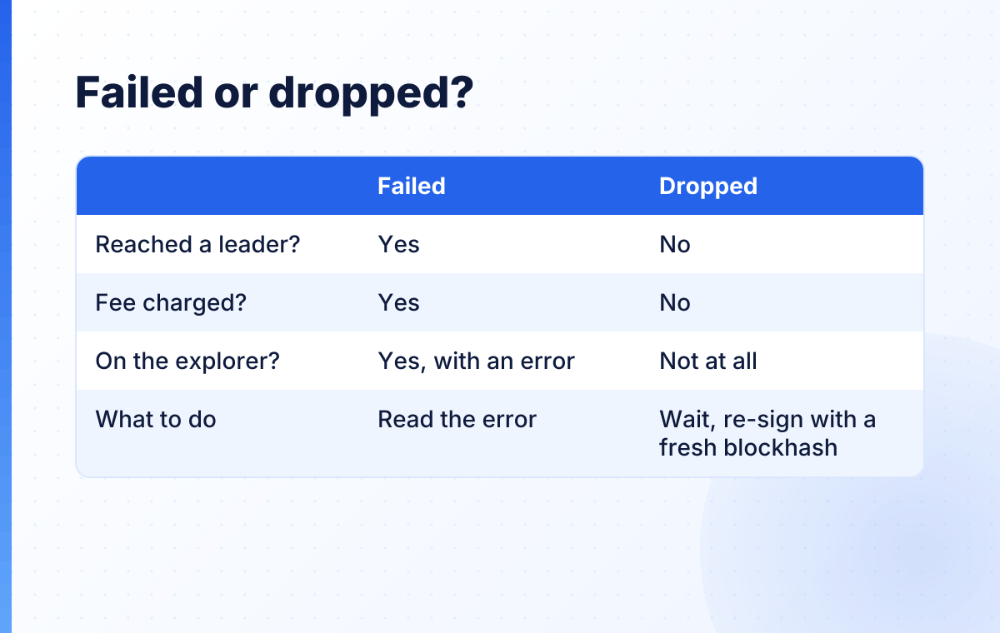
As of November 2026 the status feed shows no full halt since February 2024. In September 2026 the Foundation said it had had about two and a half years of 100% uptime. I am glad newer users never had to sit through a 17-hour wait, but I still check the explorer first.
What was the first network problem you hit, and did it change how you use Solana?