How Blockchain Technology Is Changing the Way Property Shares Are Owned

Real estate ownership has traditionally depended on centralized registries, legal documents, intermediaries, and lengthy transfer procedures. Buying a property or participating in a real estate investment often requires significant capital, extensive paperwork, and multiple parties to verify and record ownership. Blockchain technology is introducing a different approach through tokenized property ownership. By representing property shares as blockchain-based digital tokens, real estate ownership can potentially become more fractional, transparent, programmable, and easier to manage.
This does not mean a blockchain token automatically replaces a property's legal title. Instead, blockchain can provide a digital infrastructure for representing ownership interests, economic rights, or shares in a legally structured real estate investment. As real estate tokenization develops, the concept of property ownership is moving from static records toward programmable digital ownership models.
What Is Tokenized Property Ownership?
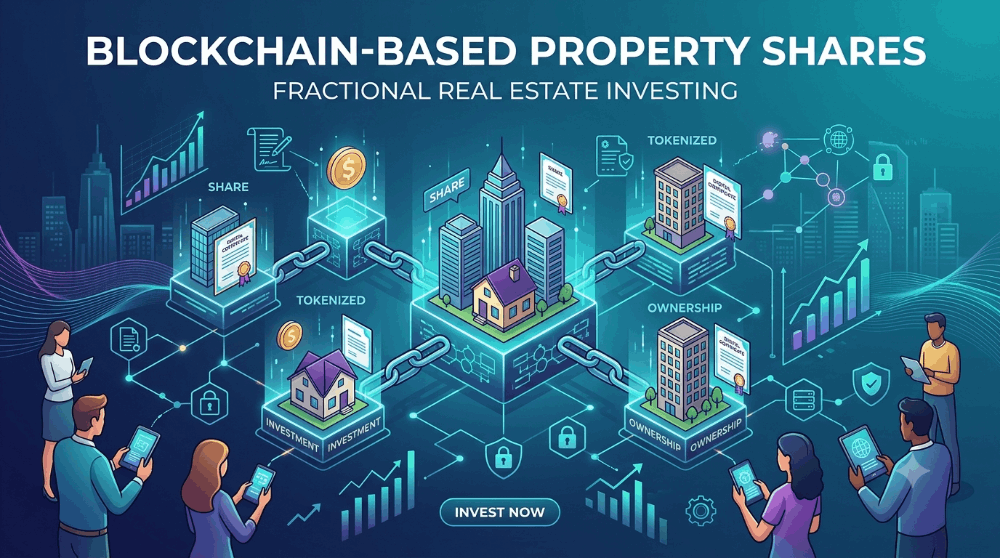
Tokenized property ownership involves representing an ownership interest in a real estate asset through blockchain-based tokens. A property may be held by a legal entity, such as a special purpose vehicle (SPV), while investors receive tokens representing defined rights in that entity or its underlying economic interests.
Depending on the structure, property tokens may provide rights related to:
- Rental income
- Capital appreciation
- Ownership interests
- Voting or governance
- Property sale proceeds
- Other contractual economic benefits
The exact rights depend on the legal documentation supporting the token.
This distinction is important because blockchain provides the digital record, while legal agreements establish the enforceable ownership rights.
How Blockchain Is Changing Property Share Ownership
1. Fractional Property Ownership
One of the biggest changes blockchain introduces is the ability to divide real estate investment into smaller digital units. Traditionally, purchasing a commercial property may require substantial capital from a single investor or a small group of investors. With tokenization, a property can potentially be divided into thousands or millions of digital units.
For example, a commercial building valued at $10 million could be structured into 1 million tokens. Each token could represent a defined economic interest in the property-holding entity.
This allows investors to participate with smaller amounts of capital, subject to applicable regulations.
Why this matters
Fractionalization can:
- Lower investment barriers
- Expand the potential investor base
- Make portfolio diversification easier
- Create more flexible ownership structures
2. Digital Ownership Records
Traditional property ownership depends on government registries, deeds, title documents, and other centralized records. Tokenized property introduces an additional digital ownership layer.
Blockchain can maintain a tamper-resistant record of:
- Token issuance
- Ownership balances
- Transfers
- Transactions
- Distributions
- Retirement or redemption events
This can make ownership tracking more efficient, particularly when a property has a large number of investors.
3. Faster Property Share Transfers
Transferring traditional property ownership can involve lawyers, registrars, banks, brokers, and other intermediaries. Transferring a tokenized property share can potentially be completed through a blockchain transaction, provided the transfer complies with applicable legal and platform restrictions. This can reduce administrative friction. However, tokenized property shares are still subject to securities, property, tax, and transfer regulations where applicable. Blockchain can make the transaction technically faster without eliminating legal requirements.
4. Automated Rental Income Distribution
Blockchain can also change how rental income is distributed among property investors.
Suppose a tokenized property generates monthly rental income. A smart contract can calculate each investor's share based on their token holdings.
For example:
Total distributable rental income × Investor's token ownership percentage = Investor distribution
The payment process can then be automated according to predefined rules.
This can reduce manual calculations and improve transparency around income distribution.
5. Programmable Property Shares
Traditional property shares are generally governed through legal agreements and administrative processes.
Tokenization allows certain rules to be embedded into smart contracts.
These rules could govern:
- Investor eligibility
- Transfer restrictions
- Distribution schedules
- Holding periods
- Voting rights
- Redemption conditions
This creates programmable property ownership, where certain financial and administrative functions can execute automatically.
6. Greater Transparency for Investors
Real estate investment often involves information asymmetry. Investors may depend on property managers or fund administrators for information about income, ownership, and transactions.
A blockchain-based system can provide a shared record of token ownership and relevant transaction activity.
Investors can potentially monitor:
- Their token holdings
- Ownership changes
- Income distributions
- Transaction histories
- Property-related financial events
This can strengthen investor visibility and reduce reliance on fragmented records.
7. Potential Secondary-Market Liquidity
Real estate has historically been considered an illiquid asset because selling a property can take weeks or months. Tokenization can create infrastructure for transferring smaller ownership interests without selling the entire property. For example, an investor who owns 5% of a tokenized property may potentially sell part of that interest through a compliant secondary market.
This creates a distinction between:
Selling the property itself and transferring an ownership interest in the property-holding structure.
The second process can potentially be much more flexible. However, tokenization does not automatically create liquidity. A functioning secondary market still requires buyers, sellers, regulatory approval, appropriate trading infrastructure, and sufficient market participation.
8. Lower Administrative Friction
Managing hundreds or thousands of property investors can create substantial administrative work.
Property managers and investment platforms may need to maintain:
- Investor records
- Ownership percentages
- Distribution calculations
- Transfer documentation
- Compliance records
- Tax information
Blockchain can automate portions of these processes.
Smart contracts can maintain ownership balances and trigger predefined financial events, reducing repetitive manual tasks.
9. Global Investor Participation
Traditional property investment is often geographically restricted. An investor seeking exposure to an overseas property may need to establish local banking, legal, tax, and brokerage relationships. Tokenized property investment can create a digital access layer for eligible investors. Depending on the jurisdiction and offering structure, investors from multiple regions can potentially participate in the same property investment. This can expand the capital base available to property owners and developers.
10. Improved Capital Formation for Property Owners
Property owners and developers can potentially use tokenization as an alternative capital-raising strategy. Instead of selling an entire property or obtaining conventional financing, a property owner may structure fractional investment interests.
For example:
Property → Legal holding structure → Digital tokens → Eligible investors
The capital raised can potentially be used for:
- Property acquisition
- Development
- Renovation
- Refinancing
- Portfolio expansion
- Construction projects
This provides property owners with another mechanism for accessing investment capital.
Key Use Cases of Blockchain-Based Property Shares
Residential Real Estate
Residential properties can be divided into fractional investment interests, allowing multiple investors to participate in rental income or appreciation.
Commercial Real Estate
Office buildings, retail centers, warehouses, and industrial properties can be tokenized to create fractional investment opportunities.
Hospitality Properties
Hotels and resorts can potentially tokenize ownership or economic interests and distribute operating income to eligible investors.
Real Estate Development
Developers can use tokenization to raise capital for construction projects while providing investors with defined economic rights.
Rental Income Tokenization
Future or existing rental income streams can potentially be represented through digital investment structures, subject to legal and regulatory requirements.
Real Estate Funds
Fund interests can be tokenized, allowing investors to hold blockchain-based representations of their interests in diversified property portfolios.
The Role of Smart Contracts in Property Ownership
Smart contracts are one of the most important components of blockchain-based real estate infrastructure. They can automate processes that traditionally require manual administration.
Ownership Management
Smart contracts can maintain token balances representing each investor's interest.
Rental Distributions
Income can be calculated and distributed according to predefined ownership rules.
Transfer Restrictions
Tokens can be programmed to prevent transfers to unauthorized investors or jurisdictions.
Voting
Certain tokenized structures can allow eligible investors to participate in governance decisions.
Redemption
Where permitted by the legal structure, smart contracts can support predefined redemption mechanisms. The result is a more programmable approach to managing property investment rights.
The Future of Property Share Ownership
The future of tokenized property ownership will likely involve a combination of traditional real estate infrastructure and blockchain technology.
Rather than replacing land registries or property law entirely, blockchain is more likely to become an additional infrastructure layer supporting investment ownership, administration, and financial transactions.
Future platforms could integrate:
- Blockchain-based ownership records
- Digital identity systems
- AI-driven property valuation
- IoT property monitoring
- Automated rental accounting
- Smart-contract distributions
- Compliant secondary marketplaces
This could create a more connected digital real estate ecosystem.
Why Businesses Are Exploring Property Tokenization
For property owners, developers, and investment managers, tokenization offers several potential advantages. It can help broaden investor access, create fractional ownership models, streamline investor administration, and introduce programmable financial structures.
For investors, it can potentially provide access to real estate opportunities with lower minimum investment requirements and more transparent ownership records. The most valuable benefit may ultimately be the ability to combine real estate ownership with digital financial infrastructure.
Conclusion
Blockchain technology is changing the way property shares can be structured, recorded, transferred, and managed. Through real estate tokenization, traditionally illiquid property interests can potentially be divided into fractional digital units, while smart contracts can automate ownership administration and income distribution. The technology can improve transparency, reduce administrative friction, broaden investor access, and create infrastructure for potential secondary-market trading. However, tokenization does not eliminate the legal and financial complexities of real estate. Legal enforceability, regulatory compliance, valuation, liquidity, cybersecurity, and integration with existing property systems remain critical.