Is Financial Freedom in Crypto Only for the Technically Skilled?

Crypto promises financial freedom.
No paperwork.
No bank approvals.
No geographic limitations.
Anyone, anywhere, can:
- Create a wallet
- Send money
- Access decentralized finance
- Participate in global markets
All you need is:
An internet connection.
But here’s a serious question:
Is Web3 really accessible to everyone?
Or only to those who understand how it works?
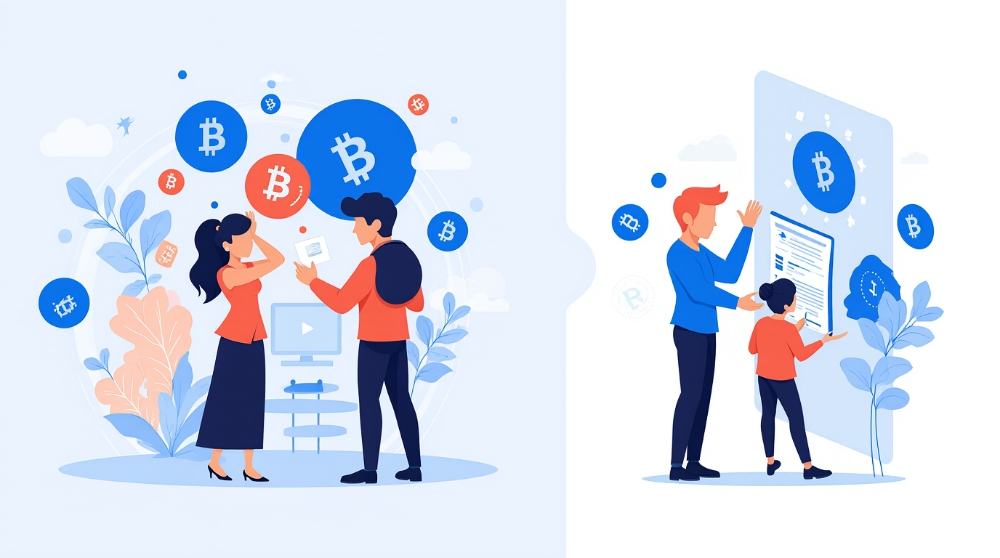
The Myth of Easy Entry
Many Web3 platforms promote simplicity:
“Create your wallet in seconds.”
“Start earning immediately.”
“Trade anytime, anywhere.”
But beneath this simplicity lies complexity.
New users must understand:
- Private keys
- Seed phrases
- Gas fees
- Network selection
- Token standards
- Smart contract permissions
One mistake can mean:
Permanent loss of funds.
Unlike traditional banking,
there is often no:
Customer support
Password reset
Transaction reversal
Freedom comes with responsibility.
But responsibility requires knowledge.
Technical Literacy as a Barrier
Financial inclusion requires accessibility.
But accessibility requires usability.
Web3 tools are powerful.
Yet many interfaces are built for:
Developers
Traders
Crypto-native users
Not beginners.
New users face:
- Confusing wallet interfaces
- Multiple network options
- Unclear transaction prompts
- Technical error messages
They are expected to:
Approve contracts
Manage permissions
Understand risk levels
Without prior training.
This creates a silent barrier.
The Risk of Self-Custody
Self-custody is one of Web3’s greatest strengths.
But also one of its biggest challenges.
Managing your own wallet means:
You are your own bank.
Lose your private key?
Your funds are gone.
Approve a malicious contract?
Your assets may be drained.
Send tokens to the wrong network?
They may become inaccessible.
Security depends on:
User awareness.
Not institutional safeguards.
Information Inequality
In traditional finance, expertise exists.
But institutions provide guidance.
In Web3:
Guidance often comes from:
- Online tutorials
- Influencers
- Community forums
- Social media threads
Information quality varies.
And misinformation spreads quickly.
Experienced users:
Understand security practices.
Recognize scams.
Avoid risky contracts.
Beginners may:
Trust the wrong link.
Approve dangerous permissions.
Interact with fake platforms.
Freedom without education can create vulnerability.
Language and Geographic Gaps
Web3 is global.
But resources are not always localized.
Documentation often exists in:
Technical English.
Users from:
Africa
Asia
South America
May face additional challenges:
- Language barriers
- Limited educational content
- Low access to support communities
Participation becomes uneven.
Opportunity remains theoretical.
The UX Problem
User experience is improving.
But still evolving.
Compare:
Opening a bank account
to
Using a decentralized exchange.
The difference in complexity is significant.
Many users choose:
Centralized exchanges
Custodial wallets
Because they offer:
- Simpler interfaces
- Customer support
- Familiar workflows
But this introduces:
New intermediaries.
Which Web3 was meant to avoid.
Does This Mean Web3 Fails?
Not necessarily.
Early internet tools were also:
Complex
Technical
Hard to navigate
Over time:
Interfaces improved.
Education increased.
Access expanded.
Web3 may follow a similar path.
But until usability matches accessibility,
financial freedom remains uneven.
The Education Imperative
For Web3 to succeed:
Education must scale.
Users must learn:
Security basics
Wallet management
Transaction verification
Risk awareness
Projects must invest in:
User-friendly design
Localized resources
Clear documentation
Freedom must be understandable.
Not just available.
Final Thought
Crypto offers new financial possibilities.
But possibilities are not guarantees.
Financial freedom cannot depend solely on:
Technical competence.
If only the technically skilled can participate safely,
inclusion becomes limited.
The future of Web3 depends on:
Making empowerment intuitive.
Not just possible.