The Taste of Midnight Rain
Even when the sky is dry, even when the cafés spill laughter into the streets and the world feels too alive to ache — there’s still that quiet hum in the air, that lingering promise of a storm. Maybe that’s why I never left. I’ve always felt that rain and I understood each other — the way it hides the tears, the way it silences the noise.
I met him on a night when the rain had returned to claim the city.
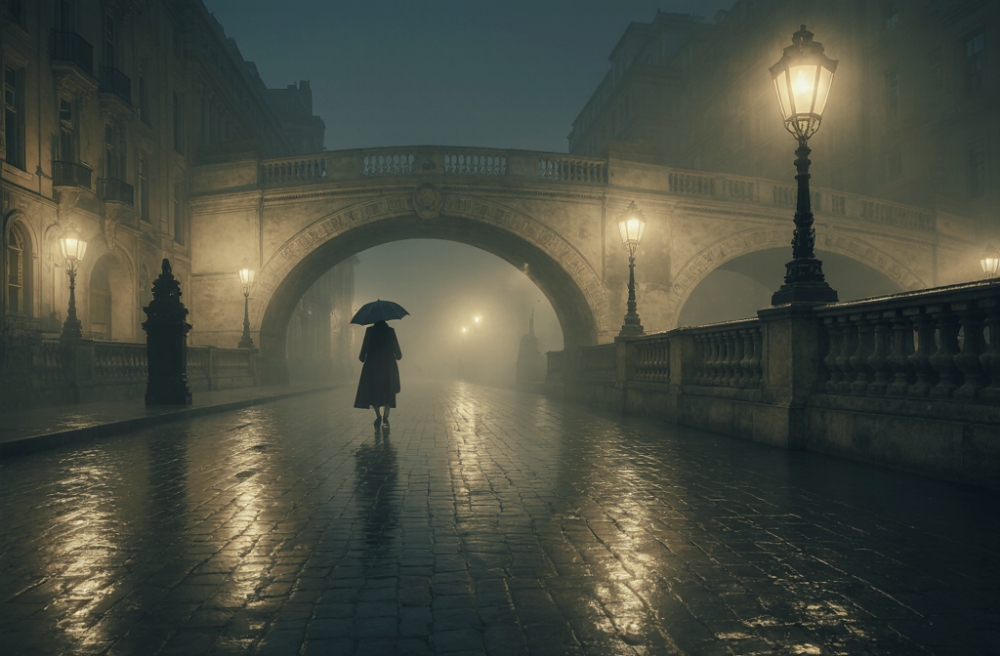
It was one of those storms that made everything shimmer — streets glossed like mirrors, light bending around puddles, the Seine breathing mist. I was leaving a gallery in Montmartre, my umbrella long gone, my shoes soaked through. I wasn’t supposed to be there. I had gone only because a friend insisted, because I couldn’t stand another night alone with my thoughts.
And then — he was just there.
Standing under an awning, his coat dark with rain, a book in his hand, watching the street as though he were waiting for something that might never come. Our eyes met, and something inside me paused — not in shock, not in recognition, but in quiet certainty, the kind you feel when a song you’ve never heard somehow knows your name.
“Bonsoir,” he said.
His voice was warm, unhurried — the kind of voice that made you forget the sound of rain for a moment.
I smiled, though I didn’t know why. “Bonsoir.”
“Are you lost?”
“Maybe,” I said. “Or maybe I just like walking in circles.”
He laughed softly, that faint, knowing laugh that said he understood more than he should. “Then perhaps you need a companion for one of those circles.”
I should have said no. It was late, and Paris at midnight belonged to ghosts and dreamers. But something in his eyes — that mixture of melancholy and mirth — disarmed my logic.
“Why not,” I said.
And so we walked.
The rain fell harder, drumming against rooftops, spilling down gutters, but neither of us cared. We wandered past shuttered bookstores, past cafés that smelled of espresso and sleep, past old bridges that looked like they’d been crying for centuries.
He told me his name was Luc — light — which felt like irony, because his presence was all shadow and soft gravity. He spoke like someone who had once loved too deeply and paid the price.
I didn’t tell him much about myself. Only that I painted. That sometimes the city felt too heavy to hold, that I painted to keep from breaking.
“Do you ever paint the rain?” he asked.
“All the time,” I said. “But it always looks sad.”
“Maybe it’s not sad,” he said. “Maybe it’s just honest.”
That silence between us felt like a heartbeat. The kind that hurts and heals at the same time.
We found refuge in a café that hadn’t yet closed — one of those old, dim-lit places with fogged windows and chairs that creaked like they remembered too much. The waiter, half-asleep, served us two cups of coffee. Luc stirred his slowly, then looked at me.
“You look like someone who’s waiting for something,” he said.
“Maybe,” I answered. “Or someone who stopped waiting, but never really stopped hoping.”
He nodded, as though he knew that kind of ache. “Hope is stubborn like that.”
I wanted to ask him what he was waiting for, but something in his expression told me not to. There are questions that don’t need answers — only presence. So I listened instead. To the hum of the lights, the soft jazz leaking from an old speaker, the world dissolving outside the fogged glass.
Hours passed without us noticing. When we stepped outside again, the rain had slowed to a whisper. The streets gleamed, emptied, infinite.
“Walk me home?” I asked.
He didn’t hesitate.
The city was quieter now — only the sound of our footsteps, the faint hum of faraway taxis. We crossed Pont des Arts, the bridge of locks, glimmering faintly under streetlamps.
He stopped halfway and leaned on the railing, looking down at the river.
“Funny,” he said, “how people believe they can trap love in metal.”
“Maybe it’s not about trapping,” I said. “Maybe it’s about remembering. Even when love leaves, the lock stays.”
He turned toward me, and for a moment, the world felt still.
“Do you believe in love?” he asked.
I looked at him — really looked — at the rain still clinging to his lashes, the exhaustion hidden behind his calm, the softness that came from having survived something unnamed.
“I believe in connection,” I said. “In moments like this. Maybe that’s what love really is — not forever, just… truth.”
He smiled faintly. “That’s beautiful.”
We didn’t speak again until we reached my street — Rue des Martyrs, where the rain smelled of old flowers and bakery air. I stopped in front of my door.
“This is me,” I said.
He looked up at my building, then back at me. “It’s late.”
“I know.”
“You should rest.”
“I know,” I repeated. But I didn’t move.
For a moment, the silence grew too full. The air between us felt charged — not with words, but with everything we weren’t saying.
He reached out, brushed a strand of wet hair from my cheek, and his fingers lingered — just long enough to make me forget how to breathe.
Then he smiled. “Goodnight, Claire.”
I hadn’t told him my name.
Before I could ask how he knew, he was already walking away — disappearing into the silver mist like he had never existed at all.
I didn’t see Luc again for weeks.
But Paris is small when you’re haunted. I saw him in reflections — in puddles, in café windows, in the faces of strangers reading under the rain. I told myself it didn’t matter, that it had just been a night. But every brushstroke I painted seemed to remember him. Every raindrop felt like his voice saying my name again.
One evening, I found him again — or maybe he found me.
It was at the Musée d’Orsay, in front of a painting by Degas. The air smelled of varnish and time. I felt him before I saw him — that same gravity, that same silence that seemed to pulse.
“Still walking in circles?” he murmured beside me.
I turned. “Still waiting for someone who never comes?”
He smiled. “Maybe I’ve been waiting for you.”
The museum lights were fading; closing time. We walked out together, and Paris greeted us again with rain.
This time, I didn’t try to hide under an umbrella.
We crossed the river, talking about nothing and everything — about art, about loneliness, about how the city could hold so many lives and still feel empty.
And then he said quietly, “Sometimes I think people meet at the wrong time, and the right time never comes.”
I looked at him. “Maybe the right time is just the moment we decide to stay.”
He stopped walking. For a moment, the only sound was the rain.
“Would you let me see your paintings?” he asked.
I hesitated — not because I didn’t want to, but because my studio was a confession. Every canvas I’d touched since that night carried his shadow.
Still, I said yes.
My studio was small, tucked beneath the rooftops of Pigalle. The windows trembled in the wind, the city stretched below like an ocean of trembling lights.
He walked in slowly, looking around — at the unfinished canvases, the scattered brushes, the smell of turpentine and rain. Then he stopped in front of one painting.
It was of a bridge — Pont des Arts — under a storm. Two silhouettes stood in the middle, blurred by water.
“You painted this,” he said softly.
“I painted the rain,” I replied. “The rest… appeared.”
He turned toward me, eyes heavy with something unspoken. “You paint the truth, Claire.”
“Maybe,” I whispered. “But truth hurts.”
He stepped closer, so close that I could feel the warmth of him despite the chill. “So does beauty.”
That moment felt infinite. The city below seemed to fade — all that remained was the pulse between us, the rhythm of rain against glass, and the fragile certainty that some connections are not meant to be explained, only felt.
He reached out, took my hand. No words, no promises — just that silent exchange, that pulse of warmth saying I see you.
Outside, thunder rolled softly over the city.
Luc stayed until dawn.
We didn’t speak much. He read one of my sketchbooks while I painted. It felt like two souls breathing in sync, both afraid of what would happen when the morning came.
When the light finally broke through the clouds, I turned and found him watching me — not like a man in love, but like someone who had found peace for the first time in a long while.
“I have to go,” he said.
“Will I see you again?”
He hesitated. “If the rain allows.”
And then he was gone.
Weeks passed. The city dried. The rain became memory again.
I painted endlessly — rain, bridges, faces I couldn’t name. People began to notice. My gallery sold more in a month than in the last two years. Yet every success felt hollow without that quiet voice, without the sound of footsteps beside mine on wet cobblestones.
Then, one morning, a letter arrived. No name, no address — just the faint scent of petrichor.
Claire,
If you’re reading this, I’m somewhere the rain cannot reach. Don’t look for me. You were never meant to stay in my shadow. You paint light — don’t forget that. Thank you for walking with me, even for a moment. Some moments are entire lifetimes.
— L.
I don’t remember how long I stared at the letter. The ink had bled slightly, as though it too had been touched by rain.
That night, I went to the bridge. The sky was clear, but I carried an umbrella anyway — out of habit, or hope, I wasn’t sure. I walked to the center, where the locks glimmered under the lamplight, and stood there until the world blurred.
Maybe love isn’t about forever. Maybe it’s about finding someone who reminds you what rain sounds like again.
I closed my eyes.
And for a moment, I could taste the midnight rain — soft, fleeting, eternal.