The Story of the AEY Scandal
When Todd Phillips’s War Dogs hit theaters in 2016, many viewers assumed the plot was typical Hollywood exaggeration. It was hard to believe that in an industry dominated by massive defense contractors, the United States government could award a military supply contract worth hundreds of millions of dollars to twenty-somethings from Miami Beach-a high school dropout and a licensed massage therapist. Yet U.S. House committee reports, federal court records, and first-hand accounts reveal that reality was even more astonishing than the movie script.
The War in Afghanistan and the Demand for Post-Soviet Ammunition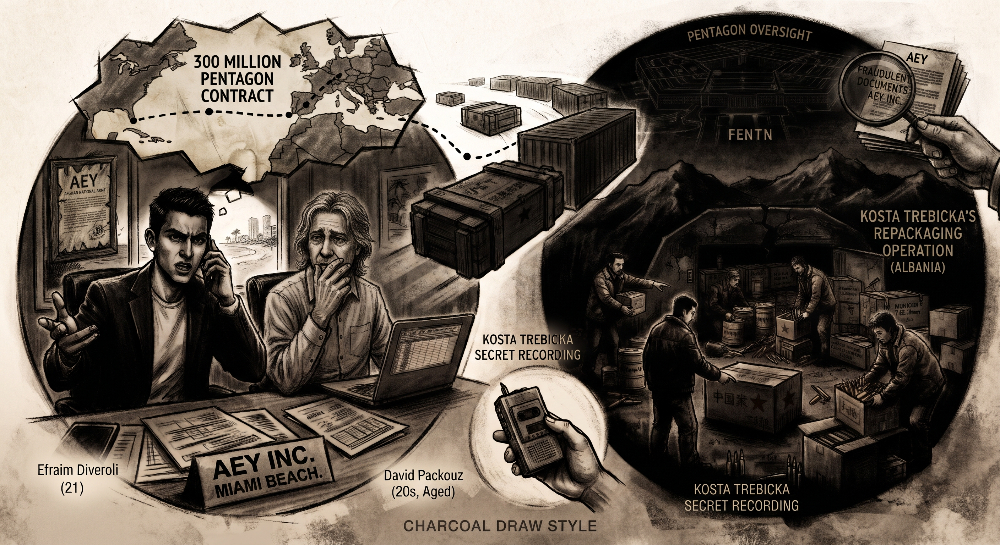
To fill the gap, the Pentagon had to look for suppliers capable of sourcing old stockpiles across Eastern Europe and the Balkans. To speed up procurement, officials opened the bidding process to smaller, previously unknown entities, allowing any contractor with the proper licenses to submit bids on the Federal Business Opportunities platform.
Efraim Diveroli stepped right into that niche. Expelled from school as a teenager, he learned the ropes working for his uncle’s police and firearms supply business in Los Angeles. After returning to Miami Beach, he struck out on his own under AEY, Inc.-a company formally incorporated by his father in 1999 that Efraim took over in 2005. He started with smaller orders, winning contracts to supply ammunition for special operations forces and helmets for the Iraqi army. As the volume of contracts grew, he brought in an old childhood acquaintance, David Packouz-a licensed massage therapist, small-time marijuana dealer, and aspiring musician.
An Offer the Pentagon Couldn’t Refuse
The turning point came with a solicitation to supply ammunition for the Afghan National Security Forces. To submit a competitive bid, Diveroli and Packouz needed a massive yet inexpensive source of supply. An intermediary named Heinrich Tomet pointed them toward stockpiles in Albania. Tucked away in mountain bunkers were vast Cold War-era reserves-including cartridges manufactured in the 1960s-that Tirana was eager to offload ahead of joining NATO. Notably, a U.S. House Oversight Committee investigation later revealed that Albania (like other countries in the region) had also offered to donate portions of its surplus stockpiles free of charge, an option the Department of Defense failed to pursue.
Working out of a modest office in Miami, the partners spent hours crunching ammunition prices and air-freight estimates in spreadsheets. They ultimately submitted a bid of $298,544,000 (later increased by an additional $8 million following a price adjustment on 122mm rockets). On January 26, 2007, AEY officially won the contract.
From the Army’s perspective, the math looked straightforward: a far more experienced competitor had priced the same job at over $500 million, meaning the Miami firm’s bid promised more than $200 million in taxpayer savings. Only later did the glaring flaws in the vetting process come to light. AEY’s paperwork contained falsified financial statements and numerous inconsistencies, and the company corresponded with military officials using a personal Gmail account. Even more troubling were the institutional oversights: according to congressional findings and Cato Institute analyses, officials failed to properly cross-check entities tied to the deal against State Department watch lists, and quality assurance essentially boiled down to whether the rounds fired when tested.
The Chinese Connection and the Repackaging Operation in Tirana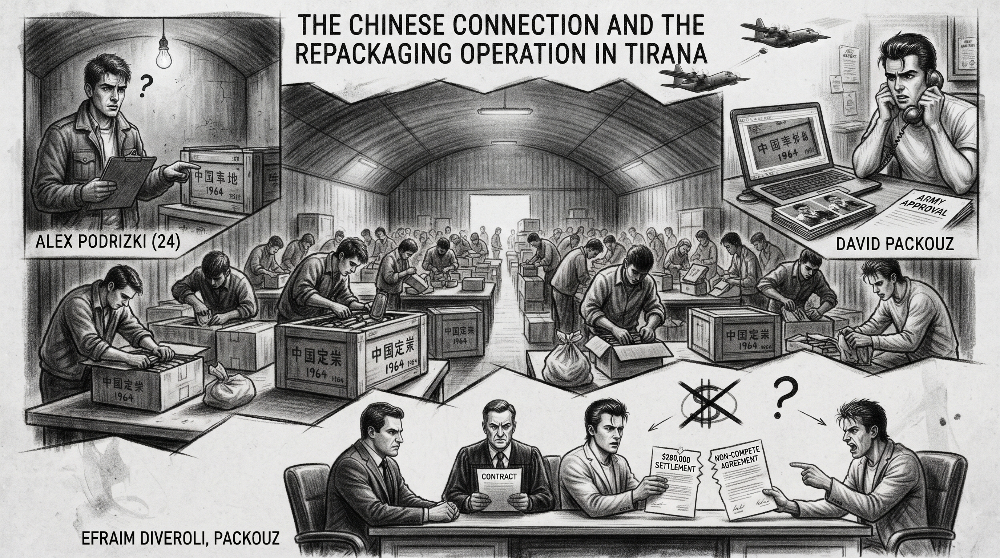
This posed a critical problem: U.S. regulations and the terms of the contract strictly prohibited supplying Chinese-made munitions. When the State Department denied a waiver, Diveroli and Packouz decided to conceal the origin of the cargo.
Air-freight expenses provided the convenient cover story. Heavy, 27-kilogram (60-pound) wooden crates and metal "sardine cans" drove up shipping weights just as fuel prices were surging. Packouz obtained Army approval to repackage the ammunition into lighter cardboard boxes, sending officials photographs of cartridges stripped of any Chinese lettering. In May 2007, an operation launched at the military section of Tirana’s airport in partnership with Albanian businessman Kosta Trebicka. Dozens of workers pried open the metal tins, removed paper labels bearing Chinese characters, and repacked millions of rounds into plastic bags and cardboard cartons.
Meanwhile, other crises mounted-from a shipment of Hungarian ammunition detained in Kyrgyzstan (where local authorities demanded steep daily storage fees) to an open rift between the partners themselves. When Diveroli attempted to unilaterally slash Packouz’s share of the profits, an explosive fallout ensued. The two parted ways in front of lawyers: Packouz accepted a $280,000 cash settlement, refused to sign a non-compete agreement, and launched his own firm to pursue government contracts independently.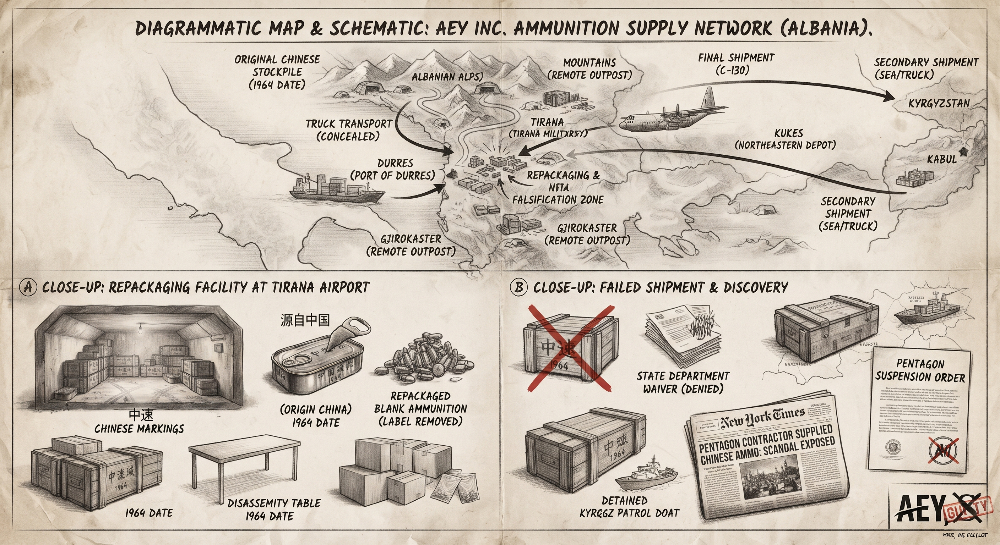
Secret Recordings, a Front-Page Exposé, and the Courtroom Finale
AEY’s downfall was accelerated by fallout inside Albania. Kosta Trebicka, after being sidelined from the lucrative repackaging job in favor of companies tied to local officials, grew convinced that corruption was driving the deal. In June 2007, he secretly recorded a phone call with Diveroli in which references were made to kickbacks and connections surrounding the head of Albania’s state arms-export agency, Ylli Pinari. Trebicka handed his findings over to U.S. investigators and journalists.
In August 2007, federal agents raided AEY’s Miami office, and on March 27, 2008, The New York Times published a front-page investigation exposing the delivery of aging, repackaged ammunition to Afghan forces. That same day, the Pentagon suspended AEY, and on May 23, 2008-after paying out roughly $66 million-terminated the contract for default. A few months later, on September 12, 2008, Trebicka was found dead beside his vehicle on a mountain road in southeastern Albania; although Albanian prosecutors and an American accident-reconstruction expert ruled it a traffic accident, his death sparked fierce political controversy for years.
In June 2008, a federal grand jury indicted the partners on 71 counts of procurement fraud, false statements, and conspiracy. Under plea agreements with federal prosecutors, all three pleaded guilty to conspiracy to defraud the United States:
- Efraim Diveroli was sentenced to 4 years in federal prison (while awaiting sentencing, he was caught in an undercover federal sting illegally accepting firearms in violation of his bail conditions). After serving his sentence and enduring a lengthy federal debarment, his eligibility to bid on U.S. government contracts was reinstated in 2022; he now works as an entrepreneur and business strategist.
- David Packouz was sentenced to 7 months of house arrest. He left the arms trade behind, returned to music, founded Singular Sound (creator of the popular BeatBuddy drum-machine pedal), and frequently discusses the scandal in interviews and podcasts.
- Alex Podrizki pleaded guilty to conspiracy and avoided prison time.
What Hollywood Changed
While War Dogs captured the sheer absurdity of the affair and the stark contrast between young Florida hustlers and the Pentagon’s war machine, the filmmakers took significant creative liberties. The movie’s tense nighttime drive through Iraq’s "Triangle of Death" was invented for action-thriller pacing; in reality, the core field operations and inspections took place in Albania, Bulgaria, and Hungary. The film also leaned heavily into dark comedy, leaving in the background the harder-edged conclusions of the congressional probe: systemic breakdowns in Pentagon oversight and the political corruption surrounding the sell-off of Cold War arsenals in the Balkans.
Resources:
http://www.youtube.com/watch?v=SocRx50oSik
https://oversightdemocrats.house.gov/imo/media/doc/migrated/20080624102358.pdf
https://www.slashfilm.com/1824881/war-dogs-true-story-explained/
https://www.alphaguard.ai/news/war-dogs
https://www.youtube.com/watch?v=N00g-LUZnDQ