Bitcoin in Geopolitics: The Battle of Supremacy Between ‘Digital Gold’ and Fiat Currency

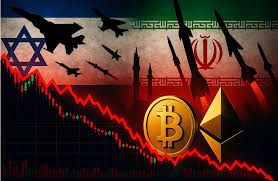
However, a profound question naturally arises—if Bitcoin is such a valuable and reliable asset, why has it not yet fully transformed into the primary global currency for international trade?
Let us dive deep into the hidden mysteries and the geopolitical power struggle behind this.
👑 The Power Struggle: Who is Pulling the Strings?
Despite the skyrocketing demand for Bitcoin today, the main reason it has not directly transitioned into a global currency is the resistance from mega-giant corporations (such as BlackRock, Fidelity, MicroStrategy), imperialist states, and a specific hyper-powerful elite group. Sounds puzzling? Let us unravel the core of this labyrinth.
First and foremost, we must recognize a mysterious group—the "Rothschilds".
This is a clan often referred to as the unwritten kings of the global economy and wealth. It is estimated that approximately 80-90% of the world's total wealth is directly or indirectly controlled by their influence, and they dominate the largest corporate giants. Their primary weapon for accumulating this vast wealth is none other than Fiat Currency or Paper Money.
📜 What History Tells Us: The Fall of the Gold Standard and the Birth of the Petro-dollar
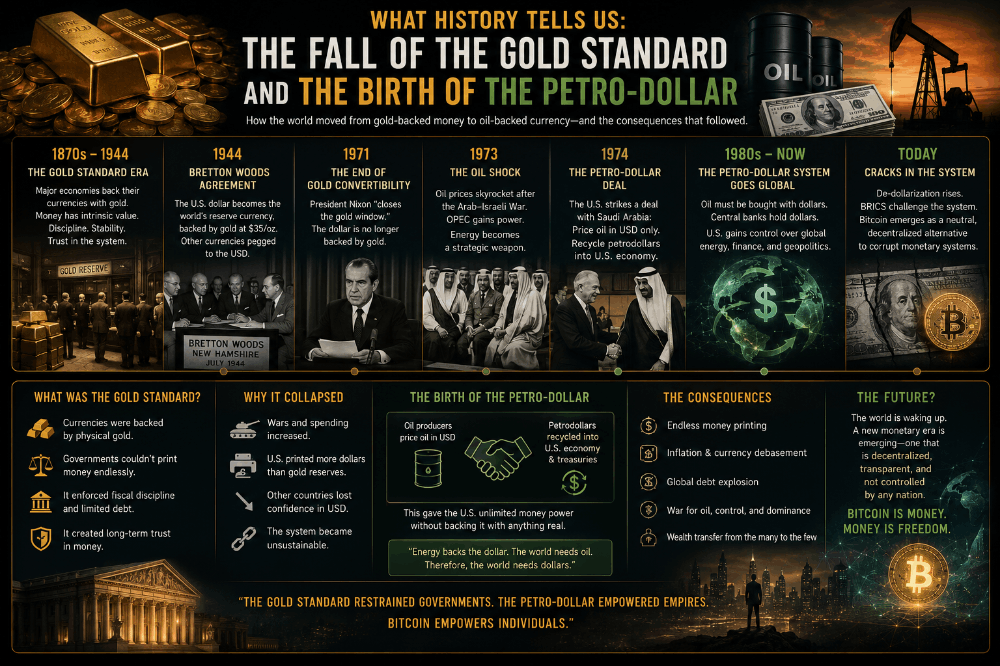
Following the Second World War—and since the Islamic empires had already fallen prior to this—a new imperialist superpower emerged on the world stage: the United States. Seizing this opportunity, and under the far-reaching strategy of the Rothschild group, paper money was imposed globally as the primary currency, replacing actual gold and silver coins (Dinar and Dirham). The "Petro-dollar" agreement was forcefully executed through America. Consequently, gold ceased to function as a currency and became merely a commodity—measured and valued by paper fiat currency, specifically the dollar.
This historic monetary manipulation was achieved through two major historic steps:
- The Bretton Woods Agreement [1944]
- The Petro-dollar Agreement [1974]
🏛 The Bretton Woods Agreement (1944) and the Hidden Trap
At first glance, the stated objectives of the Bretton Woods Agreement seemed highly noble:
- To promote international monetary cooperation.
- To facilitate the balanced expansion and growth of international trade.
- To promote exchange rate stability and prevent competitive currency devaluations.
- To provide temporary financial assistance to member states experiencing economic crises.
But what was the ultimate outcome?
- 1 ounce of gold was pegged at 35 US Dollars.
- The currencies of other nations were pegged at a fixed rate to the US Dollar.
- The US Dollar practically became the world's primary reserve currency, and this very agreement gave birth to the IMF (International Monetary Fund) and the World Bank.
⚠️ The Real Game Occurred in 1971: US President Richard Nixon introduced the "Nixon Shock", unilaterally terminating the international obligation to convert US dollars into gold. The Bretton Woods system practically collapsed, but we are still suffering from its toxic aftermath today. The Rothschilds first turned paper currency into a global reserve through an international treaty, and later, to ensure their ultimate abuse of power, they broke the system themselves to secure an absolute license to print unlimited paper money.
Gold Standard vs. Fiat Currency: The Twin Economic Paradigms
Human greed, excessive demand, and the urge for hyper-fast transactions paved the way for the downfall of gold coins. Remember—anything that moves too fast might give temporary gains, but it is the first to collapse in the long run. On the other hand, what moves steadily survives. To understand this clearly, we must examine the economic arguments of both sides:
🔶 Side 1: The Gold Standard — The Concept of a Stable Economy
Historically, the gold and silver-based monetary system was the most enduring form of money. During the medieval Islamic Golden Age, a vast network of international trade was successfully operated from Baghdad to Cordoba using Dinars and Dirhams. Its core strengths were:
- Price Adjustment (Deflation): Since the supply of gold is naturally limited, increased production causes the prices of goods to naturally fall. This allows the same amount of money to buy more goods, directly elevating the public's standard of living.
- Protection of Savings: Because governments cannot devalue the currency by printing endless money, the hard-earned savings and wealth of ordinary citizens remain protected over the long term.
- Transparency in Credit: Since the value of money remains stable, there is no room for artificial economic manipulation or financial fraud.
🔷 Side 2: Fiat Currency — The Reality of Modern Economics
According to modern economists, a limited gold supply is impractical for running a multi-trillion-dollar global economy and rapid digital transactions. Their arguments include:
- Economic Flexibility: During times of crisis, the central bank can increase the money supply to maintain liquidity in the market, preventing a total economic collapse.
- Incentivizing Investments: A mild rate of inflation encourages people to invest their money into businesses rather than hoarding it, thereby keeping the flow of money active.
🔍 Where is the Real Problem? Limited Supply and the 'Deflationary Spiral'
Many might argue that gold can be divided into tiny fractions to conduct trillion-dollar trade. However, the real issue is not about fractionalization; the core problem lies in the mismatch of a "Fixed Money Supply vs. a Flexible Economy".
The physical supply of gold (or Bitcoin, which is strictly fixed at 21 million) is finite, while the population, production, and demand for credit are constantly growing. Because of this mismatch, if gold or Bitcoin is applied directly as a currency within a fiat economic framework, it triggers a catastrophic economic collapse known as a 'Deflationary Spiral':
- Demand Delay (Purchasing Delay): When people know that the value of money is constantly rising and a product worth $100 today will cost $90 next month, they will postpone major expenses like buying a house, a car, or gadgets. This psychological trap is called 'Deflationary Expectation'.
- Halted Production and Layoffs: As consumers delay their purchases, market demand plummets, and unsold goods pile up in corporate warehouses. Facing a collapse in profits, companies are forced to initiate mass layoffs to survive.
- Salary Rigidity: In a deflationary market, it is legally and socially difficult to abruptly cut employee wages. As a result, companies choose to entirely terminate jobs instead of reducing pay. The ordinary person who thought falling prices would benefit them ends up with a net income of zero due to job loss!
- Fixed Loan Repayment Burden: While the real purchasing power of money rises during deflation, the fixed monthly installment or principal of a bank loan remains unchanged. Consequently, the real burden of debt becomes overwhelmingly heavy relative to falling incomes, driving citizens and businesses into bankruptcy.
- Investment Delay: Large investors pause their plans, thinking: "Why set up a factory with machinery costing $10 million today when I can buy it for $8 million in six months?" This delay stifles job creation and paralyzes national economic growth.
To avoid this severe stagnation, modern central banks intentionally maintain an annual inflation target of roughly 2% in the fiat system, forcing people to spend or invest their money in the market rather than hoarding it out of fear of loss.
The Balanced ‘Islamic Solution’ to This Macroeconomic Crisis
Does this mean fiat currency is the superior system? Absolutely not. By printing paper money out of thin air, central banks are continuously robbing wealth directly from the pockets of ordinary people. Islam provides a complete code of life, offering a brilliant and natural solution to this macroeconomic gridlock. [It is worth noting that in this discussion, 'Gold' can also represent its digital counterpart—Bitcoin.]
An Islamic economy utilizes several revolutionary micro and macro tools to eliminate the threats of fiat blackmail, liquidity crises, and deflationary stagnation:
1. Weapons to Reverse Liquidity Crises and Investment Stagnation:
- Zakat and Infaq (Mandatory Wealth Circulation): Hoarding idle wealth (Kanz) is strictly forbidden in Islam. If a person's wealth meets the threshold (Nisab), they are obligated to give 2.5% of it as Zakat annually. Consequently, if someone leaves their money idle in a vault, their wealth depreciates by 2.5% every year. Out of the fear of this net loss, investors are compelled to keep their capital active in the market. This entirely prevents liquidity crises or investment stagnation.
- Baitul Mal (Emergency Sovereign Fund): This is not merely a revenue collection department; it functions as an emergency national reserve fund. When a severe market depression or liquidity crunch arises, the Baitul Mal injects cash directly into productive sectors.
- Qard al-Hasan (Interest-Free Institutional Loans): During crises, the Islamic central authority provides emergency interest-free loans to commercial banks or vital businesses. Since no interest burden accumulates, viable businesses do not abruptly go bankrupt.
- Automatic Stabilizer of the Zakat Fund: During economic downturns when people lose jobs or revenues drop, the distribution of the Zakat fund is massively accelerated. This places cash directly into the hands of the most vulnerable citizens, sustaining the minimum purchasing power (Demand) and keeping the market from grinding to a halt.
2. A Debt-Free and Humane Corporate Culture:
- The Prohibition of Usury (Riba) and Profit-Loss Sharing (PLS): Conventional usurious loans—where the borrower must return the principal plus a fixed interest regardless of business profit or loss—are completely prohibited in Islam. Instead, it promotes Investment Funding through models like Mudarabah and Musharakah. Here, instead of fixed interest, equity or actual profit-and-loss are shared. If a business's revenue drops during a market slowdown, the investor's return automatically scales down, shielding the entrepreneur from the crushing debt traps of the fiat economy.
- Humane Labor Market: To protect corporate profits, Islam discourages arbitrary mass layoffs. It maintains a compassionate balance between employee productivity and the cost of living.
3. Countering Global Trade Shocks and Monetary Contraction:
- Self-Reliance in Essentials: Relying 100% on external hostile powers for strategic essentials like food, medicine, and defense equipment is restricted in Islamic policy. The state must maximize domestic production.
- Regional Blocks and Intra-Communal Trade: Islam emphasizes internal trade within the global Ummah or allied regional blocks (Intra-regional Trade). If western or global supply chains collapse, these regional blocks survive by exchanging raw materials and resources among themselves.
- Asset-Backed Monetary System: When currency is backed by gold, silver, or real physical assets, no central bank can artificially manipulate the market by arbitrarily expanding or contracting the money supply by 2% or 5%. The currency volume stabilizes naturally. This aligns with the clear divine directive of the Holy Quran: "So that wealth may not merely circulate among the rich among you." (Surah Al-Hashr: 7).
The Core Conclusion
The Islamic economic solution is not a superficial magic trick. One cannot simply open an "Islamic Window" or an isolated Islamic bank within the dirty framework of conventional fiat currency and usurious rules and expect a systemic cure.
The true benefits of Islam's economic model materialize only when a sovereign state or a powerful economic block merges both the micro layer (Zakat, Mudarabah, Infaq) and the macro layer (an interest-free monetary framework, Baitul Mal, and an asset-backed real currency) into a completely independent, unified economic ecosystem. Until this integrated structure is built, we are bound to suffer the systemic evils of the global capitalist fiat framework.
📊 Decoding Credit: Transforming Idle Capital Into Productive Power
To fully grasp how the Islamic model rectifies modern finance, we must understand the actual structure of 'Credit'. Credit is not inherently evil; it is a vital tool. Modern economics operates on four distinct dimensions of credit:
- Traditional Loan (Conventional Debt): The most common form of credit. A borrower takes capital for a fixed tenure under rigid conditions, almost always in exchange for interest. The lender bears zero business risk; whether the business makes a profit or suffers a loss, the borrower must repay both the principal and interest. Islam completely bans this form of credit.
- Investment Funding: Capital provided not as a mere loan, but based on equity partnerships and future potential. Venture Capitals (VCs) and Angel Investors provide this funding to startups or mega projects. It brings innovation to the economy by sharing equity instead of charging interest, aligning closely with Mudarabah and Musharakah.
- Bank Lending: Commercial banks providing massive pools of funds to productive sectors and entrepreneurs (e.g., setting up factories, raw material imports via Letters of Credit or LCs). By lending out public deposits, banks keep market liquidity active. If bank lending halts, a nation's GDP collapses instantly.
- Business Expansion Capital: Large-scale institutional credit or bond issuance used by an ongoing business to scale up, open new branches, or enter international markets. This form of credit directly generates new jobs and multiplies national production.
The Islamic Paradigm: Islam does not deny the vital necessity of these financial mechanisms. It completely prohibits Type 1 (Traditional Usurious Loans), but heavily encourages Types 2, 3, and 4—provided they are structured on an interest-free, equity-based (Asset-Backed), and risk-sharing basis. Credit then ceases to be a burden of slavery; it becomes a powerful engine that mobilizes idle capital to keep the economy dynamic.
This effectively dismantles the core arguments of conventional economists who claim a fixed money supply cannot support growth. Yet, they will continue to champion fiat currency because they are obsessed with GDP. We will uncover how deeply flawed this modern obsession with GDP is in our upcoming discussions.
🎭 The Puppet Masters: Beyond the Rothschilds
As established earlier, fiat currency is an inherently manipulative mechanism—a "satanic currency". But are the Rothschilds the absolute controllers of this fiat machine? In short: No.
The Rothschilds are merely the 'managers' of the global financial matrix. To put it simply: consider a factory run by a manager. The workers follow his commands, but he does not own the factory; he is controlled by the ultimate owner. In this global setup, the Rothschilds are the managers, while the Royal Families are the true owners.
These elite Royal Families engage in dark occult practices and devil worship (the evidence of which we will explore in future writings). They have strategically weaponized the global fiat economy as their ultimate instrument to expand and cement their absolute control over humanity. Through this printed paper illusion, they have successfully drained physical gold out of the public domain into their private vaults, monopolizing half the world’s actual wealth.
So, how does all of this connect to Bitcoin, and how will Bitcoin alter global geopolitics? Let us journey into the deepest layer of this battle.
🚀 The Geopolitical Shield: Iran’s Strategic Move and ‘Petro-Bitcoin’
Looking at the current world order, we see a massive global awakening—sovereign nations and citizens are rising against Western imperialism and losing all faith in the US dollar due to weaponized inflation. The modern conflicts in the Middle East serve as a textbook example.
When the United States failed to impose its westernized socio-political ideology on Iran, it unleashed brutal dollar-based economic sanctions. This caused the Iranian Rial to devalue, crippling their international trade and shrinking national revenues while triggering hyperinflation. Yet, Iran did not break. They went on to engineer highly sophisticated, uninterceptable ballistic missiles (such as the Sejjil and Khorramshahr) and pioneered the world's first advanced water drones, neutralizing high-tech Western military hardware.
How did a nation under crushing sanctions fund such advanced military development? This is where the geopolitical chess grandmaster move took place: Iran relied on a decentralized technology—Bitcoin.
Bitcoin cannot be frozen, destroyed, or controlled by any sovereign state or corporate giant. It operates entirely on immutable mathematical algorithms, sustained by thousands of global nodes, miners, and the collective trust of millions of people. Even if only one person on earth runs the original Bitcoin source code, the system survives. Imperialist cartels cannot corrupt the main chain; the most they can do is create a separate hard fork or an alternative chain, which the global public will eventually ignore in favor of the secure, original long-term ledger.
Because physical gold transactions can still be intercepted and blocked globally, Iran utilized Bitcoin as an unblockable economic shield. Furthermore, Iran exposed the ultimate global truth: paper currency is a sophisticated trap designed by imperialists to strip nations of their sovereignty.
⚓ The Strait of Hormuz and the Rise of the Petro-Bitcoin (2026)
Approximately 60% of the world's oil transit passes through the crucial Strait of Hormuz, which falls directly within Iran’s geopolitical jurisdiction. In a brilliant strategic move, Iran instituted a revolutionary toll law: The Strait of Hormuz Toll Regulation.
Under this framework, passing mega-tankers are mandated to pay their transit fees exclusively in millions of dollars worth of either Bitcoin or Chinese Yuan. By prioritizing Bitcoin, Iran ignited a monumental shift in global trade. Leading geopolitical analysts are now designating this phenomenon as the birth of the "Petro-Bitcoin"—the ultimate death knell for the unbacked hegemony of the US Dollar.
Witnessing this, other sovereign powers like China, Russia, and India have realized that operating entirely within the dollar matrix equals voluntary enslavement. This has supercharged the expansion of the BRICS alliance, accelerating global de-dollarization to establish a multi-polar world where fiat currency values stabilize evenly, eliminating Western economic coercion. However, for settlement of mega-reserves like oil, gas, and mineral minerals, the world requires an absolute decentralized reserve asset—and that is the Digital Gold, Bitcoin, a reality Iran has already actualized.
🔄 Iran's Double Game Changer & The Trap of 'Bretton Woods 2.0'
Why is Iran playing a dual game by stockpiling Bitcoin while simultaneously trading in fiat currencies within the BRICS alliance? This is a masterstroke of economic foresight.
Iran knows that even if BRICS successfully dismantles the US dollar, any nation within a new fiat system could eventually manipulate its own paper currency to build a new empire of financial imperialism. When all fiat currencies eventually reach an equilibrium of value, nations will desperately seek an absolute, decentralized asset to secure their sovereign reserves. That asset is Bitcoin. Just like El Salvador, which relentlessly accumulates Bitcoin regardless of market price volatility, Iran is aggressively building its digital reserves.
Iran's "Double Game" ensures total immunity: they bypass the dollar via BRICS fiat trade, while aggressively hoarding hard decentralized assets through the Strait of Hormuz Bitcoin tolls. In the coming century, global power will belong exclusively to those who hold the largest sovereign stocks of Bitcoin. Those who remain trapped chasing unbacked paper currencies will find no economic liberation; they will walk straight into the trap of Bretton Woods 2.0.
The Trap of Bretton Woods 2.0
The global elite and the Rothschild network are fully aware that public faith in paper fiat currency is dying, threatening the collapse of their financial empire. To preserve their supremacy, they are executing a calculated pivot toward Digital Gold.
Since Bitcoin is strictly capped at 21 million units, it is far scarcer and more valuable than physical gold. Because they cannot print it infinitely, they are absorbing it through Institutional ETFs (Exchange Traded Funds)—led by corporate monoliths like BlackRock.
The ETF mechanism is a brilliant illusion: when ordinary retail investors buy a Bitcoin ETF, the actual, underlying Bitcoin is transferred directly into the corporate vaults of these mega-institutions. In return, the public is handed a mere "Contract Paper" or a digital receipt.
If these corporate cartels successfully corner 80% of the circulating Bitcoin supply, they will push it entirely out of the reach of the masses. Once the real asset is securely locked in their vaults, they will launch a new layer of digital fiat currencies or Central Bank Digital Currencies (CBDCs) backed by their institutional Bitcoin holdings. This is the exact blueprint of the 1944 Bretton Woods agreement. Just as they stripped humanity of physical gold coins in the 20th century to impose a "satanic paper currency", Bretton Woods 2.0 aims to confiscate actual Bitcoin to trap humanity in a new digital panopticon.
Final Guidance: Defeating the Matrix
There is absolutely no reason to despair. The game is far from over. As of today, the vast majority of the circulating Bitcoin supply remains completely outside the grasp of corporate and imperial cartels.
If we cast aside financial illiteracy and actively accumulate and hold actual, self-custodied Bitcoin—just as visionary sovereign states like Iran and El Salvador are doing—the elite's master plan for Bretton Woods 2.0 will completely shatter. These sovereign nations are systematically insulating themselves from Western financial blackmail.
Let us embrace Bitcoin, take control of our financial destiny, and break free from the chains of fiat slavery. Remember, the Rothschilds did not accumulate the world's physical gold overnight through America; it took them decades. Similarly, they cannot instantly monopolize Bitcoin. This transitional window of institutional accumulation is our ultimate historical opportunity to exit the financial trap and secure true sovereignty.