THE COMPUTE CRISIS. Healthcare’s Digital Revolution vs. Infrastructure Limits

In my previous post, I defined my transition from a traditional Web2 copywriter to an Independent Web3 Researcher and Content Architect. I stated that the future of digital creation belongs to those who build deep networks of knowledge rather than those who simply chase algorithms for pennies. To demonstrate what this high-level approach looks like in practice, we must dive into one of the most critical, data-heavy intersections of our decade: the digital revolution in global healthcare and the massive infrastructure bottleneck threatening its progress.
Modern healthcare is currently facing a silent, existential crisis of scale. Every single day, the global medical ecosystem generates petabytes of complex, unstructured data. We are talking about high-resolution MRI and CT scans, complex genomic sequences, real-time biometric feeds from critical care units, and decades of fragmented, siloed patient histories.
The core problem is that our traditional medical infrastructure still relies heavily on archaic human cognitive limits. Doctors are profoundly overworked, diagnostic errors persist due to sheer cognitive fatigue, and critical, life-saving patterns in rare or aggressive diseases often go completely unnoticed until it is too late. The human brain, brilliant as it is, was simply not designed to process the exponential, terabyte-scale volume of modern medical data alone. This is no longer just a biological challenge; it is a massive, urgent computational one.
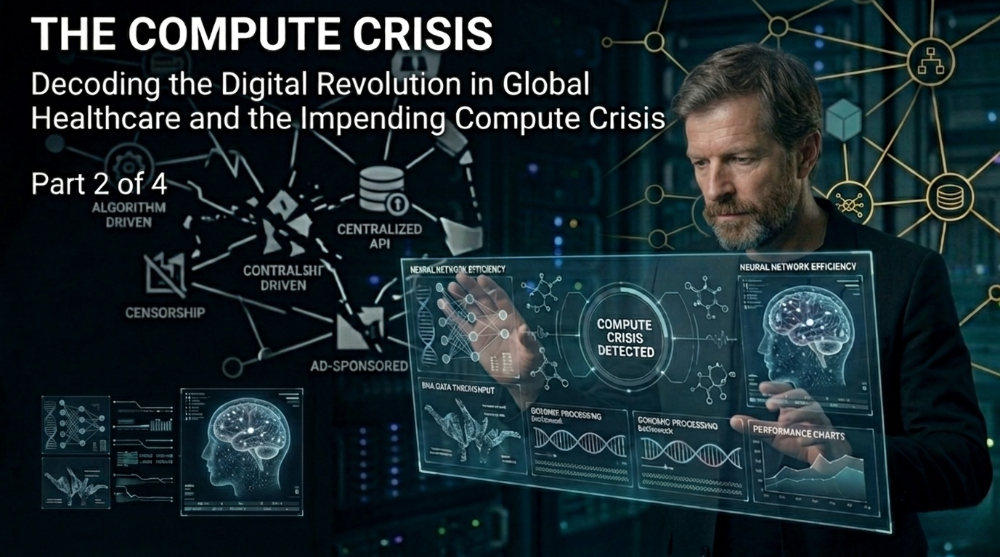

Decoding Complexity: How Neural Networks Redefine Diagnostic Precision
When we look at advanced technology in medicine, we are not talking about sci-fi robots replacing doctors. We are talking about the deployment of advanced neural networks and deep learning architectures as the ultimate analytical lens for human specialists. Where a radiologist looks at a multi-layered, highly complex scan and must rely on sight and experience under pressure, a trained convolutional neural network (CNN) processes the image as a dense, hyper-precise matrix of mathematical pixel values. It can detect micro-anomalies measured in millimeters that are statistically invisible to the human eye.
The real-world impact of this computational shift is already unfolding across three massive clinical fronts:

1 Early-Stage Oncology and Computer Vision
In cancer treatment, early detection remains the single most important variable dictating survival rates. Traditional screening often catches tumors only after they have grown large enough to cause structural changes. Today, advanced computer vision models can screen tens of thousands of mammograms, chest X-rays, or lung scans simultaneously. By cross-referencing these scans against massive datasets of known pathologies, the system flags micro-calcifications and cellular irregularities years before they present clinical symptoms.
2 Genomic Sequencing and the Demystification of Rare Diseases
Mapping a single human genome generates roughly 200 gigabytes of raw data. To find a single genetic mutation responsible for a rare disease, researchers must analyze variations across approximately 3 billion base pairs. Historically, this was a needle-in-a-haystack problem that forced families into a multi-year loop of clinical visits and misdiagnoses. Today, deep learning architectures can process these vast genomic datasets in minutes, instantly cross-referencing global medical registries to pinpoint hereditary disorders with absolute precision.
3 Predictive Cardiology and Real-Time Biometric Streams
Traditional medicine is reactive—we treat the heart attack after it happens. The digital revolution shifts healthcare into a proactive, generative model. By routing continuous data streams from wearable medical sensors and clinical monitors through predictive neural networks, systems can analyze subtle, compounding anomalies in heart rate variability, blood oxygenation, and micro-capillary blood flow. The algorithm detects the signature of a looming cardiovascular event hours before acute physical symptoms manifest, saving lives before the emergency occurs.
From Trial-and-Error to Generative Medicine: The Biotech Revolution
The disruption goes far beyond diagnostics. Advanced digital models are fundamentally reshaping how therapies and pharmaceutical innovations are designed from scratch. The traditional drug discovery pipeline is notoriously broken. It is a slow, multi-billion-dollar process of trial-and-error where researchers manually test thousands of chemical compounds in physical laboratories, hoping a molecule will bind correctly to a target disease protein. It takes an average of 10 to 12 years and over $2 billion to bring a single drug to market, and the vast majority of compounds fail late in clinical trials.
Generative technologies and advanced molecular modeling have completely flipped this paradigm on its head. Specialized AI architectures, such as Google DeepMind’s AlphaFold, have successfully predicted the 3D folding structures of virtually all known proteins. Why does this matter? Because a protein's shape dictates how it functions and how it interacts with drugs. Instead of blind guessing in a physical lab, researchers now use deep learning models to simulate millions of molecular interactions in a virtual environment within hours. We can now design bespoke, synthetic molecules engineered from the ground up to target specific cellular structures of complex diseases. Medicine is transitioning from a slow, reactive science of treating symptoms to a precise, generative science of programming cures.

The Centralized Bottleneck: The Unspoken Compute Crisis
However, as an independent researcher, my job is to look past the corporate press releases and analyze the underlying infrastructure. And right now, this entire technological medical renaissance is heading straight into a massive, heavily centralized bottleneck: The Compute Crisis. To train a single neural network capable of accurately identifying rare pathologies, processing genomic data, or running molecular simulations, you need an astronomical amount of high-performance computational infrastructure. These advanced models require uninterrupted access to thousands of enterprise-grade GPUs (like Nvidia’s H100 or H200 chips), immense distributed storage systems, and highly reliable processing nodes.
Currently, this infrastructure is heavily monopolized by Big Tech corporations and a handful of centralized cloud providers (Amazon AWS, Microsoft Azure, Google Cloud). This creates a highly dangerous environment for global health innovation for three critical reasons:
1. Financial Exclusion: The cost of renting high-end computational power from centralized providers is skyrocketing. Independent research laboratories, public universities, and medical startups are being systematically priced out of the market. If a breakthrough analytical model cannot secure millions of dollars in funding just to pay for cloud computing time, the research stops. Innovation becomes a luxury only mega-corporations can afford.
2. The Privacy and Legislative Paradox: Medical data is highly sensitive and protected by strict global frameworks like HIPAA in the United States or GDPR in Europe. Healthcare networks cannot legally or ethically dump raw patient records into centralized corporate cloud servers due to immense data-leak risks and surveillance concerns. Centralization actively stifles the collaboration needed to train smarter medical models.
3. Structural Vulnerability: Relying on a few centralized data centers means global healthcare research has a single point of failure. If a corporate provider changes its pricing structure, updates its terms of service, or suffers a major regional outage, critical medical projects worldwide can be throttled or shut down instantly.


Conclusion: The Blueprint for Sovereign Infrastructure
The digital revolution has fully proven its capabilities. The science is solid, the algorithms are written, and the potential to eradicate complex diseases is within our grasp. But the foundation upon which this entire future rests is structurally fragile and dangerously monopolized. To make life-saving medical AI truly global, affordable, and resilient, we must fundamentally decouple computational power from corporate gatekeepers. We need a sovereign, decentralized infrastructure that cannot be throttled, overpriced, or compromised by a single corporate entity.
In the next part of this analytical series, we will examine the structural solution to this crisis. We will explore how Decentralized Physical Infrastructure Networks (DePIN) are step-by-step breaking the tech monopoly, turning idle computing power across the globe into a massive, censorship-resistant, and highly accessible supercomputing network capable of fueling the future of global medicine. Stay tuned.

Don't miss the next parts — follow for more insights! 🚀
Disclaimer: This series is for informational and educational purposes only. It does not constitute financial, investment, or legal advice. Research and evaluate projects independently before participating in any decentralized networks or tokenized ecosystems.