Crypto Market 2026: Between Calculation and Stillness
In a corner of Palsigunung Terminal, an old man sits atop a used shipping container. His name is Rasid. In his hand, a phone with a cracked screen—like a shattered map, yet he still traces its paths. He opens an orange-colored app. Green and red numbers move up and down, like the heartbeat of someone in fever. He doesn't understand blockchain. He's never heard the term hash rate. But he knows this: three years ago, his neighbor Sandi—once a vegetable delivery boy—can now buy a house from something called dogecoin. Rasid followed along. Saving from his fried snack sales. Then the market crashed. And now he still sits here, staring at the screen, waiting for who knows what—like a man waiting for rain in a long drought.
We call it crypto. A word that sounds like the name of a skin disease, or a kind of spell that can only be whispered in expensive cafés. But for Rasid, it is the last hope—a candle burning in a blackout, one that might be extinguished by the wind at any moment.
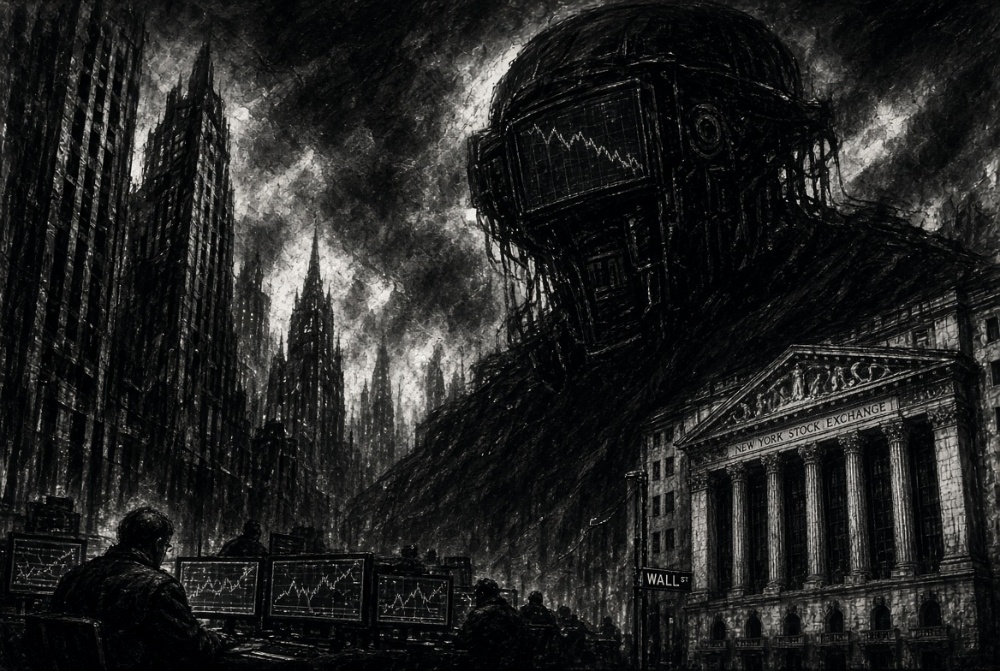
The year 2026 is said to be a transition phase. According to experts: crypto is starting to behave like a macro asset. It no longer stands alone on a deserted island; it has boarded a great ship called the Traditional Market. There are ETFs, institutional adoption, pension funds quietly buying Bitcoin. And so we ask: is this victory? When something born as a protest against the system—an open letter from Satoshi Nakamoto about irresponsible central banks—is now embraced by that very same system? Or as the saying goes: The devil bites his own tail.
One afternoon in New York, an investment manager named Jennifer explains to her client that Bitcoin now has a correlation with the S&P 500. She says, "Now it's just another risk asset." At the very same moment, in a village on the slopes of Mount Talamau (a fictional name, but the bitterness is real), a young man named Irsan sells one Bitcoin inherited from his father to pay for medical treatment. He only gets half of the peak price from two years ago. Because the market is in a bear, they say. Irsan doesn't understand what kind of animal a bear is. He only understands that his father is coughing blood.
We recall that in 1936, John Maynard Keynes wrote The General Theory. He said that markets can stay irrational longer than we can stay solvent. But Keynes probably never imagined a market that never sleeps—whose price is determined by a billionaire's tweet from his toilet, or by a rumor that China will ban it again (after banning it yesterday, allowing it before that, and banning it before that again). He never imagined an asset whose value rises because Elon Musk changes his profile picture to a picture of a dog.
The wind blows, prices fall, young people are still waiting.
That is the sound of a poem never finished—one that is rewritten every day by those sitting in front of screens, with red eyes, with coffee that has long gone cold.
Bitcoin's four-year cycle—from halving to halving, from peak to trough—may be becoming obsolete. Like the theory that the rooster crows because the sun rises. In truth, the rooster crows even when the sun does not rise. In 2026, ETFs and big banks have changed the rhythm. The whales of the past were cypherpunks who believed in freedom. Now the whales are BlackRock and Fidelity. They won't panic-sell because of a tweet. They will sell because of quarterly financial reports. And that, perhaps, is more orderly. But is orderly always better?
A philosopher named Ivan Illich once said: when a tool becomes an end in itself, it becomes poison. Crypto was born as a tool for disintermediation. Now it is being intermediated precisely by the parties it once sought to avoid. It's not Satoshi's fault. He was probably just an idealist who believed that code is law. But in this world, code can be bought. And law can be negotiated.
I had a friend, let's call him Wahid. He used to own three Bitcoin. He kept them in a cold wallet—on a flash drive that he wore around his neck like an amulet. Every night he slept with his hand on his chest, feeling the flash drive like a talisman. He believed in number go up. Then he got sick. The flash drive was lost in the hospital, somewhere. Now Wahid works as an online motorcycle taxi driver. He says, "Better to have cash under your pillow." We want to laugh, but we're afraid that might be our fate too.
---
Poem as a Pause
At the end of the season, prices fall like leaves
but there is no next spring
only us, endlessly picking them up
then asking: is this a leaf or money?
---
Regulation. A word that makes the maximalists shudder. In Indonesia, the Financial Services Authority (OJK) has begun to supervise. There are rules about crypto influencers, about storage, about license revocation sanctions. On one hand, this makes the market safer—at least Rasid will no longer be tricked by pump and dump schemes celebrated by white-toothed YouTubers. On the other hand, we recall Michel Foucault's words: power is productive. It does not only prohibit; it also creates reality. When crypto is regulated, it becomes something else. It loses its rebellious spirit—but perhaps that is the price of acceptance.
We look to Singapore. Or to the United Arab Emirates. Places where regulations are installed like garden fences: neat, beautiful, but you can still enter if you pay. And we ask: will crypto in 2026 become a kind of luxury casino for the rich, while Rasid and Irsan can only watch from behind the fence? Or will it remain a dark passage for those without access to banking?
A woman named Tiara, in a coastal town—let's call it Tanjung Rindu—sends money to her brother in Malaysia every month. Via crypto. The transfer fee is only one percent, not ten percent like Western Union. She knows nothing about volatility. She knows nothing about staking. She only knows that her money arrives, and her brother's child can buy milk. This is what is called a use case. While we are busy debating market cycles, Tiara quietly does a small thing that changes lives.
We don't know where Bitcoin's price will be at the end of 2026. Perhaps it will rise to $150,000, as optimistic analysts predict. Perhaps it will fall to $40,000, as pessimists predict. But what is more important: what happens to Rasid? Is he still sitting at Palsigunung Terminal, staring at his cracked screen? Can Irsan buy medicine for his father? Can Tiara still send money without intermediaries taking too much?
There is a question hanging in the air, like cigarette smoke that never leaves a cramped room: When crypto has become fully part of the system, can it still be a tool for those who have no place in the system? Or will it only become a new toy for those who already have everything?
The old man at the terminal does not answer. His eyes are still fixed on the green numbers on the screen. Perhaps he is still waiting. Perhaps he no longer knows what he is waiting for. In the distance, an old bus sounds its long horn—inviting anyone who still has a destination.
But Rasid does not move. He just sits there. And the screen in his hand slowly dims, because its battery is almost empty.
Like a hope that never gets recharged.