⚡ The Rise of Layer 2 Solutions: Scaling the Blockchain Revolution

If you’ve ever tried sending crypto during a market rush, you’ve probably felt the pain — high gas fees, slow transactions, and endless pending confirmations.
This problem isn’t new. It’s the same challenge that has haunted blockchain networks for years: scalability.
Fortunately, the rise of Layer 2 solutions is changing everything. They’re fast, cheap, and crucial for blockchain’s next era of global adoption.
Let’s explore what they are, how they work, and why they matter more than ever.
🔍 1. Understanding the Blockchain Bottleneck
Before diving into Layer 2, let’s understand the issue.
Most popular blockchains — like Ethereum and Bitcoin — can only process a limited number of transactions per second (TPS).
- Bitcoin: ~7 TPS
- Ethereum: ~15–30 TPS
Compare that to Visa’s 65,000 TPS, and you’ll see the gap.
The more people use these networks, the more congested they become — leading to:
- High transaction fees (gas)
- Slower confirmation times
- Frustration for users and developers
This is where Layer 2 (L2) steps in.
🧩 2. What Is Layer 2 (L2)?
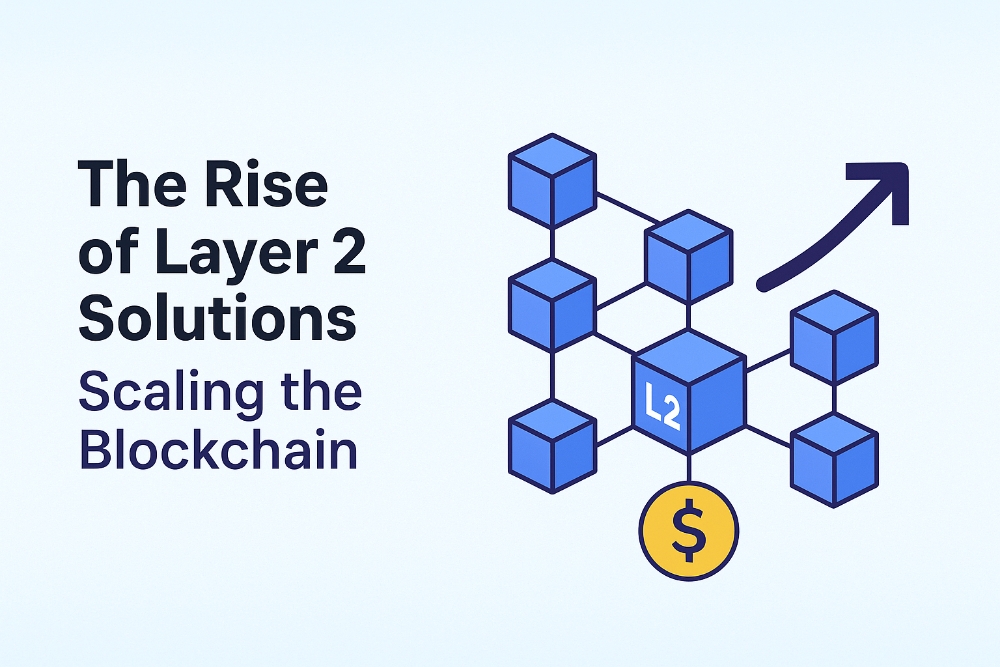
Layer 2 solutions are secondary frameworks built on top of existing blockchains (Layer 1) like Ethereum.
They take some of the transaction load off the main chain and process it elsewhere — but still rely on the security and decentralization of the underlying blockchain.
Think of it like an express lane on a highway:
- Layer 1 = Main highway (secure but slow)
- Layer 2 = Express lane (faster, less crowded)
When the transactions finish on Layer 2, they’re bundled and sent back to the main chain — reducing congestion and costs.
⚙️ 3. How Layer 2 Solutions Work
There are several approaches to Layer 2 scaling, each with its own trade-offs. Let’s break down the main types:
🔸 Rollups
Rollups group (or “roll up”) many transactions into one batch before submitting them to Layer 1.
They come in two main forms:
- Optimistic Rollups (e.g., Arbitrum, Optimism)
- Assume transactions are valid by default, checking only when challenged.
- ZK Rollups (e.g., zkSync, StarkNet)
- Use zero-knowledge proofs to verify transactions instantly and securely.
✅ Benefits: Fast, cheap, and secure.
⚠️ Drawback: Complex to develop and maintain.
🔸 Sidechains
Independent blockchains (like Polygon) that run parallel to Layer 1 but are connected via bridges.
✅ Benefits: Highly customizable and fast.
⚠️ Drawback: Slightly less secure since they rely on their own validators.
🔸 State Channels
Two users open a private channel to transact multiple times off-chain, then record the final result on-chain.
✅ Benefits: Instant, low-cost transactions.
⚠️ Drawback: Only works for limited use cases (e.g., payments or gaming).
💡 4. Why Layer 2 Matters for the Future of Crypto
Layer 2 isn’t just a technical fix — it’s the bridge to mass adoption.
Here’s why:
- Cheaper transactions: Micro-payments become possible again.
- Faster dApps: Web3 apps can rival Web2 speeds.
- Scalable DeFi: Protocols can handle thousands of users simultaneously.
- Greener blockchain: Less energy use per transaction.
Without Layer 2, Ethereum and similar chains could never handle the global scale of DeFi, NFTs, and Web3 gaming.
🔗 5. The Biggest Layer 2 Projects to Watch
Here are some of the most promising L2 networks leading the charge in 2025:
Layer 2 Project Technology Key Strength Arbitrum Optimistic Rollup Strong DeFi ecosystem, fast adoption Optimism Optimistic Rollup Backed by Coinbase, user-friendly zkSync Era ZK Rollup High speed, strong security StarkNet ZK Rollup Advanced scalability, developer-friendly Polygon PoS / zkEVM Sidechain + ZK Rollup Hybrid model with strong brand trust These networks are already processing millions of transactions daily — and their growth is just beginning.
⚔️ 6. Challenges Layer 2 Still Faces
Layer 2 is powerful, but not perfect. Key challenges include:
- User experience: Switching between L1 and L2 can still feel technical.
- Bridges: Cross-chain transfers remain a weak point for security.
- Liquidity fragmentation: Assets and liquidity are spread across multiple networks.
- Centralization risks: Some L2s depend on centralized sequencers.
Developers are actively addressing these issues — and progress is rapid.
🧠 7. Layer 3: The Next Evolution?
Yes, there’s already talk of Layer 3 (L3) — specialized networks built on top of Layer 2s.
Imagine:
- Gaming ecosystems running entirely on fast L3 chains.
- dApps with near-zero fees and instant execution.
- Personalized blockchains for different industries.
It’s early, but the direction is clear: blockchain is becoming modular, scalable, and user-friendly.
🚀 Final Thoughts
The rise of Layer 2 is not just a technical milestone — it’s a revolution in how we experience blockchain.
By solving the scalability puzzle, Layer 2 brings us closer to a world where crypto isn’t niche — it’s everyday technology.
“Layer 2 is where blockchain finally becomes practical for everyone.”
💡 Did you learn something new today?
React 💬 Comment 🔁 Share — and tell me which Layer 2 project you believe will lead the next crypto wave!