ICO Marketing for RWA Projects: How Tokenized Assets Are Changing Launch Strategies

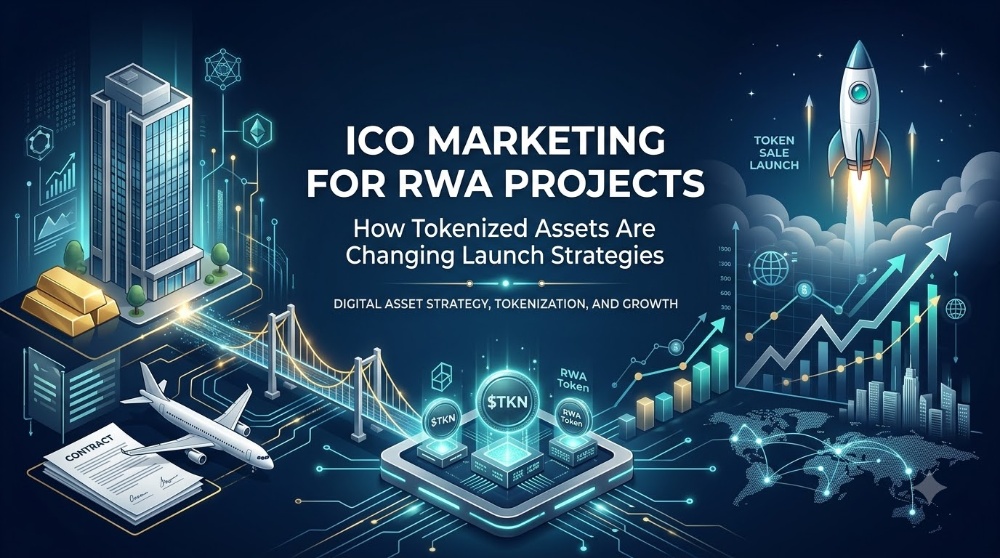
Real-world asset (RWA) tokenization is changing how blockchain projects approach fundraising and market launches. Instead of creating digital assets with value based mainly on blockchain utility, RWA projects connect tokens to assets such as U.S. Treasuries, real estate, private credit, commodities, and investment funds.
This creates a different marketing challenge. Investors want to know not only what the token does but also what supports its value, who controls the underlying asset, how ownership works, and how redemption and transfers are handled. As a result, RWA marketing is becoming more focused on education, transparency, and evidence.
The market has expanded rapidly. CoinGecko reported that tokenized RWAs reached $19.3 billion by the end of Q1 2026, more than tripling from the beginning of 2025. Tokenized Treasuries were the largest category during this period.
Why RWA Projects Need a Different Marketing Strategy
Traditional ICOs often focus on token utility, technology, roadmap, community growth, and exchange listings. RWA projects need to communicate these areas while also explaining the real-world asset behind the token.
For example, a token representing exposure to a Treasury fund requires information about the underlying securities, custody, valuation, investor rights, redemption process, and transfer restrictions.
The regulatory structure also matters. In January 2026, the U.S. Securities and Exchange Commission released a staff statement discussing different approaches to tokenized securities and how tokenization can affect investor rights.
This means ICO marketing services for RWA projects need to combine crypto communication with financial and regulatory education. Marketing claims should be supported by clear documentation rather than relying on hype.
Trust Is the Foundation of RWA Marketing
Trust is especially important when a token represents a real-world asset. Investors need clear answers to basic questions:
- What asset backs the token?
- Who holds and manages the asset?
- What legal rights does the token provide?
- How is its value calculated?
- How can investors redeem or transfer it?
- What risks and restrictions apply?
These details should appear consistently across the website, white paper, tokenomics, FAQs, and investor documentation.
Terms such as “fully backed” or “regulated” should also be supported with appropriate evidence. Clear disclosures can help investors understand the difference between the blockchain token and the underlying financial asset.
Tokenomics Must Reflect the Underlying Asset
RWA tokenomics require more explanation than a standard utility token. Supply, distribution, vesting, and governance remain important, but investors also need to understand how token supply relates to the underlying asset.
For example, if a project tokenizes government securities, investors should know whether one token represents a fixed asset unit, a proportional interest in a fund, or another type of financial claim.
These mechanics directly affect investor expectations and should be part of the marketing strategy. ICO marketing agencies like Blockchain App Factory can help present the tokenomics, asset structure, and investor benefits through clear content and focused campaign messaging.
Real-World Example: Franklin Templeton's BENJI
Franklin Templeton's Franklin OnChain U.S. Government Money Fund is a strong example of tokenized financial assets moving beyond experimentation.
The fund uses blockchain as part of its system for recording transactions and ownership. By April 2026, its tokenized RWA value on Stellar exceeded $650 million, while the broader BENJI platform represented about $1.98 billion in assets under management. Franklin Templeton also reported that BENJI investors increased by more than 140% between April 2024 and March 2026.
The key marketing lesson is that the blockchain itself is not the entire value proposition. Franklin Templeton communicates practical benefits such as peer-to-peer transfers, onchain dividend distribution, and faster settlement.
RWA projects can apply the same principle by explaining what blockchain changes for users instead of simply describing the technology as innovative.
Tokenized Treasuries Are Reshaping Investor Messaging
Tokenized Treasuries have become one of the strongest RWA categories because they combine familiar financial instruments with blockchain infrastructure.
CoinGecko reported that tokenized Treasury products exceeded $10 billion in market capitalization in February 2026 and represented a major share of RWA market growth.
This creates a useful communication model:
Traditional Asset → Tokenized Representation → Blockchain Utility → Investor Benefit
Instead of promoting a token simply as a new investment opportunity, marketers can explain how blockchain improves settlement, transferability, transparency, or access.
This approach makes the campaign easier for both crypto-native and traditional financial audiences to understand.
Regulation Must Be Part of the Launch Plan
Regulation should be considered before an RWA marketing campaign begins.
The classification of a token can affect who can purchase it, how it can be promoted, which jurisdictions can participate, and what disclosures are required. The SEC's recent work on tokenized securities has also highlighted areas such as custody, investor disclosures, redemption, cybersecurity, and market infrastructure.
Marketing teams should therefore work closely with legal and compliance specialists. Promotional materials, influencer campaigns, social posts, and website content should reflect the project's actual regulatory position.
For RWA projects, ICO marketing services should support compliant communication rather than simply maximizing reach.
Community Marketing Becomes More Educational
RWA communities need more than token announcements and price discussions. Investors often need educational content explaining the asset, legal structure, custody model, tokenomics, and risks.
X and Telegram can support regular updates and discussions, while LinkedIn can help reach financial professionals and institutional audiences. Webinars, research reports, explainer videos, and long-form articles can address more complicated questions.
The goal should not simply be to create a large community. It should be to build an informed audience that understands what the token represents.
Liquidity Should Not Be Overpromised
Tokenization does not automatically create deep liquidity.
Research using RWA market data has found significant differences in liquidity across tokenized asset categories. Asset value alone does not necessarily translate into active trading.
This is important for launch campaigns. Projects should explain actual liquidity mechanisms, transfer restrictions, redemption processes, eligible trading venues, and investor requirements.
Rather than claiming that tokenization automatically makes an asset liquid, marketing should explain exactly how investors can enter, transfer, and exit their positions.
Building an Effective RWA Launch Funnel
An RWA investor usually needs more information before participating than a typical crypto trader. The marketing funnel should therefore move through several stages:
Awareness → Education → Verification → Due Diligence → Eligibility → Participation → Retention
Each stage requires different content. Social media creates awareness, educational articles explain the product, documentation supports verification, and legal and financial information helps investors conduct due diligence.
This makes ICO marketing services more than a promotional function. They become part of the project's investor communication system.
Conclusion
RWA tokenization is changing the traditional ICO model by connecting blockchain-based tokens with established financial and physical assets. This makes investor education, transparency, regulation, tokenomics, and liquidity central parts of a successful launch.
Projects such as Franklin Templeton's BENJI demonstrate how tokenization can provide practical benefits while operating within a structured financial framework.
As the sector matures, ICO marketing services will need to move beyond conventional crypto promotion. Successful RWA campaigns will depend on clear documentation, evidence-based communication, targeted education, and consistent messaging across every stage of the investor journey.