The Blueprint to Crypto Crypto Sovereignty: Secret Ways to Hide and Protect Your Bitcoin

Assalamualaikum. How are you everyone? I hope you are all doing well.
By looking at the title, you probably already understood what today’s discussion is about.
Think about one thing for a moment.
You worked hard your whole life and bought very valuable assets like BTC and other crypto for the future.
But have you ever thought whether your BTC or other crypto is being stored safely?
Today, in this age of modern technology, as technology has improved, different kinds of wrongdoing have also increased.
Stealing, fraud, cheating—these things have become common.
And with the internet and modern technology, these wrong actions have taken digital forms like hacking, spam, and others.
In this world where ethics are becoming weaker, today’s discussion is about how you can keep your digital gold 100% safe in the digital world.
So, let's go into the discussion in detail.
Do not store your BTC in a broker / exchange
The first thing is this: never keep your hard-earned BTC in a broker or exchange for long-term storage. Because it can be risky.
You may think, “Why is it risky? My account has a password.”
So let’s use a simple example.
Think about a bank account. You open an account, and the account number and password stay with you. But one day the bank tells you that the funds are gone because of a hack.
Now think for a second. If the password and account details were with you, then how did the money disappear?
There can be different reasons.
First, hackers may attack the bank’s main system. If the main system gets hacked, user data and account access can also be affected.
Second, your device or transaction activity may get targeted. Harmful software can collect login details and send them to attackers.
Third, internal problems can happen. Fraud, poor management, or misuse from inside the company can also create risk.
The same idea can apply to brokers and exchanges.
In many ways, exchanges work like a crypto bank. You may control the password to your account, but the actual crypto is often stored inside their system.
So even if your login is safe, problems on their side can still affect access to your assets.
Sometimes companies may repay users after incidents—but the bigger issue is control.
Think about normal banks. When you put money in a bank, the cash is not sitting in your house. It stays in the bank’s vault, and your account shows that you own it.
Crypto exchanges can feel similar.
Another point is that when assets stay inside a company system, they may follow local rules, restrictions, or account actions depending on laws and regulations. Some countries also use financial sanctions against people, groups, or regions.
Because of that, some people prefer not to keep large amounts of crypto inside exchanges for a long time.
Also, exchanges can monitor transactions for security, compliance, and account protection purposes.
That is why many long-term holders prefer not to leave all their BTC inside brokers or exchanges.
So the next question becomes:
If not an exchange, then where should we keep BTC?
Cold Wallet
When we go outside, we carry money in a wallet. But when we come home, we usually keep our money in a safe place like a locker or cabinet. A cold wallet works in a similar way for BTC.
After you finish buying or moving BTC, you can store it in a cold wallet. It works like your own private vault.
Usually, a wallet gives you a 12-word or 24-word recovery phrase (seed phrase). This phrase is the key to your crypto.
The main idea is simple: whoever has the seed phrase controls the wallet.
Unlike keeping funds on an exchange account, many self-custody wallets give you direct control over your assets.
But one important thing:
If you lose your recovery phrase, recovery may become impossible. In many self-custody wallet systems, there is no company that can reset it for you.
That means you must protect that phrase very carefully.
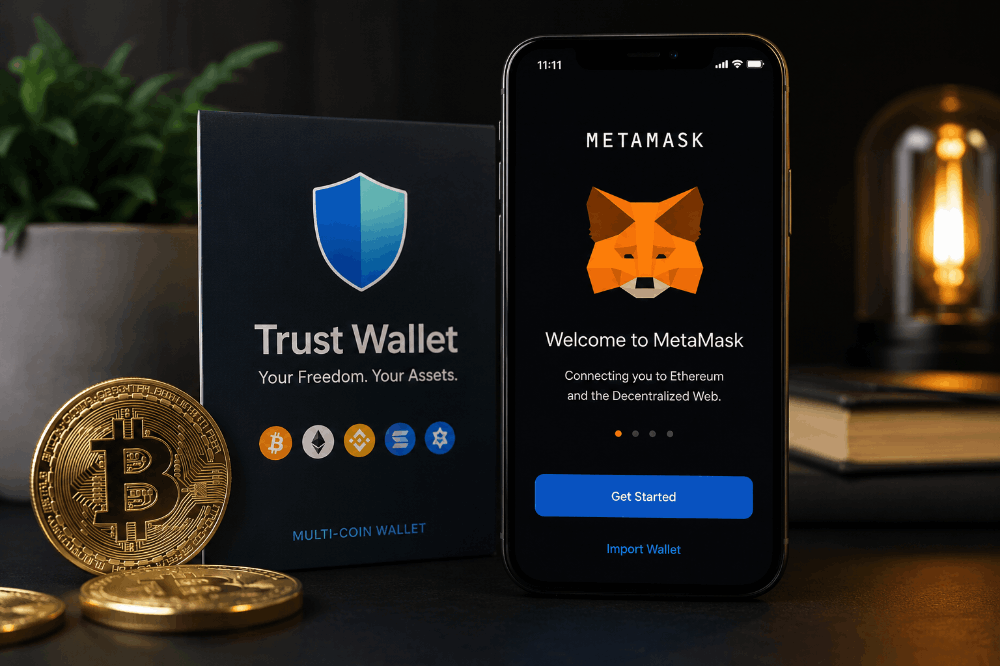
Some popular crypto wallets people use are:
- Trust Wallet
- MetaMask
- Phantom
- Solflare
Many of them can be installed as apps or browser extensions.
But there is another thing to remember:
Even if a wallet itself is designed for self-custody, your device can still be attacked. Malware, fake websites, screen recording software, clipboard attacks, or device compromise may expose your recovery phrase.
So never:
- Save your seed phrase in screenshots
- Send it in chat apps
- Store it in cloud notes
- Type it into random websites
- Share it with anyone
For small amounts, many people use software wallets.
For larger amounts or long-term storage, some people choose hardware wallets because the private keys stay inside a dedicated device and are harder to expose during normal use.
So the basic idea is:
Exchange → for buying and trading
Self-custody wallet → for holding
Hardware wallet → for stronger long-term protection
Hardware Wallet
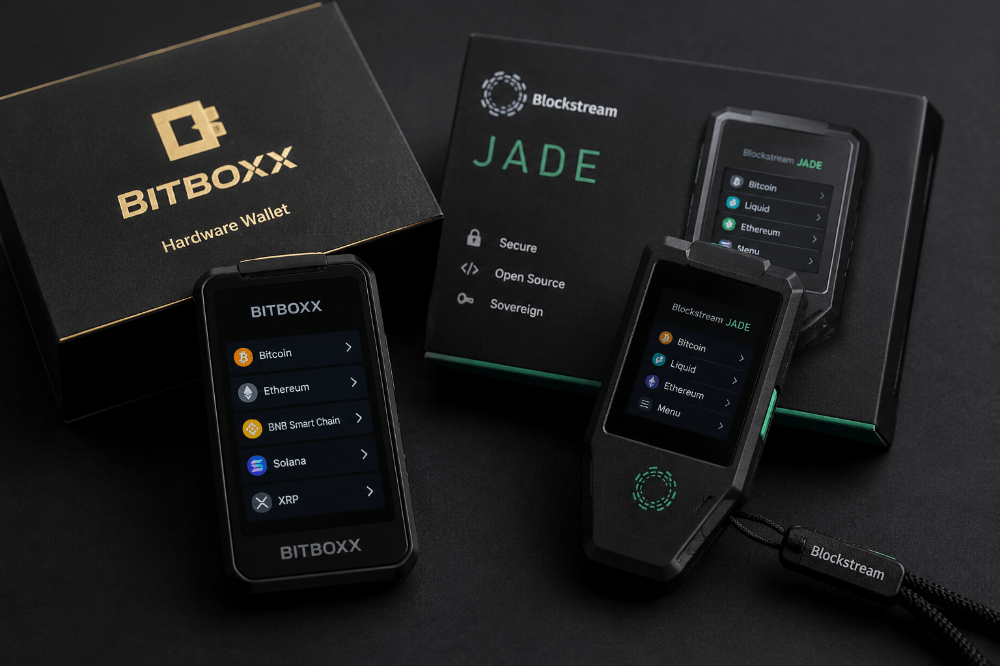
First, we need to know what a hardware wallet is and what it looks like.
A hardware wallet is not a wallet that stays connected to the internet all the time.
Unlike some normal wallets that usually depend on network access, a hardware wallet mainly works outside the internet.
It looks almost like a USB drive, though usually a little bigger.
These wallets are often considered among the most secure wallets in the world.
Like cold wallets, they also do not depend on one fixed server.
Because of that, they are considered very secure.
But some weaknesses people worry about in normal cold wallets are reduced here.
First, it can also be used in offline transactions.
Second, it gives stronger protection against device cloning and screen recording attacks.
If you think there may be risks from screen tracking or network tracking during transactions, then you can use the air-gapped method with QR code scanning.
With QR code scanning, you do not need to type the seed phrase every time.
And these are not normal QR scans.
One QR code comes from your device and another comes from the wallet.
Both work together during the process.
Because of this system, it becomes much harder for someone else to use the information.
Even if someone sees the QR code on your device, they still cannot complete the process without the wallet side.
Another interesting thing is that new security data may be created during different verification steps.
So even if someone watches your camera, that alone does not automatically give them access.
Also, even if someone somehow gets your seed phrase, some hardware wallets add extra security steps such as extra verification or additional passwords.
Because of that, having only one piece of information may not always be enough.
Many of these wallets also use open-source security systems.
Another useful thing is this:
If you lose the wallet device but still have your seed phrase and password, you can buy another wallet and restore your balance there.
Now, until this point, we talked about where to safely store your BTC after transactions.
Next, we will talk about where to make transactions safely and how to move Bitcoin safely into a hardware wallet after buying it.
Because today, one common way people lose assets or control is through tracking transactions.
So before protecting storage, transaction safety also matters.
So, let’s continue.
Non-KYC Trading
You may be surprised to hear this. Usually, in normal business or money transactions, people need to share their name, address, and identity so both sides can trust each other. But there is also a problem — when you share too much personal information, someone may use it to track, control, or misuse your data.
On the other hand, if nobody shares any information, trust becomes difficult and scams become easier.
Because of this, people started building systems where transactions can happen with more privacy while still keeping security. One example of this idea is peer-to-peer (P2P) blockchain transactions.
In this type of system, there is no single person or company controlling everything. Instead, the transaction follows rules that both sides agree to.
For example, imagine I want to sell an asset to my friend.
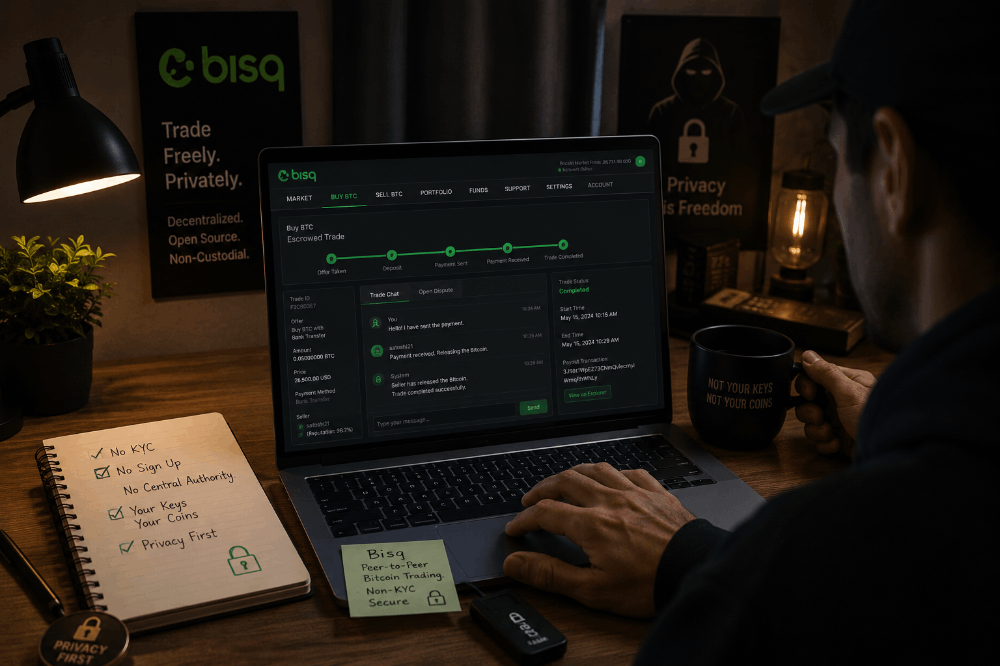
- If he does not send the payment, the asset stays locked.
- If he sends the payment, then the asset can be released.
- If I do not send the asset, the payment also stays protected.
In simple words, both sides follow the conditions of the transaction.
Many systems also use time limits. If the transaction is not completed within a certain time, it can cancel automatically and the funds return according to the rules.
Because of this process, transactions can become more private compared with traditional methods while reducing the need to fully trust one person.
Now, after talking about privacy and storage, the next topic is:
How to move BTC safely from a broker or exchange into your cold wallet or hardware wallet.
There are also platforms people use for peer-to-peer trading, such as Bisq.
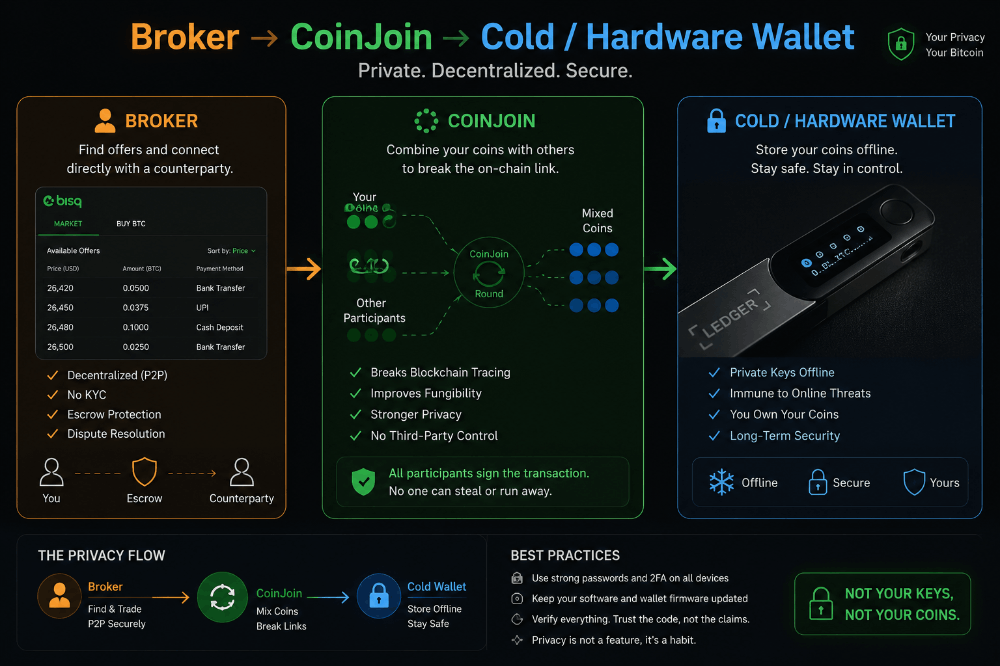
First Strategy: Broker → CoinJoin → Cold / Hardware Wallet
This is one of the simplest ways people use to move BTC into long-term storage.
When you buy BTC, usually you first buy it through an exchange or broker. After buying, your BTC normally stays inside the exchange wallet until you decide to withdraw it.
Then, when moving BTC out, some users choose networks and wallet methods that are supported by their setup and storage plan.
One method people discuss is CoinJoin.
CoinJoin works by combining transactions from multiple users together. The goal is to make transaction history harder to connect directly to one person and improve privacy.
After that, some users move their BTC into a cold wallet or hardware wallet for long-term storage.
Some hardware wallets support extra networks and wallet connections. For example:
- Blockstream Jade may work together with Blockstream Green for some transfer setups.
- Other wallets support BTC together with other assets.
People also sometimes choose solutions that reduce network fees depending on compatibility.
Second Strategy: Exchange / Broker → CoinJoin → Intermediate Wallet → Hardware / Cold Wallet
This method is similar to the first one but adds one extra step: an intermediate wallet.
The idea behind this setup is simple.
Instead of moving BTC directly from CoinJoin into your main wallet, some people temporarily move funds into another wallet first.
Supporters of this method believe it creates another layer between buying and final storage.
Examples often mentioned in privacy discussions include wallets such as:
- Wasabi Wallet
- Samourai Wallet
The idea is that an extra wallet step may make transaction paths less direct.
Some users also choose wallet routes based on lower fees.such as muun wallet.
For example:
- Move BTC from exchange
- Use Lightning Network where supported
- Transfer to an intermediate wallet
- Then move into a cold or hardware wallet
The goal is usually to reduce cost and separate spending activity from long-term storage.
At the same time, it is important to remember:
- Privacy tools do not make transactions invisible.
- Blockchain activity can still sometimes be analyzed.
- Exchanges may have rules depending on location and compliance requirements.
- Always back up your wallet recovery phrase offline and never share it.
Final Words
My goal is never to encourage anything harmful. I only wanted to explain how people think about protecting themselves from unfair control, pressure, or loss of freedom.
At the same time, any technology can be used in both good and bad ways. Some people may use these ideas for positive purposes, while others may misuse them. That responsibility belongs to the user, not the technology itself.
In the end, what matters most is morality and values.
Without morality and self-control, even the most advanced technology can create more problems. Technology alone cannot make society better. People create technology, and people also decide how to use it.
A simple example — a knife can be used to cut fruit, but it can also be used to harm someone. The tool itself is not good or bad; the way people use it makes the difference.
That is why Islam gives strong importance to morality, good character, and spiritual growth. The idea is that when people build strong values, they can use knowledge and technology to improve their community, help others, and create a better society.
But without ethics, even modern progress may not bring real benefit to religion, society, or people.
So let us try to build good character, improve ourselves spiritually, and use knowledge and technology in ways that bring benefit.
That is all for today.
AssalamuAlaikum.