From the Auction House to the Feed: The Value of Art in the 21st Century
From the Auction House to the Feed: Klimt, Beeple and the Value of Art in the 21st Century
Introduction
Few artists manage to break through their own bubble and become part of global culture. Beeple is one of them. Since 2007, he has maintained the Everydays project — a sequence of daily images that has now surpassed six thousand works — a flow canonized in the NFT Everydays: The First 5000 Days, auctioned in 2021 for US$69 million and permanently inscribed in the history of digital art.
Filled with “degen” references, blending memes, pop culture and political critique with an immediately recognizable style, the Everydays series has become a landmark of contemporary art, where Beeple condenses the spirit of the age into scenes saturated with symbols, irony and discomfort.
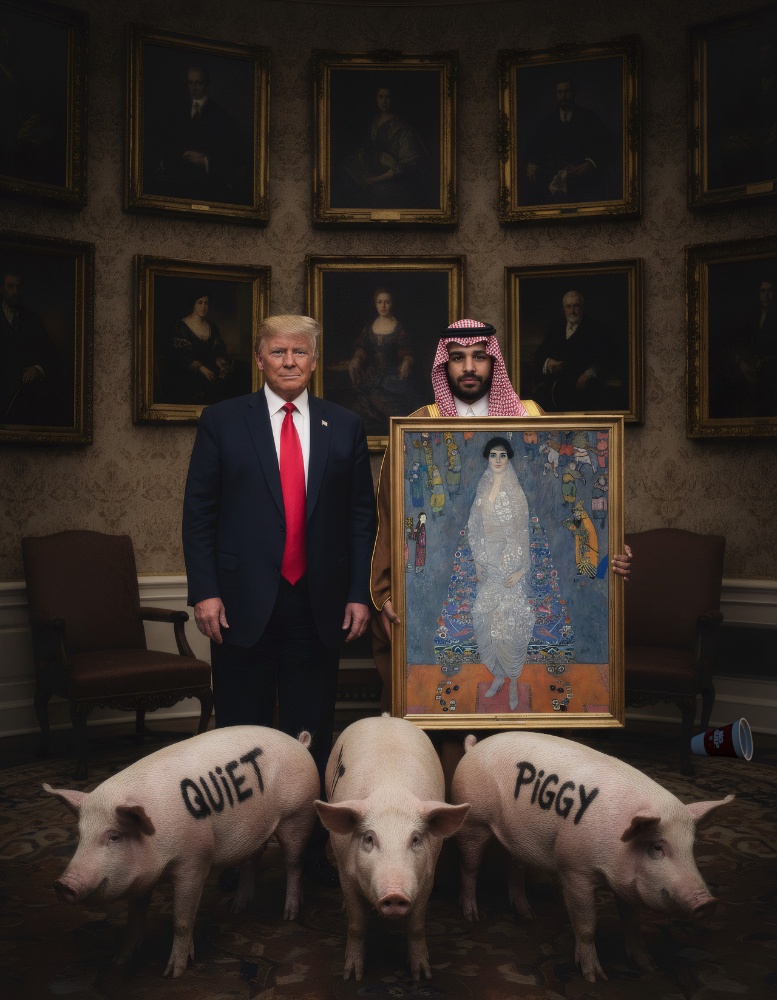
Here we focus on one of these images: ALL THE KING’S MEN, the Everyday published on November 19, 2025. The post of the artwork on X went viral instantly, generating hundreds of comments and shares. The scene follows the artist’s visual grammar: an encounter between Donald Trump and the Crown Prince of Saudi Arabia, staged amid fast-food leftovers, the spectral appearance of Jeffrey Epstein, and pigs labeled “Quiet” and “Piggy”, references to insults uttered by Trump toward a journalist. Among these elements, one detail silently dominates the composition: the painting Portrait of Elisabeth Lederer by Gustav Klimt.
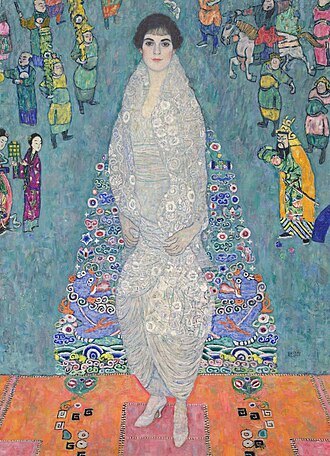
The choice is not accidental. The original portrait was sold for US$236.4 million at a Sotheby’s auction, becoming the second most expensive painting ever sold at auction and the most expensive modern artwork in auction history. Placing this Klimt at the center of a theater of power, oil, scandals and excessive consumption is another gesture of Beeple’s surgical precision.
It is from this unlikely encounter — a record-breaking Klimt and a viral Beeple — that this article unfolds.
The Current Art Market
The auction of Portrait of Elisabeth Lederer reveals a peculiar convergence: while the global economy slows and entire sectors face contraction, the top tier of the art market operates according to its own logic, a space where rarity, symbolic power and concentrated liquidity combine to produce values that defy traditional economic parameters.
The sale of the painting for US$236.4 million condenses several central vectors of the contemporary market. In times of uncertainty, works of the highest reputation — Klimt, Picasso, Rothko, Basquiat — become refuges for global fortunes. They function as cultural value securities, with selective liquidity and consolidated historical narratives.
Portrait of Elisabeth Lederer, one of the last major Klimts still in private hands, fits perfectly into this model: absolute rarity, impeccable provenance, and an aesthetic associated with the peak of Viennese painting. The twenty-minute bidding battle by telephone, anonymous bids surpassing US$200 million, reveals more than desire; it demonstrates confidence: in the artwork, in the artist, and in the very structure of the art market as a mechanism of value appreciation.
The price, however, goes beyond the physical object. It is explained by narrative: Klimt, Vienna 1900, the Lederer family, gilded modernity, the imagery of European luxury. Sotheby’s did not sell merely a portrait; it sold a chapter of history, a cultural symbol converted into a financial asset.
This narrative dimension helps explain why Klimt’s presence in Beeple’s Everyday is so powerful: Beeple understands that Klimt is more than an artist, he is an icon. And icons live as much in museums as in memes.
NFTs Are Dead — But Doing Just Fine
Saying “NFTs are dead” has become almost an ironic mantra on X. But this statement weakens when we observe what sustains long-term markets: technology, culture and behavior, not merely price cycles. The truth is that NFTs have not died; they have simply ceased to be hype and have become cultural infrastructure.
The reference to Klimt in the Everyday is not merely a visual joke. It reveals attentiveness to the contact zones between the global art market and the possibilities of the crypto universe. Between 2021 and 2022, NFTs lived as a collective fever, the acronym became synonymous with automatic appreciation. This enthusiasm, natural in emerging technologies, was followed by downturns, abandonments and frustrations.
The central point is that an NFT is contract technology, not a guarantee of price. An artwork does not appreciate “because it is an NFT,” just as it does not appreciate merely “because it is oil on canvas.” The medium does not define value; it expands its possibilities when inserted into digital ecosystems.
Just as the art market does not survive solely on record-breaking sales, the NFT ecosystem cannot survive solely on explosions of hype. Maturity arrives when NFTs cease to be speculative events and clearly function as contractual technological structures, tools for registration and certification.
The high auction value highlights something essential: the symbolic value of an artwork depends on its ability to remain culturally active. Beeple proved this with The First 5000 Days and continues to prove it with Everydays that go viral daily. A US$236 million Klimt and a Beeple reaching hundreds of thousands of views operate, each at its own scale, within the same narrative ecosystem.
There is also an institutional context: Sotheby’s has positioned itself as an advocate of blockchain technologies. It has already conducted entire NFT auctions, created its own platform, and accepts cryptocurrency as payment for selected lots. The image is as clear as it is provocative: an anonymous buyer acquires a multimillion-dollar Klimt in an auction house fully integrated into the on-chain world.
These are the subtleties Beeple perceives and incorporates into the artwork — integrating in a single image technology and symbolism, art and finance, museum and protocol, aesthetics and infrastructure.
Final Considerations
The appearance of a record-breaking Klimt inside a Beeple Everyday is not merely an aesthetic coincidence. On one side, a Viennese portrait from 1916 reaching figures sustained by the upper echelons of global finance. On the other, a digital artwork of instantaneous circulation, created in a few hours and designed to multiply at the speed of the timeline.
Between these two poles, oil paint over a century old and yesterday’s JPEG, emerges the true panorama of contemporary art: a field where materiality and digitality, tradition and rupture coexist and mutually feed one another.
The Klimt sold at Sotheby’s and the Beeple viral on X ultimately belong to the same cultural ecosystem: both are objects in dispute, both condense symbols, and both circulate as units of symbolic, social and financial value.
It is precisely here that NFTs reemerge with clarity: not as a fever or a promise of quick enrichment, but as the infrastructure of a world in which art, ownership and circulation have become inseparable from digital logic. The mainstream media may call this movement a fad or a speculative delusion, but technologies that survive their own hype are usually the ones that shape the future.
If the portrait of Elisabeth Lederer continues to appreciate more than a century after being painted, it is because certain images traverse eras and devices. If the Everydays remain alive after six thousand days, it is because there is something in the digital that no longer depends on external validation to exist.
And perhaps it is precisely there, in this interval where a US$236 million painting appears in a viral post, that one can recognize the real landscape of art in the 21st century. And if the NFT “died,” it is only because it is ceasing to be a headline and consolidating itself as infrastructure.