CLARITY Act Gains Momentum as Crypto, Banks, and Lawmakers Clash Over Stablecoin Rules

CLARITY Act Gains Momentum as Crypto, Banks, and Lawmakers Clash Over Stablecoin Rules
The CLARITY Act is back in the spotlight, and this time the bill appears to be moving closer to a real Senate test. Recent reporting from CryptoSlate, Reuters, CNBC, and DL News shows that lawmakers have made progress on the most difficult part of the bill, the stablecoin rewards question, while the crypto industry is pushing hard for the Senate Banking Committee to move the legislation forward.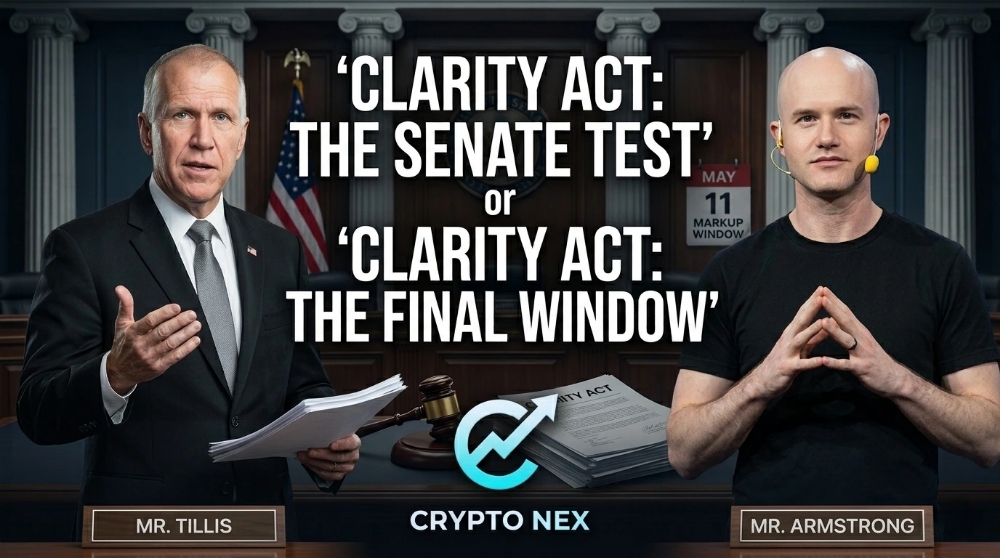
Why the bill matters now
The recent compromise on stablecoin rewards helped unlock new momentum for the CLARITY Act. The revised language appears to allow rewards tied to actual user activity while still blocking yield that resembles interest on bank deposits, which was the main concern for banks.
That compromise matters because it removes one of the biggest roadblocks to the bill’s progress. Multiple reports now suggest that the Senate Banking Committee could take up markup soon, with some outlets pointing to the week of May 11 as the key window to watch.
Cathie Wood’s latest move
Cathie Wood and ARK Invest remain central to the market reaction around the bill. Investors.com reported that ARK bought Circle shares while the stock was falling on Clarity Act-related uncertainty, showing that Wood continues to treat regulatory panic as a buying opportunity rather than a reason to step back.
That approach is consistent with her broader crypto strategy. ARK has repeatedly shown interest in crypto-linked equities whenever the market has overreacted to policy headlines, and that makes her one of the clearest examples of how institutional investors are reading the CLARITY Act as a market catalyst rather than just a legislative event.
Saylor’s “crypto reactor”
Michael Saylor has added another layer to the conversation by framing Bitcoin as the base of a “crypto reactor” model. In that structure, Bitcoin serves as digital capital, while related financial products are built around it to capture upside and manage volatility in more familiar yield-oriented forms.
That concept is important because it shows how the crypto debate has moved beyond simple price speculation. Saylor’s model suggests that Bitcoin can act as the reserve layer of a broader financial system, and that view helps explain why regulatory clarity is so important for institutions that want to build around digital assets.
What the market is seeing
The market has already reacted to the stablecoin compromise. CNBC reported that Circle jumped sharply after the weekend agreement, while Coinbase also moved higher as traders interpreted the updated language as a relative win for major crypto platforms.
DL News also noted that odds of the CLARITY Act passing in 2026 rose sharply after the compromise, which shows that policy progress is now being reflected directly in market expectations.
That reaction matters because it shows how tightly connected legislation and valuation have become in the crypto sector. The bill is not just changing rules on paper; it is affecting how investors price Circle, Coinbase, and other crypto-related names in real time.
The real political risk
Even with momentum building, the bill is still exposed to political friction. Reports continue to mention possible resistance from Senate Republicans and unresolved issues around DeFi protections, developer liability, and ethics language, all of which could slow the markup process or change the final text.
This is why the CLARITY Act is still not guaranteed to move smoothly. A compromise on stablecoins helps, but the bill still has to survive Senate procedure, coalition politics, and the possibility that unrelated disputes could spill into the process.
Why it matters for crypto
For the crypto industry, the bill is about more than one policy detail. It is about whether the U.S. will finally define a workable framework for market structure, stablecoins, custody, intermediaries, and the roles of the SEC and CFTC.
For investors, it is also about whether the next phase of crypto adoption will happen inside the U.S. or continue shifting toward offshore markets and foreign platforms. That is why names like Brian Armstrong, Tom Tillis, Circle, and Coinbase are all part of the same story now.
Conclusion
The CLARITY Act has entered a more serious phase, and the latest stablecoin compromise has given it a real chance to advance. But the bill still has to clear Senate politics before it becomes law, which means the next markup window could be decisive for the future of U.S. crypto regulation.
At the same time, the market is already telling its own story. Brian Armstrong is pushing for momentum, Tom Tillis remains central to the Senate timeline, and traders are treating every legislative update as a possible turning point for the entire sector.