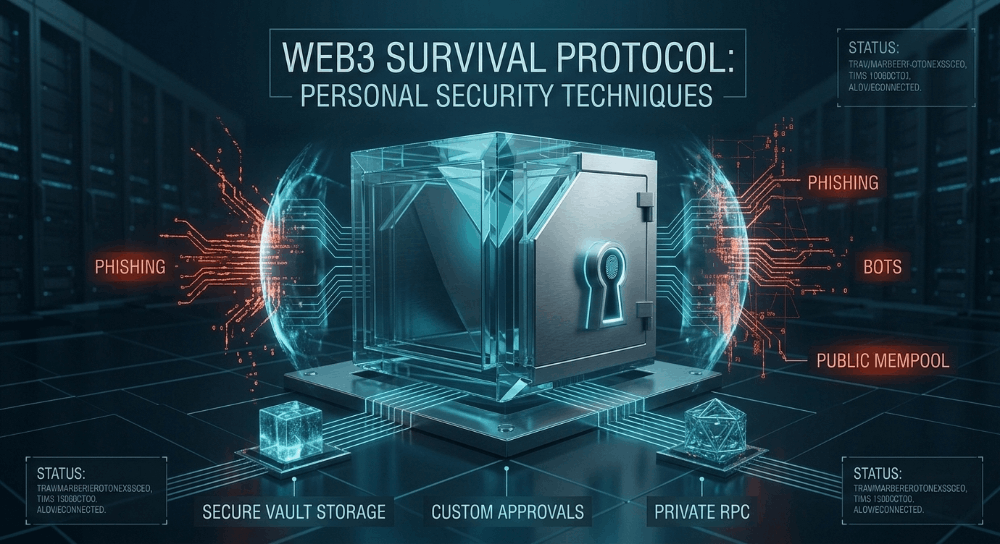
Web3 Survival Protocol: Personal Security Techniques

In the world of Web3, the phrase "be your own bank" isn't just a slogan for flashy presentations. It is a strict technical requirement. As soon as I move assets from a centralized exchange (CEX) to a non-custodial wallet, I assume full responsibility. In the traditional world, a bank and regulators are responsible for my safety, but here—it's only me. In blockchain, there is no "undo" button or customer support.
As one industry pioneer once noted: "In crypto, code is law, but often that law is written against you."
If I make a mistake, the smart contract will execute the attacker's will with the same flawlessness as my own.
Statistics show that over $1.8 billion has been lost to hacks and phishing. The most frightening part isn't that the blockchain was "hacked"—that is almost impossible. What’s scary is that these losses are the result of our own trivial mistakes in key management. This guide is my personal survival protocol, which I have developed to ensure that my portfolio remains mine.
Section 1. Storage Architecture and Key Management
My security strategy doesn't start with searching for "high-yield" dApps, but with the right architecture. One wallet "for everything" is a gift for hackers.
1.1 Hot Wallets vs. Cold Storage: Analyzing Vulnerabilities
The first mistake I made early on was using a browser wallet (like MetaMask) as my primary vault.
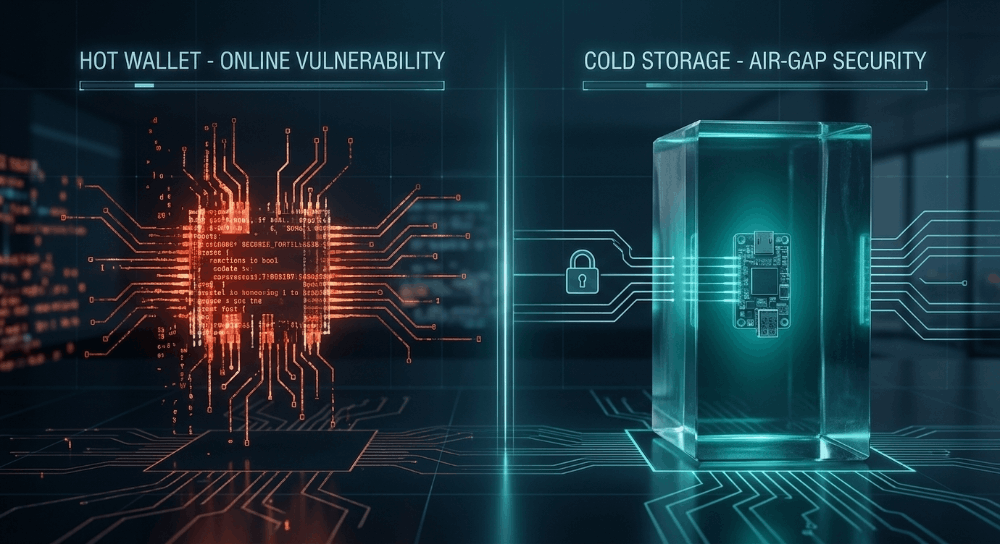
Hot Wallets are always "online." Private keys reside in the computer's file system or RAM. If my PC is infected with a Trojan or keylogger, a hacker can extract my keys in seconds.
Hardware Wallets (Cold Storage) are my body armor. They operate on the principle of an "Air-Gap." Keys are generated and live inside a secure chip; they are never transmitted to the computer. The device signs the transaction internally. An attacker can hijack my PC, but they cannot press the physical button on my device
1.2 Deep Segmentation: The "Three-Tier" Method
To sleep soundly, I have divided my capital into three tiers of access:

Tier 3: The "Vault"
Goal: Long-term accumulation (80-90% of the portfolio).
Tool: Cold wallet only (Ledger, Trezor, Keystone), mandatory use of a Passphrase.
Protocol: This address is "dead" to Web3. No staking, farming, or NFTs. It only receives assets. Withdrawals are only allowed to a "whitelist" of addresses.
Tier 2: "Operational DeFi"
Goal: Active interaction with DeFi (Uniswap, Aave, Lido), trading.
Tool: Hardware wallet connected to Rabby or MetaMask.
Protocol: I use different address indexes within the wallet for different networks. If one project is compromised, I lose only a portion, not my entire net worth.
Tier 1: "Burner Wallet"
Goal: Testing new projects, NFT mints, suspicious airdrops.
Tool: A clean hot wallet (MetaMask) not linked to my main assets.
Protocol: I keep only enough for gas here. If a dApp turns out to be malicious, my losses will cost the price of a cup of coffee, not a yearly budget.
1.3 Seed Phrase: My Absolute Protection
The seed phrase (12-24 words) is the master key. Lose it, and you lose everything. As they say, "not your keys, not your coins," but if the keys are stolen, the coins are definitely gone.
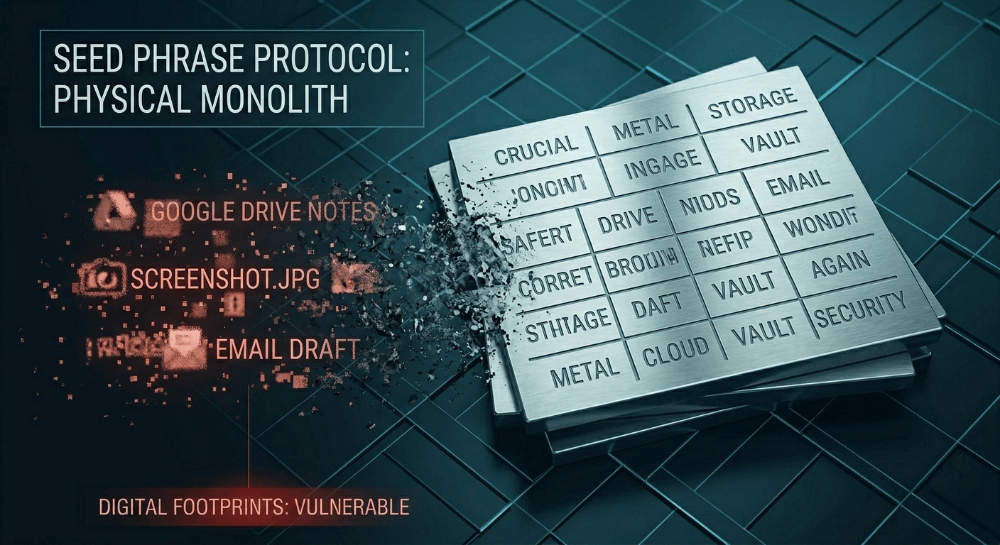
Digital Footprints: No screenshots, Google Drive, or notes. The vulnerability of any cloud service is just a matter of time.
Transition to Metal: Paper burns and dissolves. I use engravings on steel plates (Cryptosteel, Billfodl). This protects against fire and floods.
Split and Passphrase: For a paranoid (and correct) level of security, I use a 25th word. The 24 words are stored in one place, and the 25th (which I memorize) is stored in another. Without both components, access to assets is impossible.
Section 2. Attack Vectors: How They Steal Even if the Key is in the Safe
Hackers know that a hardware wallet is almost impossible to "hack" directly, so they attack me at the moment of signing a transaction.
2.1 Toxic Approvals: The Invisible Vulnerability
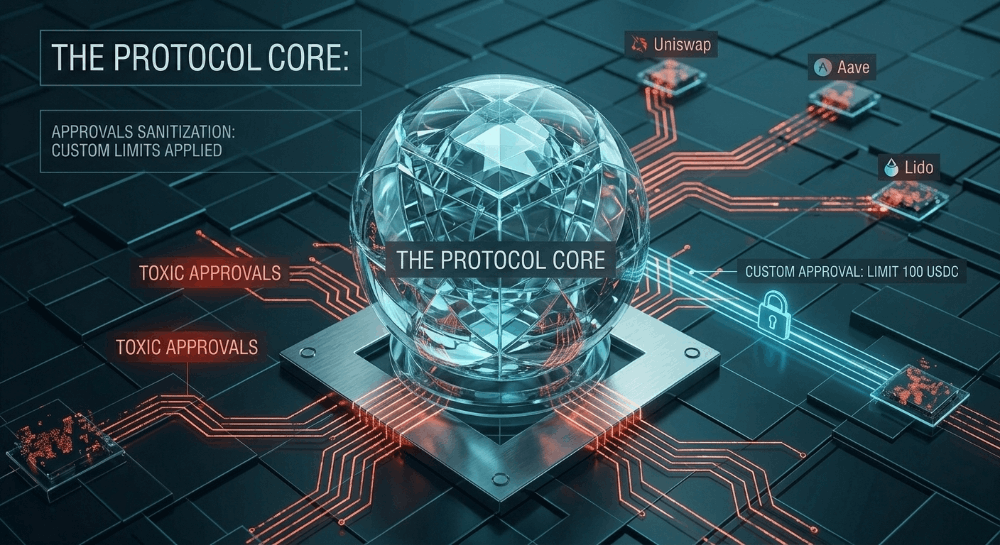
When I swap tokens on Uniswap, I sign an "Approval." This is a command to a smart contract: "I authorize you to spend my USDC."
Problem: Many projects request "Infinite Approval" for convenience.
Risk: If the project is hacked, the hacker will drain all my tokens from the wallet, even if I’m sleeping at that moment.
Defense Protocol:
Custom Limits: I never sign for "Infinite." In the wallet interface (Rabby is my choice), I always manually set the limit to the exact amount of the transaction.
Regular Audit: Once a week, I check all issued permissions via Revoke.cash or Etherscan Token Approval. If I don't use a dApp, I immediately revoke access.
2.2 Phishing and Transaction Redirection
Phishing in Web3 is a science. Hackers create clone sites that look like Uniswap or Blur. I connect my wallet, and they offer me to "Claim Airdrop," but in reality, it's a hidden command to drain my assets.
Address Poisoning: A hacker creates an address nearly identical to mine (the first and last 4 characters match). They send me a zero-value transaction. I see "my" address in the history and copy it out of habit. The result: assets go to the hacker.
Defense Protocol:
URL Hygiene: Before connecting, I check the address bar letter by letter. I often see substitutions like 'rn' instead of 'm'.
Rabby Wallet: It decodes transactions into human-readable form. This saves against 90% of blind signing.
Whitelists: I have configured address whitelists on exchanges. Withdrawals are only possible to these addresses.
Test Transaction: To a new address, I always send the minimum amount, verify receipt, and only then send the main sum. I never copy addresses from history.
2.3 MEV Attacks (Sandwich) and RPC Protection
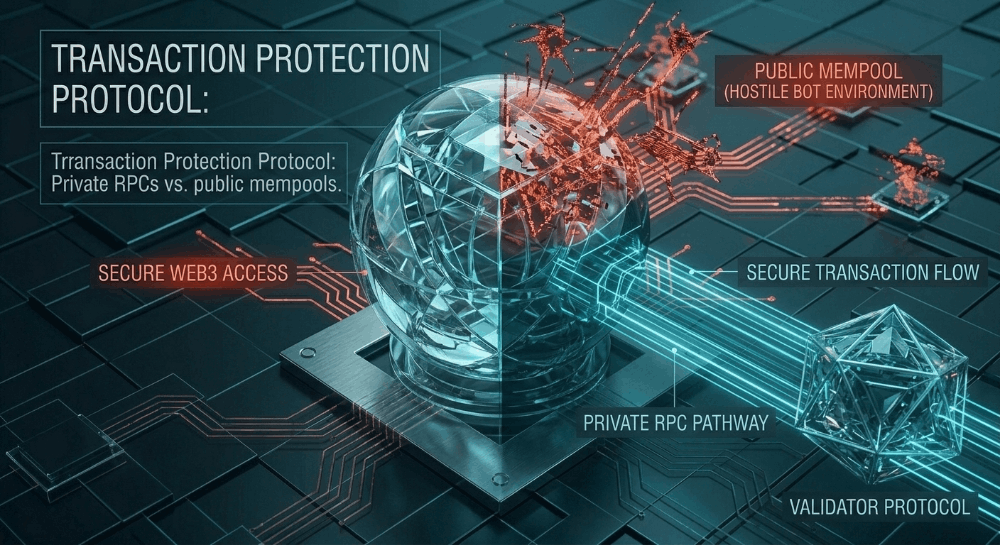
When I send a transaction, it goes to the "Mempool"—a waiting room. MEV bots scan it, and if they see my large trade, they "sandwich" it, buying the token before me and selling it back to me at a higher price.
Defense Protocol:
Private RPCs: I have switched to MEV-Blocker or Flashbots Protect. They don't send my transactions to the public mempool but deliver them directly to validators.
Slippage: I set slippage no higher than 0.1–0.5%. A high value is an open invitation for bots.
Conclusion: Security as a Lifestyle
We’ve broken down layers of protection—from steel for seed phrases to private nodes. This protocol takes time. But either I spend 30 seconds verifying a transaction, or I risk everything. As they joke in the industry: "Security is what you do before you get hacked."
Follow my profile for more interesting and useful information! 🛡️📈🚀
Disclaimer: This article is for educational purposes only and does not constitute financial, investment, or legal advice. Crypto assets are volatile and carry significant risk. Always do your own research (DYOR) and consult with a professional before making any financial decisions.