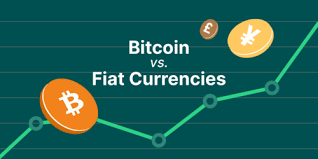
Bitcoin vs Fiat Currency
Now imagine this: you bought a bar of soap for 100 taka today. But after one year, the same soap can no longer be bought for 100 taka — now it costs 200 taka. Naturally, we say, “The price of the product has increased.”
But the real question is:
Has the product actually become more expensive? Or is there another reason behind it? Let’s explore.
We know that the value or price of anything mainly depends on supply and demand.
- If supply is higher than demand, the price decreases.
- If demand is higher than supply, the price increases.
- And if supply and demand remain balanced, the price usually stays stable.
Now suppose you buy a beverage. Every year, the company produces millions of bottles, and the demand is also strong. In other words, both supply and demand are relatively equal.
But when you go to the market, you notice something strange:
The beverage that used to cost 50 taka now costs 100 taka, even though its supply and demand have not changed significantly.
So why did the price increase?
The answer is simple: the thing we are using to buy the product — money itself — is losing value over time.
Yes, I am talking about paper currency or fiat money.
How Does Paper Currency Lose Value?
Imagine you own a chair, and that chair exists only with you in the entire country. Nobody else has it, and it is extremely useful and beautiful. Naturally, many people want it.
Now when you bring that chair to the market, its price will be very high because demand is high while supply is extremely limited.
Since the chair is rare, its rarity increases its value.
The same thing happens with antique objects. A 200- or 300-year-old item often becomes very expensive because its supply is limited while people’s interest and demand continue to grow.
In simple terms:
Higher Demand + Limited Supply = Higher Value
Now the question is: what does this have to do with paper currency?
We know paper currency is made from paper, and paper comes from trees. As long as trees exist on Earth, paper can continue to be produced. And as long as paper can be produced, governments can continue creating more paper currency.
In other words, fiat currency is practically unlimited.
Another important point is that we do not measure money by the amount of paper it contains; we measure it through numbers.
When we say we have 500 taka, we are not talking about the number of paper notes. We are talking about their total value. For example, five 100-taka notes equal 500 taka in value.
Similarly:
- Rice is measured in kilograms,
- Water in liters,
- Distance in kilometers.
Mathematics is not only used for counting objects but also for measuring value, quantity, and relationships.
Since numbers can theoretically continue infinitely, fiat currency can also continue expanding infinitely.
If everyone possesses the same “1-value” note, then its uniqueness and purchasing power decrease because it becomes easily available everywhere.
And when governments continue printing larger amounts of money while older money still remains in circulation, the overall value of the currency decreases.
Simply put:
The more money enters the market, the less valuable each unit of money becomes.
That is why, over time, the same product requires more money to purchase.
Even if you suddenly owned several hundred trillion dollars today, it would not guarantee long-term value. Because a currency that can be created endlessly will naturally continue losing purchasing power over time.
But Bitcoin is fundamentally different.
Bitcoin
Bitcoin is a limited asset because its total supply is fixed at only 21 million coins.
Bitcoin’s code is based on mathematical principles, and no one can create more than 21 million Bitcoin — not even by a fraction.
Unlike fiat currency, Bitcoin is not controlled by a single individual, government, or institution. This is one reason why many people consider it a more democratic monetary system.
[To learn more about why Bitcoin is considered democratic and how it works, you can read my other article: “The Creation of Bitcoin and Blockchain.”]
Bitcoin’s supply is fixed and predetermined. Because of this scarcity, many people compare Bitcoin to digital gold.
Some believe that if goods and services were traded using Bitcoin in the future, inflation could become far less severe. This is because, unlike fiat currency, new Bitcoin cannot simply be printed whenever desired.
Another important point is that the modern interest-based financial system largely depends on the continuous creation of new money. But since Bitcoin is limited, its economic structure is fundamentally different from traditional fiat systems.