DePIN: THE SOVEREIGN SUPERCOMPUTER

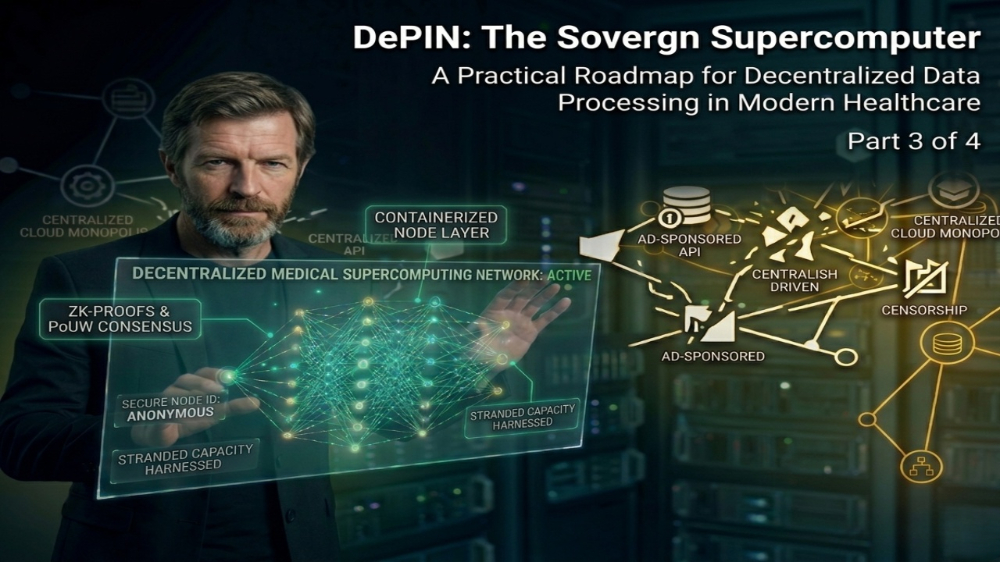
A Practical Roadmap for Decentralized Data Processing in Modern Healthcare.
In the previous part of this series, I didn't just point out a flaw in modern healthcare; I defined a structural dead-end. The AI-driven medical revolution—ranging from convolutional neural networks mapping neural pathways to generative models synthesizing bespoke molecular chains—is collapsing under the weight of its own data. Centralized legacy infrastructure is physically and economically melting. We are facing a global compute crisis.
But as a content architect and Web3 researcher, my job isn't to look at a crisis and write superficial commentary. My job is to analyze the engineering blueprints that solve it. Today, we are breaking down the practical mechanics of DePIN (Decentralized Physical Infrastructure Networks). We are going to answer exactly how, why, and at what cost decentralized networks can outperform corporate server monopolies and build a bulletproof supercomputer for global healthcare.

1. The Mechanics of Aggregation: How DePIN Harnesses Stranded Compute
To understand why DePIN works, you have to realize that the world isn’t actually suffering from a lack of silicon; it is suffering from an absolute failure of hardware distribution. While Big Tech spends billions building concrete data fortresses, millions of high-end GPUs sit idle in local production studios, private clouds, and gaming rigs.
So, how do we practically turn this fragmented hardware into an enterprise-grade medical supercomputer?
The Containerized Node Layer: Instead of building proprietary networks, DePIN utilizes lightweight container technology (like Docker or specialized WebAssembly runtimes). Hardware providers globally download a node client that isolates their system's compute layer from their personal data.
The Orchestration Protocol: When a medical research lab requests compute—for instance, to run a simulation of a protein folding structure—the DePIN orchestration engine breaks the massive task down into thousands of tiny computational micro-tasks.
Dynamic Resource Allocation: The protocol acts as an algorithmic dispatcher. It benchmarks individual nodes based on their latency, VRAM capacity, and uptime, distributing the micro-tasks to where they can be processed most efficiently.
By aggregating this "stranded capacity," DePIN can spin up thousands of teraflops of computing power instantly, without laying a single brick or buying a single new graphics card.



2. Zero-Knowledge and Proof-of-Computation: Solving the Trust Problem
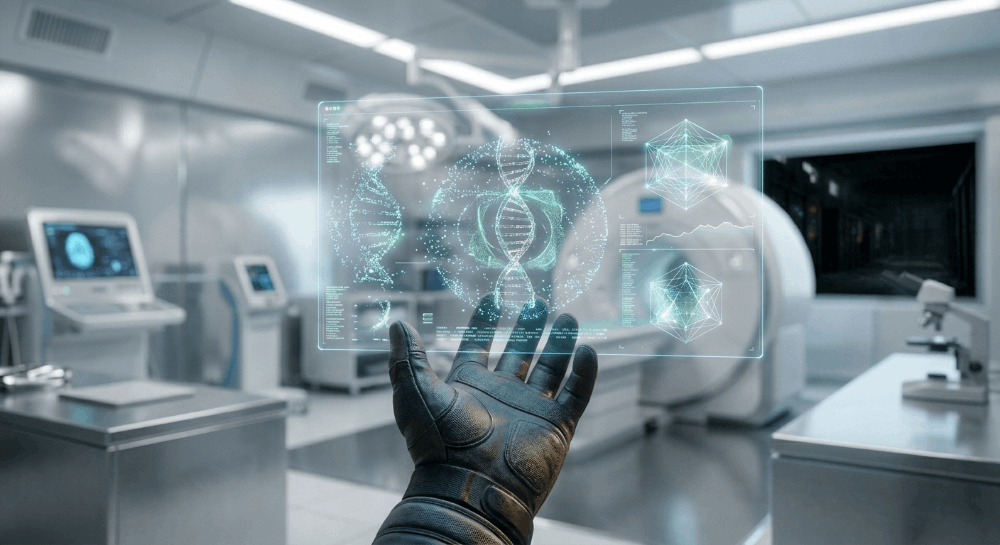
Here is the most critical question I had to ask myself when researching this architecture: medical records and genomic data are highly confidential and heavily regulated. How can a hospital legally or ethically send a patient's DNA data to be processed on an anonymous node owned by a stranger? This is where standard cloud computing fails, and where Web3 engineering shines. We solve the privacy and trust problem through two non-custodial cryptographic breakthroughs:
Zero-Knowledge Proofs (ZKPs): Using zk-SNARKs or zk-STARKs, medical data is heavily encrypted before it ever leaves the hospital network. The remote processing node executes the machine learning algorithm on the encrypted data packet. It can mathematically prove that the computation was completed correctly without ever decrypting or "seeing" the actual genetic code or patient names.
Proof-of-Useful-Work (PoUW): To prevent bad actors from feeding fake data or lazy nodes from claiming rewards without doing the work, the protocol uses PoUW consensus. Nodes must submit a cryptographic proof of execution. If their calculated output doesn't match the consensus verifiers, or if their proof is mathematically invalid, they are instantly penalized.
The result is a zero-trust architecture. For the first time in history, we can achieve maximum computing scale without sacrificing a single byte of data privacy.

3. The Economic Asymmetry: Why Tokenomics Outperforms Big Tech Capital
An architecture is only a fantasy until you back it up with sustainable economics. Why will healthcare systems migrate to DePIN? Because the corporate cloud model is an economic parasite, and DePIN introduces a structural cost reduction of up to 70-80%. Let's look at why the economics of DePIN are fundamentally superior:
The Capital Expenditure (CapEx) Inversion: Centralized cloud providers must charge massive premiums because they have to recoup the billions spent on land, physical security, cooling systems, and corporate overhead. DePIN has zero CapEx. The infrastructure already exists; it is paid for by the individual node operators.
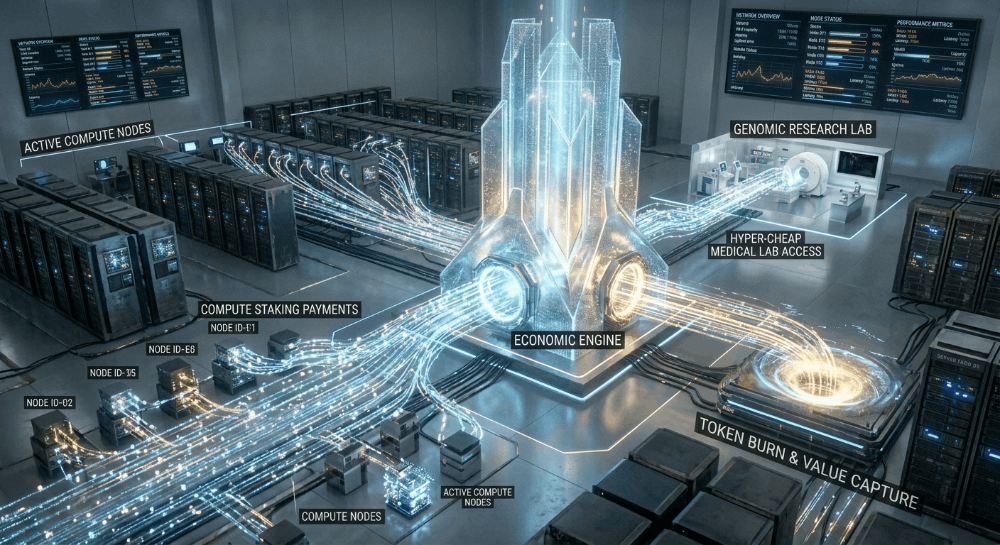
The Token-Incentivized Scaling Loop: DePIN protocols bootstrap their supply side using native utility tokens. Operators aren't just paid in fiat dust; they receive protocol tokens for proving their computational capacity (Uptime Staking) and executing jobs. This allows the network to offer hyper-cheap compute rates to medical labs while still keeping node operators highly profitable.
As the demand for medical AI compute scales, the network burns or locks tokens, driving value back into the ecosystem. It is an autonomous economic engine that completely strips away the legacy corporate margin.
Conclusion: The New Paradigm for Content and Tech
What I am mapping out for you isn't a speculative prediction; it is an inevitable architectural migration. The intersection of AI diagnostics and healthcare cannot physically survive on the centralized, expensive, and restrictive Web2 web. DePIN is the infrastructure that makes the future of medicine possible.
As a content architect, my goal is to lay down these deep, structural blueprints so we can understand where the world is actually going. But to build a completely free, highly technical media ecosystem, we must look at how we, as creators, survive and fund this research. In the fourth and final part of this series, we will pivot to Web3 Media Economics. I will break down exactly how independent authors can leverage censorship-resistant networks and tokenized communities to scale their operations without corporate algorithms. Stay tuned.
Subscribe to stay up to date with the next and final part of this series 🚀
Disclaimer: This series is for informational and educational purposes only. It does not constitute financial, investment, or legal advice. Research and evaluate projects independently before participating in any decentralized networks or tokenized ecosystems.