What Happens During a Tarot Reading? A Beginner’s Guide to the Process
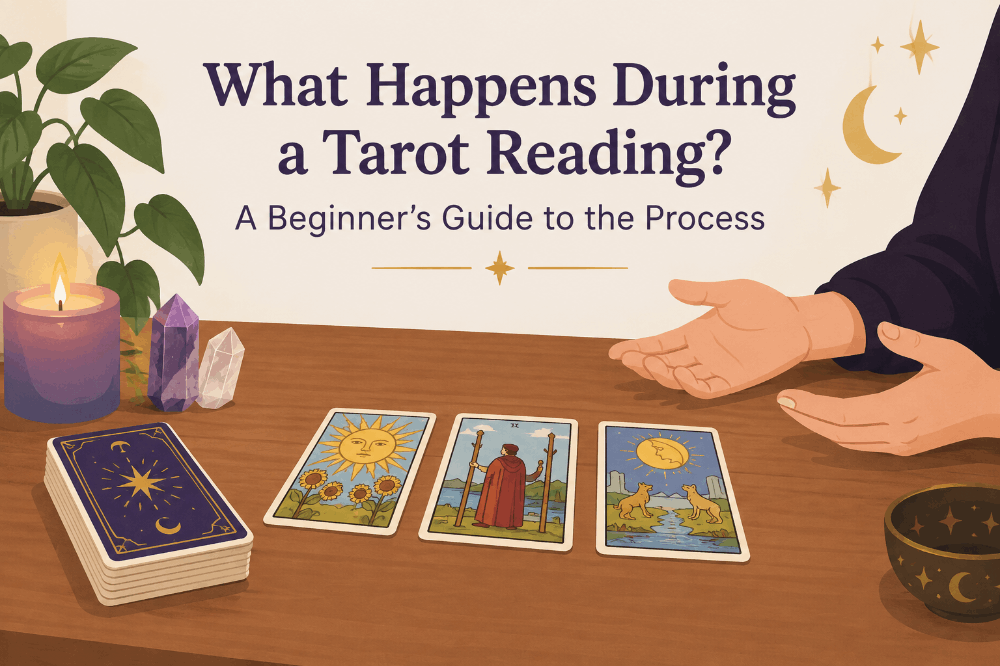
So, what actually happens when you sit down with a tarot reader for the first time? Here is a simple look at the process.
Starting With Your Questions
Most tarot readings begin with a conversation. The reader may ask what you would like to explore or whether there is a particular situation on your mind.
Your question could be about a relationship, career, family matter, personal growth, or a decision you are considering. You do not always need to have one perfectly worded question, either. Sometimes you simply know that something has been bothering you and want a fresh perspective.
This opening conversation helps give the reading some direction.
Choosing the Tarot Spread
Once the topic is clear, the tarot reader may choose a particular spread. A spread simply refers to the way cards are arranged and the meaning assigned to each position.
For example, a simple three-card spread might explore the past, present, and possible direction of a situation. Another spread may look at a challenge, what is influencing it, and what you could consider moving forward.
The number of cards can vary depending on the question and the reader's approach.
Shuffling and Selecting the Cards
Next comes the familiar part: shuffling the deck. The reader may shuffle the cards themselves, ask you to shuffle them, or use another method to select the cards.
Some readers invite you to choose cards intuitively, while others draw them directly from the deck. There is no single universal way to do this.
Once the cards are selected, they are placed according to the chosen spread. This is where the visual symbols of tarot begin to become part of the conversation.
Understanding the Card Meanings
Every tarot card has traditional imagery and interpretations associated with it. However, a card does not necessarily mean exactly the same thing in every reading.
The position of the card, the surrounding cards, the question being asked, and the reader's interpretation can all influence the discussion. A tarot reader may explain the traditional meaning first and then connect it with the situation you brought to the session.
This is why tarot reading is not simply about memorizing 78 card definitions.
Looking at the Bigger Picture
One card rarely tells the whole story. Readers generally consider how the cards relate to one another.
Imagine reading several chapters of a book instead of looking at one sentence. One card may suggest a particular theme, while another adds context or introduces a different angle.
The reader may also notice repeated symbols, suits, numbers, or patterns across the spread. These details can help shape a more complete interpretation.
Asking Follow-Up Questions
A tarot reading does not have to be a one-way conversation. You can ask questions as the session continues.
If a card seems confusing, ask what it could mean in your particular situation. If an interpretation raises another question, bring it up. The more openly you communicate, the easier it can be for the reader to understand what you are trying to explore.
This also makes the experience more personal instead of feeling like a generic reading.
What Can a Tarot Reading Explore?
People turn to tarot for many different reasons. Some want to reflect on relationships, while others are curious about career choices, personal goals, emotional patterns, or an upcoming transition.
A reading can offer themes and perspectives that encourage you to think about a situation differently. It may highlight something you had overlooked or help you put your feelings into words.
However, tarot should not be treated as a guaranteed prediction of future events. Its interpretations are better approached as guidance for reflection rather than fixed outcomes.
Online Tarot Readings
You do not necessarily need to visit someone in person for a tarot session. Online tarot reading has made it possible to connect with readers through chats, calls, or video consultations.
The basic process remains similar. You discuss your question, cards are selected, and the reader explains their interpretation. For a video session, you may even be able to watch the cards being drawn and placed during the reading.
For many beginners, the convenience of an online session makes exploring tarot feel more accessible.
How to Prepare for Your First Reading
You do not need special knowledge before your first session. Simply come with an open mind and a few questions you genuinely want to explore.
Try to avoid asking the same question repeatedly just to get the answer you hope to hear. Instead, use the reading as an opportunity to consider different perspectives.
It can also help to remember that you remain responsible for your own choices. A tarot reading can provide reflection and insight, but important decisions should be based on practical information and your own judgment.
Final Thoughts
A tarot reading is usually less mysterious than it first appears. You bring a question or situation, the cards are selected through a chosen method, and the tarot reader interprets their symbols and relationships within the spread.
For beginners, the most useful way to approach tarot reading is with curiosity. You do not have to believe every interpretation literally. Sometimes, simply seeing a familiar situation from another angle can give you something valuable to think about.